CampingKnow is reader-supported. When you buy through links on our site, we may earn an affiliate commission at no extra cost to you. Learn more.
You get to camp, the fire ring has wrist-thick pieces, and the stove wants pencil-size sticks right now. A full axe can handle it, but you may not want a heavy axe bouncing around the truck or pack for a job that mostly means kindling, tent stakes, and small-wood control. The average customer rating across the 95 listings screened is 4.6 out of 5. That sounds like an easy shopping trip, but high ratings cover a lot of very different tools.
Length changes how a hatchet feels the second you swing it. A short handle rides well in a camp bin and works for trimming stakes, while a longer handle gives you more speed through dry rounds and a safer two-hand grip when the wood fights back. Weight gets old fast. Handle material matters too, since wood has a classic feel and can be replaced or reworked, while fiberglass and molded composite handles shrug off wet storage and rough treatment.
Sheath quality deserves real attention because a sharp bit loose in a gear tote is a bad surprise. Look for a cover that stays put, protects the edge, and clips or straps down cleanly if you plan to carry the hatchet outside a pack. Wood type should guide the final pick: soft pine and cedar need less head weight, hardwood knots ask for more bite and a handle long enough to keep your hands clear. The best camping hatchet is the one that matches your wood pile, your storage space, and the chores you actually do after the tent is up.
Do you still need a hatchet if you already pack a folding saw?
If you already pack a folding saw, you may not need a hatchet on every trip. A saw is the better tool for clean crosscuts, especially when you are bucking small deadfall into stove length or trimming a branch without tearing up the fibers. It is also quieter, easier to control, and less awkward around kids or a crowded campsite.
A hatchet earns its spot when the job changes from cutting across wood to breaking it open or shaping it. If you need kindling from a wrist-thick stick, a few light splits with a sharp hatchet get to the dry inner wood faster than a saw. The same edge works for shaving feather sticks, knocking small knots off firewood, and camp chores that need a striking edge.
The saw wins on precision. It leaves a flat end, wastes less wood, and asks for steady motion instead of swings, which matters if you are working near a tarp line or after dark. A hatchet asks for more space, more attention, and a safe chopping surface, so we leave it behind when the trip only calls for trimming down a few sticks.
For most warm-weather backpacking and simple overnights, a folding saw by itself covers the firewood work you are likely to do, especially in areas where you collect only small deadwood. Carry both when weight and space matter less, such as car camping, basecamp trips, or cold-weather weekends where you burn more wood and need dependable kindling. In wet weather, that splitting ability can save time because the dry fuel is inside the stick, not on the bark.
Use the saw for lengths, use the hatchet for splits. If your fire plan starts with small branches and a camp stove backs you up, skip the hatchet. If you expect damp campground firewood or a steady cooking fire, the hatchet has a real job to do.
Fiskars X7 14-inch Hatchet
Fiskars X7 gets the overall pick because it is light, sharp, easy to handle, and built for real camp chores: kindling, small firewood, and branch removal. Its 14-inch size packs well, the FiberComp handle cuts hand fatigue, and the low-friction coated blade helps prevent sticking. At $26.88 with a lifetime warranty, it is a strong value.
Check price on AmazonCamp Hatchet Picks at a Glance
| Rank | Product | Best for | Price |
|---|---|---|---|
| #1 | Fiskars X7 14-inch Hatchet | Overall | Check price |
| #2 | Estwing Sportsman's Axe 14-inch | Premium | Check price |
| #3 | Outdoor Hatchet 14-inch | Budget | Check price |
| #4 | Estwing Camper's Axe 14-inch | Camp utility | Check price |
| #5 | Fiskars Freescape Hatchet 17.5-inch | Backpacking | Check price |
| #6 | The Frostbreaker Camping Hatchet | Bushcraft | Check price |
| #7 | Hatchet with Sheath 14-inch | Classic | Check price |
| #8 | Fiskars X13 Camping Axe | Lightest | Check price |
14 inches or 17.5 inches: what changes at the woodpile?
14 inches or 17.5 inches: what changes at the woodpile?
A 14-inch hatchet feels like a camp tool you can place with care. The Fiskars X7, the Estwing models and the budget hatchets in this lineup all sit in that easier-to-manage zone, where your hands stay closer to the head and small corrections happen fast. Control changes fast. Around a picnic table, a fire ring or a packed tent site, that shorter handle gives you more room to work without sweeping the bit through someone else’s space.
The longer Fiskars Freescape changes the job. At 17.5 inches, it gives you a wider swing arc and more splitting power, so it feels better when you are breaking down wrist-thick rounds instead of just shaving kindling or knocking bark off a split. That extra length asks for cleaner setup, with a stable chopping block, clear ground and more space behind and beside you. In a tight campsite, that matters.
- Pick 14 inches if you care most about packability, quick one-hand control and safe handling around camp clutter. The Fiskars X7, Estwing options and budget hatchets fit better in bins, truck boxes and side pockets, and they feel less awkward when you are making small fuel for a stove or fire pit.
- Pick 17.5 inches if your camp chores lean toward splitting. The Freescape gives your swing more reach and bite, and that helps when the woodpile includes tougher pieces that fight a shorter hatchet.
Short hatchets reward accuracy. Longer hatchets reward space. Before you fall for the lightest pack size or the hardest-hitting swing, picture the actual place you cut wood: open dirt pad, crowded campground, backcountry site or tailgate next to stacked gear. That picture usually tells you which length belongs in your kit.
How Each Hatchet Fits a Real Campsite
Fourteen inches is the number that decides this buy. Fiskars’s X7 fits the camp jobs most people actually do: splitting small to medium kindling, trimming branches around camp, and prepping firewood for a stove or fire ring. That size carries well. Its lightweight feel, balanced swing, and FiberComp handle help cut hand fatigue during longer kindling sessions.
The blade uses Fiskars proprietary grind with a low-friction coating, so it is built for deeper cuts and less sticking in wood. Owner notes line up with that: sharp edge, easy handling, and a case that feels necessary because the edge comes keen. We like it for firewood prep, hot tent stove fuel, and small log splitting at home, too. Leave tree felling and large rounds to a longer axe.
Pros
- 14-inch size works well for common camp chores and safe carry.
- Sharp blade, low-friction coating, and balanced swing help with kindling prep.
- FiberComp handle helps reduce hand fatigue during repeated swings.
- Lifetime manufacturer limited warranty.
Cons
- Too small for felling trees or serious large-log work.
- FiberComp handle will not satisfy buyers who want a traditional wood or all-steel tool.
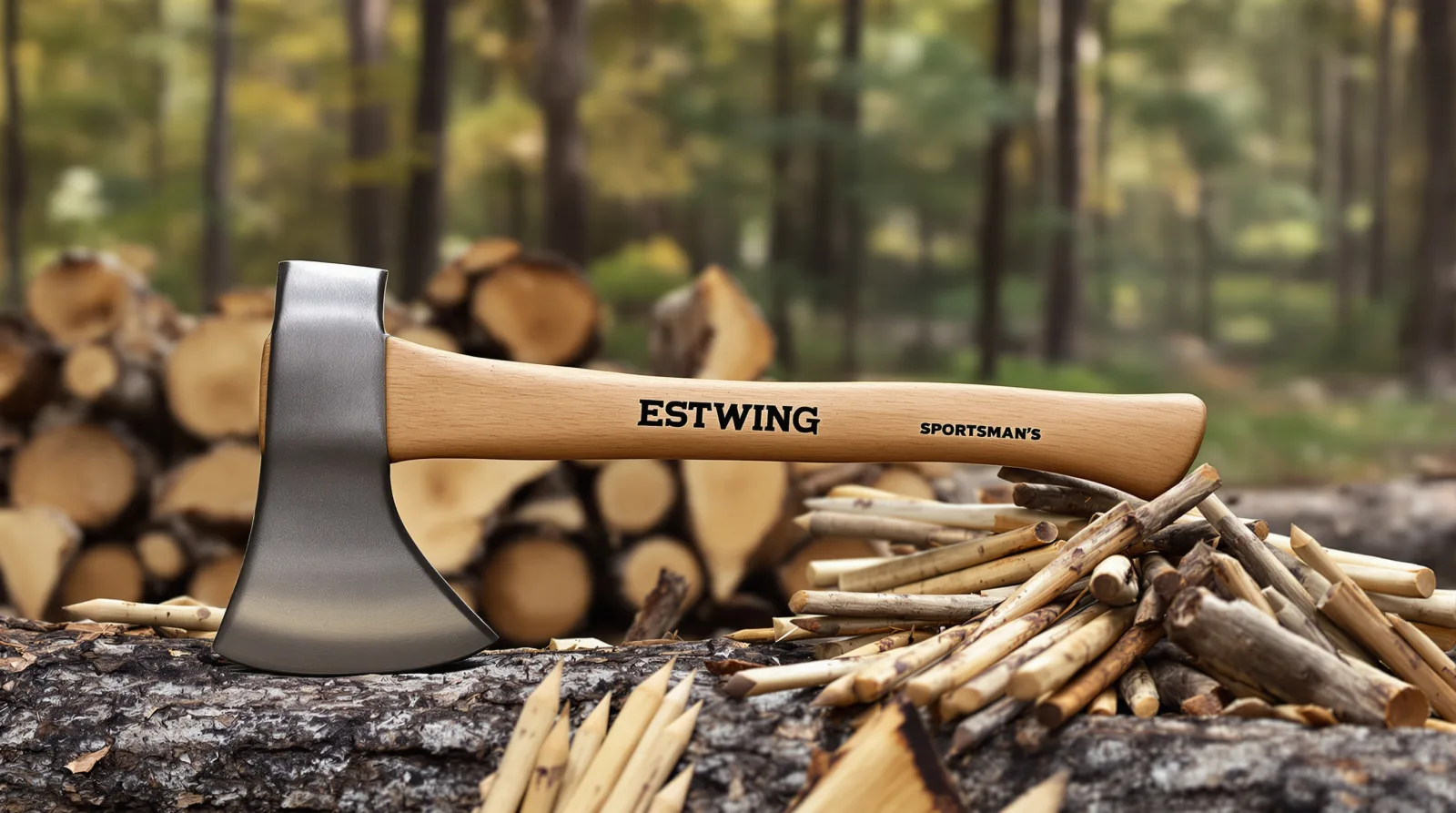
A truck-camp kit with split firewood, bent tent stakes, and branch cleanup is where this 14-inch Estwing makes sense. It is made from one piece of solid American steel, so there are no head joints or welds to worry about during normal camp use. The poll can pull tent stakes, and the edge is sized for limbs, branches, kindling, and small firewood.
The leather grip gives it the old-school feel people often want from a premium camp hatchet. Reviewers call out the forging, the rugged grip, and the sense that it can stay in service for years if you treat the edge and sheath right. It feels like a real tool.
One owner weighed the E24A at 29.3 oz without the sheath, heavier than the 22.7 oz Fiskars X7 they compared it with. That extra steel feels reassuring at a campsite and less fun in a small pack. Backpackers counting ounces should pick a lighter hatchet.
Pros
- One-piece forged steel construction avoids separate head joints.
- Leather grip gives a secure, traditional feel in hand.
- Useful for chopping branches, splitting kindling, and pulling tent stakes.
- Strong fit for car camping, cabin kits, and shop-to-camp use.
Cons
- Heavier than Fiskars X7 based on reviewer-measured weights.
- Poor fit for ounce-counting backpack trips.
Only 142 reviews sit behind this budget pick, so it does not have the long buyer record of the Fiskars or Estwing above. That matters for anyone looking for a camp tool with years of public feedback behind it. Still, the 14-inch Uibkor earns a spot because the job list is practical: splitting kindling, chopping small branches, yard cleanup, and campsite firewood prep. Starter kits need tools like this.
The spec sheet calls out a fiberglass shock reduction handle with an anti-slip grip, a forged one-piece head, and a backside that works as a hammer for tent stakes. Reviewers say it arrives sharp enough for small logs, roots, and small projects, which is exactly where a low-cost camp hatchet should live. Keep it away from big wood and heavy chopping sessions. For the most proven pick in the group, move up to the higher-review models.
Pros
- Low-cost 14-inch option for kindling, small branches, and yard cleanup.
- Fiberglass shock reduction handle with anti-slip grip.
- Back of the head can drive tent stakes around camp.
- Reviewers report enough sharpness for small logs and roots.
Cons
- Much smaller review base than the Fiskars and Estwing picks.
- Not the right tool for big wood or heavy chopping sessions.
Against the Estwing Sportsman's Axe ranked above it, the 14 inch Camper's Axe feels more like a work truck tool than a keepsake camp axe. You give up some old school charm and get a molded Shock Reduction Grip, plus the confidence of a head and handle forged from one piece of solid American steel.
That one piece build is the reason we like it for camp utility: splitting kindling, chopping branches, pulling tent stakes and riding in a truck box. Estwing says the grip cuts impact vibration by 70 percent, and reviewers call out the rubber grip, sturdy feel and easy sharpening.
At 14 inches, it stays handy around a fire ring but still bites into smaller wet or dry wood, according to owner comments. Backpackers counting ounces should move on, and anyone who wants a traditional wood handle should pick a different style.
Pros
- One piece solid American steel build removes loose head worries.
- Shock Reduction Grip is rated to cut impact vibration by 70 percent.
- Good camp range: kindling, branches, small logs and tent stake pulling.
- Reviewers say the edge sharpens easily and can get very sharp.
Cons
- Molded grip will not satisfy buyers who want a classic wood handle.
- More of a camp and vehicle tool than an ultralight backpacking hatchet.
Reviewers keep coming back to the same points: this Fiskars cuts harder than a small hand hatchet, feels light in the hand and holds up to rough trail work. One owner said the extra head weight made branch clearing far faster, while another used it on small firewood around 3.5 inches or less in diameter.
The specs line up with those comments. You get a 17.3 inch overall length, a forged steel head, a PTFE coated blade to reduce friction, a composite shock absorbent handle and a slim sheath for carry. The soft touch over mold helps when you are making repeated chops. It fits backpacking better than a short steel handled axe, but the blade cover gets complaints for being bulky, so pack placement matters.
Pros
- Longer 17.3 inch size gives more swing than a compact hand hatchet.
- PTFE coated forged steel blade is built to reduce friction while chopping.
- Composite handle is lightweight, shock absorbent and reported to resist cracking.
- Reviewers praise its sharp edge and performance on branches and small firewood.
Cons
- One reviewer found the blade cover bulky.
- Longer handle takes more pack space than the smallest hatchets.
Picture a low mileage bushcraft weekend where you walk in, set camp and spend more time shaping wood than covering miles. The Frostbreaker makes sense there: split kindling, clean up stakes, carve basic camp pieces and keep the blade covered in a leather sheath between jobs.
The build suits that trip. It has a 14.4 inch full length, a 5 inch blade, a 1.98 pound weight, a forged 1065 steel head and a beech wood handle. That is compact enough to carry by hand or strap to camp gear, with more bite than a pocket size chopper.
Owner comments point to a solid head, sturdy handle and easy carry, and one reviewer used it heavily through winter. Several buyers also mention the edge needing sharpening to their liking. For a hatchet that arrives ready for fine carving with no bench work, choose one with more consistent edge prep.
Pros
- Bearded axe shape works well for basic carving and camp wood tasks.
- Forged 1065 steel head, beech handle and leather sheath give it a traditional bushcraft feel.
- 14.4 inch length and 1.98 pound weight stay manageable around camp.
- Reviewers call out the solid head, sturdy handle and easy carry.
Cons
- Multiple reviewers say it needs sharpening out of the box.
- Lower review count and rating than the higher ranked picks in this group.
Campers who want a classic camp hatchet often assume they need a wood handle and a heavy head. This Fiskars model argues the other way, with a 7/8 lb hatchet format, a molded head that will not loosen, and a shock absorbing DuraFrame handle that is built to prevent overstrike damage. It is aimed at kindling and small to medium logs, which is the work most campsites actually hand you. Good camp size.
The proprietary blade grind and low friction coating are there for cleaner contact and fewer stuck cuts, so you spend less time wrestling the head out of a round. Reviewers call it light, durable, easy to pack, and strong for the money, with one buyer replacing a 20 year old X7 because the ergonomics and blade design still worked for them. Campers splitting bigger rounds or wanting a traditional wood handled hatchet should move to a longer or heavier axe. The lifetime warranty also helps if you treat this as a camp tool you plan to keep in the bin for years.
Pros
- Light, easy to pack design with a 7/8 lb hatchet format
- Molded head will not loosen during normal camp use
- Low friction blade coating helps keep the head from sticking
- Lifetime warranty from Fiskars
Cons
- Best suited to kindling and small to medium logs, not heavier splitting
- DuraFrame handle will not satisfy campers who want a wood handled axe
Fiskars builds the X13 around a double hardened, coated blade and a bright orange FiberComp handle. The blade edge is made for long lasting sharpness, and the handle is listed as strong, light, and easy to spot around camp. It is compact too, at 33.2 cm.
Wet mornings or cold hands put more attention on the grip, since one reviewer notes the handle is not rubberized and works better with thin leather gloves. The bright orange color helps when you set it down in leaves, grass, or a gear pile. Handy detail.
Packed carry is where this axe fits best. Fiskars lists it as 15% lighter than compact X-series axes, with a listed weight of 480 g, plus a blade guard with a belt loop. The back of the axe head is made for hammering tent pegs, so it covers kindling, light camp cutting, and stake work without adding a separate mallet. Buyers who want a heavier splitter for larger firewood should pick a longer handled option.
Pros
- 15% lighter than compact X-series axes, according to Fiskars
- Bright orange FiberComp handle is easy to find around camp
- Back of the axe head is made for hammering tent pegs
- Includes a blade guard with belt loop
Cons
- Handle is not rubberized, and one reviewer preferred thin leather gloves for grip
- Compact 33.2 cm length is not the right fit for heavier splitting
What customer ratings can and cannot tell you about a camp blade
Dataset note: the average customer rating across the 95 listings screened is 4.6 out of 5. That high baseline tells you most camp hatchets and small axes on the market are doing the basic job well enough for buyers to feel satisfied after purchase. Strong ratings also help flag widely accepted tools, including Fiskars' X7 and Estwing Sportsman's Axe, because thousands of buyers have already weighed in on cutting feel, durability, balance and day-to-day camp use. Numbers have limits.
A star rating does not tell you if the sheath fits the outside pocket on your pack, if the handle feels right when you wear gloves or if the head shape matches the kind of wood pile you usually face. Reviews can hint at those details, but they often mix backyard kindling, truck camping, trail work and emergency-kit use into the same score. We treat ratings as a useful filter, then read the comments for repeated patterns: loose covers, slick grips, awkward belt carry, edge complaints or praise from people using the blade the way you plan to use it.
This section is here because page one numbers can make every well-liked camp blade look the same. A 4.7-rated hatchet may still feel wrong in your hand, and a slightly lower-rated model may fit your kit better if its size, cover and grip line up with your trips. Use the rating to shorten the list, then let the physical details decide the final pick.
Choose by Chore, Pack Space and Handle Type
Match the Tool to the Camp Chore
Pick the hatchet for the job you do most. Splitting kindling wants a head that parts straight-grained sticks, trimming deadfall wants a controlled swing, pounding stakes needs a poll made for impact, and small bushcraft cuts need edge control near your hand.
Keep expectations sane. A short camping hatchet is handy around a fire ring, but it is not a full-size felling axe, and treating it like one can leave you tired, with a stuck bit or a damaged handle.
Handle Length Changes the Swing
A 14-inch hatchet packs easily and feels tidy close to a fire ring, picnic table or tent pad. You get control in tight space, which helps when you are shaving kindling or making short chops.
The 17.5-inch Fiskars Freescape gives more force on thicker rounds and lets the head build speed with less wrist work. Longer handles take more room in a pack and around camp, so check storage length before you buy.
Head Shape Matters More than Hype
For kindling, a wider wedge usually matters more than fancy wording on the package. It pushes wood apart as the bit enters, so straight pieces split with fewer stuck swings.
A thinner bit can bite deeper for carving, trimming and light chopping, but it may wedge in rounds instead of popping them open. Match the head to your chore list, not to a claim you cannot check in the product photos or specs.
Handle Material Changes Grip and Upkeep
Composite handles ask for little care and shrug off wet ground well, but field repair options are limited if one cracks. One-piece steel is tough at the head and handle joint, though it can feel cold and pass more shock into your hand.
Wood feels warmer and can be replaced or tuned by someone with basic tools. It also needs more owner care, including drying, checking the head fit and keeping the grain from getting beat up in a gear box.
A Safe Sheath Is Part of the Tool
Look at the sheath as closely as the hatchet. You want full edge coverage, firm retention and a closure that does not pop open when the tool rides in a bin, canoe bag or side pocket.
Interest in the Fiskars sheath makes sense because pack safety is real. A dull hatchet can still cut fabric, fingers and sleeping pads if the bit works loose, so tug on the sheathed head before you trust it near soft gear.
Weight and Balance Beat Spec-Sheet Bragging
A light hatchet feels quick and easy to guide, especially for short campsite work. On knotty wood, though, it can bounce or stall because the head lacks mass.
A heavier head helps split kindling and small rounds because more weight lands behind the edge. Carry comfort matters too, since extra ounces feel worse on long walks and can make tight work around stakes or a fire ring feel clumsy.
Budget Picks Still Need Basic Quality Checks
Low-cost hatchets can work for camp chores, but inspect the basics before you keep one. Sight down the edge for alignment, pull and twist the handle, and make sure the head or grip does not shift.
Check sheath fit before the return window closes. If the edge arrives badly uneven, the handle feels loose or the sheath barely covers the bit, use the return policy instead of hoping it wears in.