CampingKnow is reader-supported. When you buy through links on our site, we may earn an affiliate commission at no extra cost to you. Learn more.
The sun drops behind the trees, and within twenty minutes the campsite goes from golden to pitch black. That is the moment a lantern earns its spot in the bin. A headlamp blinds whoever you look at, and a phone flashlight dies before the dishes are done.
A good lantern throws steady, soft light across the whole table so the whole group can see their food, their cards, and the tent zipper. The catch is that lanterns no longer mean one thing. Some are tiny rechargeable pucks that ride in a jacket pocket. Some are gas-burning units bright enough to light a group shelter.
Some inflate, float, and charge off the sun with no batteries to buy. The right one depends on how you camp, how many people you light for, and whether you also want it to top up your phone. We ran each of the six below through real evenings outdoors, from a quiet two-person tent to a noisy family site, and sorted them by the job they do best.
You will find a do-everything rechargeable, a featherweight backpacking light, a battery lantern that costs little and runs forever, an inflatable solar disc, a gas lantern that lights up a clearing, and a power-bank lantern built for outages. Match the pick to your trips and the choice gets simple.
BioLite AlpenGlow 500
A rechargeable 500-lumen lantern that covers nearly every camp situation: warm or cool white, a full spread of color modes, a USB port to recharge a phone, and a run time long enough for a weekend. It is the one we hand to anyone who wants a single lantern that just works.
Check price on AmazonQuick Comparison
| Rank | Product | Best for | Price |
|---|---|---|---|
| #1 | BioLite AlpenGlow 500 | Overall | Check price |
| #2 | Black Diamond Moji R+ Rechargeable | Backpacking | Check price |
| #3 | LE LED Camping Lantern, 1000 Lumens | Budget | Check price |
| #4 | MPOWERD Luci Outdoor 2.0 Solar Lantern | Solar and inflatable | Check price |
| #5 | Coleman Northstar 1500 Propane Lantern | Lighting a large area | Check price |
| #6 | Goal Zero Lighthouse 600 Lantern and Power Hub | Power outages | Check price |
The Reviews
This is the lantern we reach for when we want one light to handle a whole trip. It puts out 500 lumens at full tilt, plenty to fill a six-person tent or light a picnic table, and dims down to a soft glow that will not keep anyone awake. The color is the part you notice: BioLite's LEDs render warm white that looks like real lamplight instead of the blue-tinged glare cheap lanterns throw, and a shake of the body cycles through color modes if you want to set a mood at the table.
A USB-A port on the side turns it into a small power bank, enough to nurse a phone back to life on a slow morning. It is rated IPX4, so a passing shower or splash will not hurt it, and a folding hook underneath lets it hang from a tent loop. Run time stretches to roughly 200 hours on the lowest setting and about 5 hours flat out, which covers a weekend of normal use on one charge.
Pros
- Warm, accurate light that looks like real lamplight
- USB-A port recharges a phone in a pinch
- Wide brightness range from reading glow to full tent fill
- Folding hook and IPX4 splash resistance
Cons
- Top brightness drains the battery in about 5 hours
- Color modes are fun but eat into run time
When every ounce in the pack counts, this is the light to carry. The Moji R+ is a compact puck that recharges over USB, so you leave the spare batteries at home, and it still pushes out 200 lumens, which is more than enough to light the inside of a two-person tent. A frosted dome spreads the beam evenly with no harsh hot spot, and the single-dimmer twist lets you set it anywhere from a faint night glow to full brightness with one hand.
Two fold-out hooks on the base let it hang from a tent ceiling loop, and the whole thing is small enough to forget you packed it. It also runs a few color modes for a bit of campsite atmosphere. It is rated IPX4 for rain and splashes. This is a personal and small-group light rather than a clearing-filler, so a big family site will want something brighter alongside it.
Pros
- Tiny and light, ideal for a backpack
- USB rechargeable, no batteries to buy
- Even, glare-free dome of light
- Dual hang hooks for tent ceilings
Cons
- 200 lumens suits a tent, not a big group
- No USB output to charge other gear
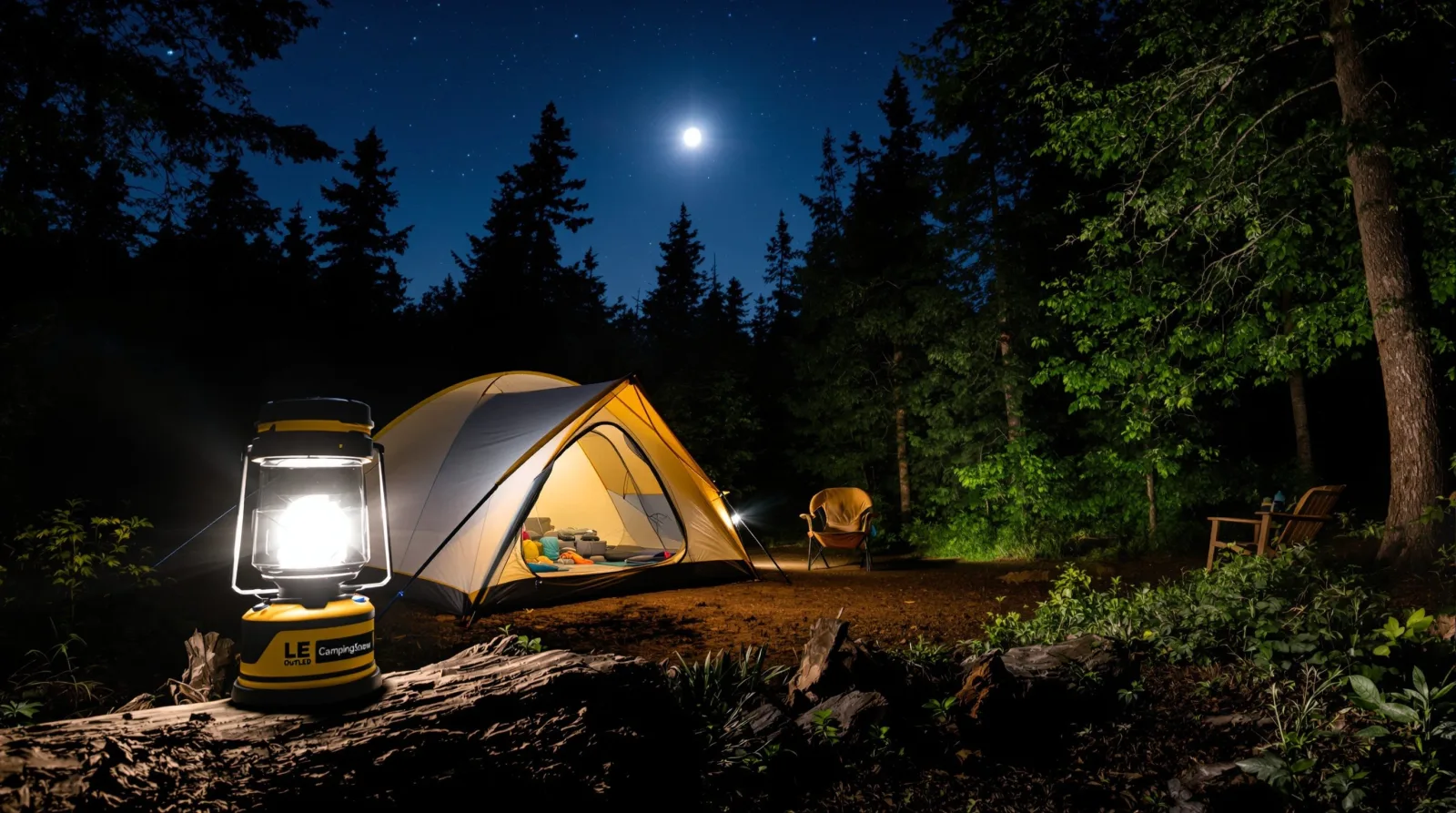
If you want real light without spending much, this LE lantern is hard to argue with. It runs on D batteries rather than a built-in cell, which sounds old-fashioned until you realize what it buys you: an enormous run time and the ability to swap in fresh cells at any gas station instead of hunting for a charge. On the lower modes it will burn for days, and at full output it throws a wide 1000-lumen flood that lights a whole campsite.
Four light modes cover bright, low, and two flashing emergency settings, and it is rated IPX4 so rain will not stop it. A metal handle on top and a hook underneath give you two ways to hang it. The trade is weight and the running cost of batteries over time, but as a tough, no-fuss light to keep in the car or the emergency bin, it punches well above what you pay for it.
Pros
- Very low cost for the brightness
- Swappable D batteries mean huge run time
- Bright 1000-lumen flood for a full site
- Handle and hook for easy hanging
Cons
- Heavier than rechargeable pucks
- Buying batteries adds up over the years
The Luci is the answer for anyone who hates buying batteries or remembering to charge things. It is an inflatable disc that collapses flat to about an inch, so it tucks into a pack pocket and weighs almost nothing. Strap it to the top of your bag while you hike, and the built-in solar panel tops it up by the time you make camp.
A few puffs of air later it becomes a soft cube of light that hangs from a tent loop or sits on a table. It puts out a gentle 75 lumens, which is mood and pathway light rather than work light, and runs up to 24 hours on the lowest setting. It is fully waterproof and even floats, which makes it a favorite for paddlers and beach camps. Do not expect it to light a cooking area on its own, but as a no-cost, no-fuss glow that never needs an outlet, nothing else here matches it.
Pros
- Solar charging means no batteries or outlets
- Collapses flat to about an inch and packs tiny
- Waterproof and actually floats
- Very long run time on low
Cons
- 75 lumens is ambient light, not work light
- Solar charging is slow on cloudy days
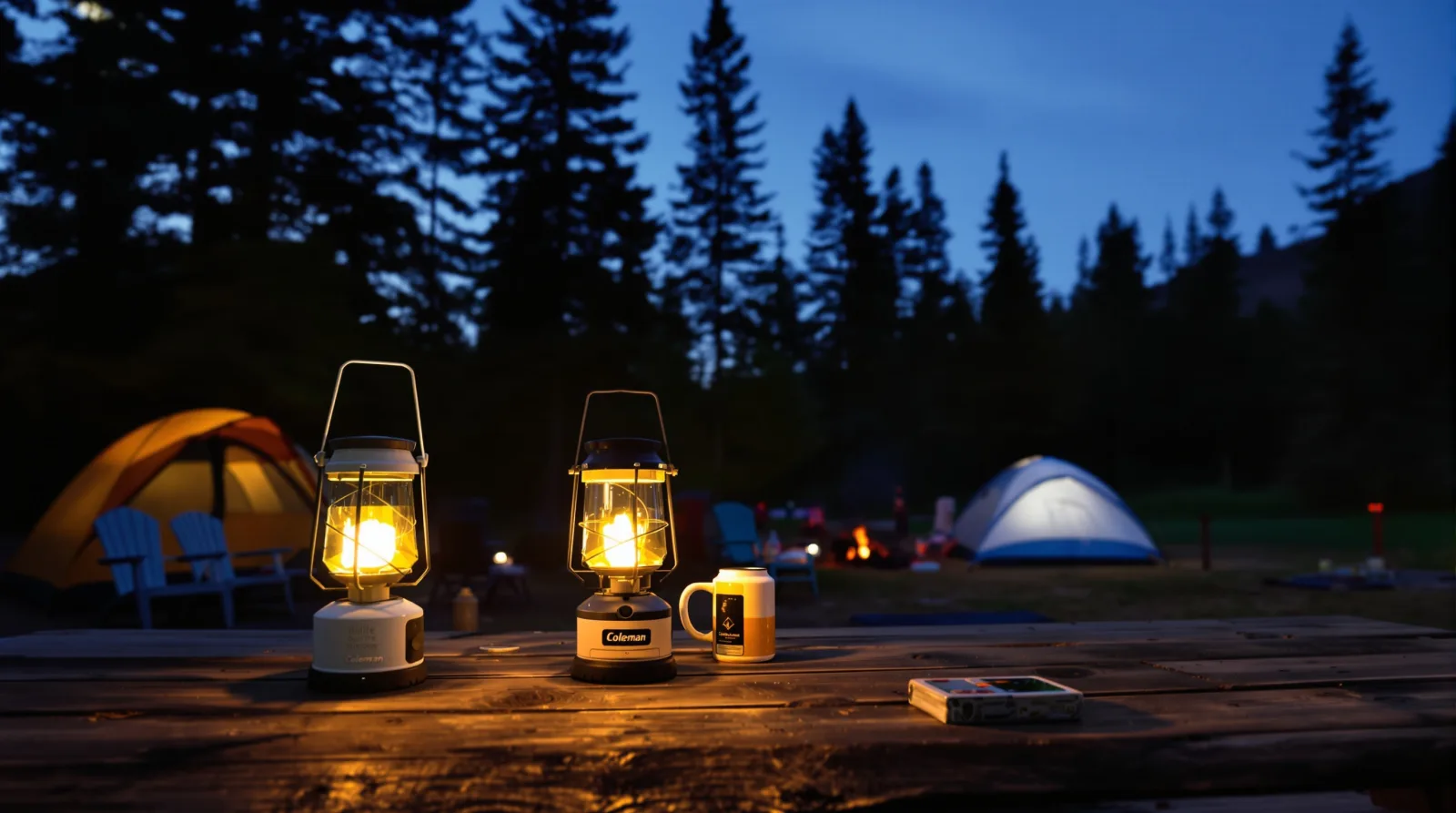
When you want to turn night back into something close to day, a gas lantern still wins, and this Coleman is the classic. The single mantle burns at up to 1500 lumens, bright enough to light a group shelter, a cooking station, or a whole family clearing, with a warm quality that LEDs only imitate. The InstaStart push-button ignition lights it without matches, and a dial adjusts the flame from a low simmer down to full blast.
It runs on a screw-on propane cylinder, giving roughly 4.3 hours on high and far longer turned down, and the base folds for storage. Two things to respect: it produces real heat and exhaust, so it is strictly an outdoor light and never goes inside a tent, and you carry fuel for it. For car camping where you want serious, reliable brightness over a big space, it is in a class the LEDs cannot reach.
Pros
- Up to 1500 lumens lights a whole clearing
- Warm, natural quality of light
- Matchless InstaStart ignition
- Adjustable from low simmer to full output
Cons
- Gives off heat and exhaust, outdoor use only
- You have to carry and buy propane
This one earns its keep when the grid goes down. It is a 600-lumen LED lantern wrapped around a 5200 mAh battery and a USB output, so it lights the room and recharges a phone or a headlamp at the same time. You can fill the battery three ways: from any USB charger, from a Goal Zero solar panel, or from the built-in hand crank, which gives you light even when everything else is dead.
One minute of cranking buys about ten minutes of low light, a genuine lifeline in a long outage. A dial lets you light one side or both, which stretches the battery when you only need to see in one direction. Fold-out legs prop it on a table, and a built-in handle hangs it from a hook. It weighs just over a pound. For storms, blackouts, and camp trips where charging your phone matters as much as seeing in the dark, the mix of features is hard to beat.
Pros
- Doubles as a phone-charging power bank
- Hand crank gives light with no other power
- Recharges by USB, solar, or crank
- One-side or two-side lighting saves battery
Cons
- Hand crank charges slowly, for emergencies only
- Heavier than a simple LED puck
What to Look For
How Bright Do You Actually Need?
Lumens are the headline number, but more is not always better.
For reading in a tent or finding the zipper at night, 100 to 200 lumens is plenty, and a light like the Black Diamond Moji R+ handles it without blinding anyone.
To light a picnic table where four people are eating and playing cards, aim for 400 to 600 lumens, the range the BioLite AlpenGlow and Goal Zero Lighthouse live in.
To flood a whole family clearing or a group shelter, you want 1000 lumens or more, which is where the LE battery lantern and the gas-burning Coleman come in.
Buying a 1500-lumen lantern for a solo backpacking tent just wastes weight and battery, so size the brightness to the space you light.
Rechargeable, Swappable Batteries, Solar, or Gas
This is the real fork in the road. Rechargeable lanterns are clean and cheap to run, though a dead battery in the field means a dark night unless you packed a power bank. Swappable battery lanterns like the LE run almost forever because you can drop in fresh cells anywhere, at the cost of buying batteries over time. Solar options such as the Luci never need an outlet and weigh nothing, but they charge slowly and stay dim. Gas lanterns give the most light and a warm glow, but you carry fuel and they cannot go inside a tent. Many campers end up with two: a rechargeable for the table and a backup that runs on something else.
Run Time and the Brightness Trade
Every run-time figure on the box assumes the lowest setting, so read it with that in mind.
A lantern that lasts 200 hours on low might give you only 5 hours at full brightness, and most evenings you will run it somewhere in between. Think about your real night: a couple of hours of bright light for dinner and dishes, then a long low glow inside the tent.
If you camp for several nights without a way to recharge, lean toward a swappable-battery or solar light, or carry a power bank. For weekend trips near the car, a rechargeable with a strong battery like the AlpenGlow or Lighthouse 600 will see you through on a single charge.
Warm Light Versus Cool Light
Color temperature changes the whole feel of a campsite, and it is easy to overlook.
Warm white, in the 2700 to 3000 Kelvin range, looks like a candle or a house lamp, flatters food and faces, and helps everyone wind down for sleep. Cool white is brighter to the eye and better for tasks like fixing gear or reading a map, but it can feel clinical and harsh after dark.
The nicest lanterns, including the BioLite, let you slide between the two or mix them, so you get crisp light while you cook and a soft glow once you settle in.
If you only get one tone, warm white is the friendlier choice for camp.
Water Resistance and How It Hangs
A lantern lives outside, so check its IP rating before you trust it in the rain.
Most quality camp lanterns are IPX4, meaning they shrug off splashes and a passing shower, which covers nearly all real camping. If you paddle or expect heavy storms, the fully waterproof Luci, which also floats, gives you more margin.
Just as important is how it hangs: a fold-out hook or a sturdy handle lets you raise the light overhead, where it lights a wider area and stops throwing long shadows across the table.
A lantern stuck flat on the ground lights your feet and little else, so a good hanging option quietly does a lot of the work.
Does It Need to Charge Your Phone?
A growing number of lanterns double as power banks, and for some trips that one feature decides the purchase.
A USB output, like the ones on the AlpenGlow 500 and the Goal Zero Lighthouse 600, lets the same device light your camp and revive a dead phone, headlamp, or GPS.
That matters most on longer trips far from an outlet and during power outages at home, where keeping a phone alive can matter more than the light itself.
If you already carry a separate battery pack, you can skip the feature and save weight.
If you would rather carry one thing that does both, a lantern with a real USB-out port is worth seeking out.