ONETIGRIS SUPRATIROS Extra Large Cot
It hits the sweet spot for most campers: a roomy 80-by-32-inch sleeping surface, a 300-pound capacity, a built-in side table with a cup holder, and a folding design that packs into its own bag. Tall sleepers up to 6 feet 6 inches fit without their feet hanging off. For the price, it's hard to beat for car camping.
Check price on AmazonThe Short List
Extra long 86.6 inch and extra wide 31.5 inch sleeping area.

Frame is aircraft grade aluminum and weighs around 5 to 6 pounds.

Deck measures 85 inches long and 40 inches wide.
A good night's sleep makes or breaks a trip. Sleep cold and lumpy and you'll be packing up grumpy by 6am. A cot gets you off the ground, away from rocks, roots, and the chill that an air mattress can't hold back.
It also stays inflated all night, because there's nothing to inflate. That alone is worth the swap for a lot of campers. The catch is that cots are not all built the same. Some weigh five pounds and disappear into a backpack.
Others tip the scales at 26 pounds and need two hands and a knee to set up. Some hold a 110-pound teenager just fine, others carry 600 pounds without a creak. The trick is matching the cot to how you camp, how tall you are, and how far you have to haul it.
We pulled together 10 cots we'd actually sleep on, from budget steel frames to packable aluminum builds. Below you'll find what each one does well, where it falls short, and who it suits. After the lineup there's a buyer's guide and a short FAQ to help you choose with confidence.
Quick Comparison
| Rank | Product | Best for | Price |
|---|---|---|---|
| #1 | ONETIGRIS SUPRATIROS Extra Large Cot | Tall car campers who want storage extras | Check price |
| #2 | KingCamp Ultralight Oversized Sleeping Cot | Backpackers who want a packable cot | Check price |
| #3 | Byer of Maine Extra Large Easy Cot | Big sleepers who want simple setup | Check price |
| #4 | Coleman ComfortSmart Cot | Comfort-first campers and guests | Check price |
| #5 | TETON Sports Outfitter XXL Camping Cot | Big and tall campers who want maximum space | Check price |
| #6 | EARTH Ultimate Extra Strong Military Style Folding Camp Cot | Campers who want a rugged classic at a fair price | Check price |
| #7 | Coleman Trailhead II Cot | Smaller tents and budget campers | Check price |
| #8 | REDCAMP Heavy Duty Folding Camping Cot | Heavier campers wanting strength on a budget | Check price |
| #9 | ARAER Camping Cot | Backpackers wanting light weight and high capacity | Check price |
| #10 | Alpcour Folding Camping Cot | Campers wanting a comfortable, well-rounded value cot | Check price |

The Reviews
ONETIGRIS SUPRATIROS Extra Large Cot
The ONETIGRIS SUPRATIROS is a strong fit for a roomy car camping cot slot. Its extra long 86.6 inch and extra wide 31.5 inch sleeping area gives adults space to stretch or turn over, with the listing calling out bigger users in particular.
Specs
- Sleeping area
- 86.6 inch by 31.5 inch
- Capacity
- up to 400 pounds
- Weight
- Not listed
- Setup
- Not listed
It also brings extras that make sense beside a car. The built in pillow pocket helps keep your pillow from sliding to the ground, and three utility mesh pockets below the cot store clothes and other items off the ground.
The cot uses 300D Oxford fabric that is water resistant, tear resistant, and wear resistant. Aircraft grade aluminum support bars and legs provide a listed load capacity up to 400 pounds, making this a roomy single cot for car trips, travel, beach use, or an office nap.
What we like
- 86.6 inch extra long design
- 31.5 inch extra wide design
- Pillow pocket and mesh pockets
- Supports up to 400 lbs
Watch out for
- Needs space for its length
- Pillow pocket needs your pillow
KingCamp Ultralight Oversized Sleeping Cot
This is the cot for people who count grams. The frame is aircraft-grade aluminum, which keeps the whole thing down around 5 to 6 pounds, light enough to clip to a pack and forget about. When it's broken down it shrinks to roughly the size of a one-person tent, so it tucks into a pack body instead of swallowing your trunk.
Specs
- Sleeping area
- about 75 by 28 inches
- Capacity
- up to 265 pounds
- Weight
- around 5 to 6 pounds
- Setup
- pole-tension design
For a cot, that's genuinely impressive. The deck stretches to about 75 by 28 inches and carries up to 265 pounds. The tensioned fabric sits a few inches off the ground, which is enough to dodge cold and damp without making the cot tippy. The taut surface gives a firm, supportive feel that side and back sleepers tend to like.
It's not a plush mattress, but with a thin pad on top it sleeps well. The trade for all that lightness is setup. This is a pole-tension design, so you assemble the frame and then stretch the deck over the end bars.
The last corner takes a firm push and can nip a finger if you're careful, and the first couple of attempts feel awkward. Once you've done it twice it becomes muscle memory and takes a few minutes. It suits backpackers, bikepackers, and anyone who hikes to a site and refuses to sleep on the ground. Taller and heavier campers should size up, since 75 inches and 265 pounds are real limits here. If you want a cot that travels light and packs small, this one earns its spot in the bag.
What we like
- Very light aluminum frame around 5 to 6 pounds
- Packs down to roughly tent size for backpacking
- Firm, supportive tensioned deck
Watch out for
- Pole-tension setup is fiddly at first
- Shorter 75-inch deck and 265-pound limit

Byer of Maine Extra Large Easy Cot
Byer of Maine has been making cots for a long time, and the Extra Large Easy Cot shows that experience. The bed runs about 78 inches long, 30 inches wide, and sits a tall 18 inches off the ground, which makes getting in and out feel less like a floor exercise and more like sitting on the edge of a real bed. That extra height is a quiet luxury for anyone with cranky knees.
Specs
- Sleeping area
- about 78 by 30 inches
- Capacity
- up to 330 pounds
- Weight
- around 21 pounds
- Setup
- under a minute
The frame mixes powder-coated steel with aluminum, and it carries up to 330 pounds with no nervous flex. The deck fabric is a tough, tightly woven poly that stays taut over time rather than sagging into a hammock after a few nights. At around 21 pounds it's solid without being a beast to move from car to tent. True to the name, setup is easy.
The legs fold out and lock with a confident snap, no separate poles to thread and no fabric to wrestle. You can have it ready in under a minute, even in the dark. Folded, it's flat but long, so plan trunk space accordingly.
This cot suits larger and taller campers who want a sturdy, high-sitting bed without a fight at setup. The give-back is that it's a car-camping piece. It's too long and heavy to backpack, and the tall stance means you'll want a wider tent so the legs aren't pressing the walls. For a base camp or a cabin, it's a comfortable, dependable choice.
What we like
- Tall 18-inch height makes getting up easy
- Sturdy 330-pound capacity with little flex
- Quick fold-out setup, no poles to thread
Watch out for
- Long when folded, needs trunk space
- Tall legs want a roomier tent

Coleman ComfortSmart Cot
Most cots ask you to add your own pad. The ComfortSmart skips that step by building a thick foam mattress right onto the deck, sitting on a coil suspension system. The result feels closer to a real bed than almost any bare cot, with a soft top layer and a bit of bounce that takes the edge off a hard frame.
Specs
- Sleeping area
- about 80 by 30 inches
- Capacity
- up to 300 pounds
- Weight
- Not listed
- Setup
- opens in seconds
If your main complaint about cots is that they sleep firm and cold, this one answers it. The bed is about 80 inches long and 30 inches wide, fitting sleepers up to roughly 6 feet 2 inches, and the steel frame supports up to 300 pounds. The coil suspension does more than add comfort; it spreads your weight and keeps the surface even instead of dipping in the middle. Stretch out and it holds its shape through the night.
Setup is the fold-out type, so the legs are pre-attached and it opens in seconds. The padded deck adds bulk, though, so this is one of the larger cots to store and move. Folded, it's both thick and long, which means it owns a good chunk of trunk.
It's a strong pick for comfort-first campers, guest beds at home, and anyone who wants to skip buying a separate sleeping pad. The honest cost is portability. The foam and coils make it heavy and bulky, so this is firmly a car-camping and home cot. If comfort tops your list and you're not hauling it far, it delivers.
What we like
- Built-in foam mattress and coil suspension
- Sleeps warmer and softer than a bare cot
- No separate pad needed
Watch out for
- Bulky and heavy to store and move
- Strictly a car-camping or home cot
TETON Sports Outfitter XXL Camping Cot
If you've ever felt cramped on a standard cot, the Outfitter XXL is the cure. The deck measures a huge 85 inches long and 40 inches wide, which is enough room for a tall sleeper to stretch fully and still roll over without a thought. It's the kind of cot you lie down on and actually relax, because there's no edge waiting to dump you off.
Specs
- Sleeping area
- 85 inches by 40 inches
- Capacity
- 600 pounds
- Weight
- roughly 26 pounds
- Setup
- pivot-arm type
The steel frame is the real story. It's rated to a stout 600 pounds, so it holds heavy campers, two kids piled on, or a person plus a dog plus a duffel without a single worrying creak. TETON uses a pivot-arm design that locks the frame rigid and keeps the deck drum-tight. This is a cot built to take abuse season after season.
All that strength and space comes at a price in heft. At roughly 26 pounds it's one of the heaviest cots here, and it packs long and bulky. Setup is the pivot-arm type, so you fit the legs and tension the deck, which takes a few minutes and a bit of muscle the first time.
Once it's up, it's a fortress. This is the cot for big-and-tall campers, hunters, and anyone running a base camp who wants no compromises on space or capacity. The trade is obvious: weight and packed size rule out any kind of hike-in use. If you drive to your site and want the roomiest, strongest cot on the list, this is it.
What we like
- Massive 85-by-40-inch deck for tall sleepers
- Heavy-duty 600-pound capacity
- Rigid pivot-arm frame built to last
Watch out for
- Very heavy at around 26 pounds
- Bulky pack size, not for backpacking
EARTH Ultimate Extra Strong Military Style Folding Camp Cot
This one leans on the old military-issue design, and there's a reason that pattern has lasted. A heavy steel frame, a simple scissor-leg fold, and a tough fabric deck add up to a cot that just works. It's the no-nonsense option, built to be hauled to a field, slept on hard, and folded away wet without complaint.
Specs
- Sleeping area
- about 75 by 28 inches
- Capacity
- Not listed
- Weight
- Not listed
- Setup
- cross-leg ends fold out
There's a satisfying ruggedness to it that fussier cots lack. The deck runs about 75 by 28 inches and the frame shrugs off serious weight, holding heavy sleepers with a planted, stable feel. The legs splay wide for stability, so it doesn't rock when you sit on the edge to pull off your boots. The fabric is thick and tightly stretched, the kind that survives years of use rather than tearing at the seams after a season.
Setup follows the military template. The cross-leg ends fold out and the frame snaps into tension, which is quick once you get the knack but can take a firm hand on the final bar. It's not the lightest cot, and folded it stays long, so this is gear for the truck rather than the trail.
It suits campers who want a rugged, dependable bed without paying a premium, plus anyone who likes the simplicity of a proven design. The drawbacks are the usual ones for steel: weight, a long folded profile, and the need to dry it before storage so it doesn't rust. For a tough, affordable base-camp cot, it's a smart buy.
What we like
- Rugged steel military-style frame
- Wide-splayed legs feel very stable
- Affordable and simple to use
Watch out for
- Heavy and long when folded
- Steel frame needs drying to avoid rust

Coleman Trailhead II Cot
The Trailhead II is the compact, wallet-friendly cot in Coleman's lineup, and it's a great fit when space and budget are tight. The deck is about 75 by 25 inches and sits low to the ground, which has two upsides: it slips into a smaller tent without crowding the walls, and the low stance keeps it stable. It's a sensible first cot for someone testing the waters before spending big.
Specs
- Sleeping area
- about 75 by 25 inches
- Capacity
- up to 300 pounds
- Weight
- around 17 pounds
- Setup
- opens fast
The steel frame carries up to 300 pounds, which is plenty for most solo campers, and the build feels reassuringly solid for the modest price. The deck fabric is taut and breathable, and the low height means you sit down onto it rather than climbing up, which some people actually prefer in a cramped tent. Setup is fold-out, so the legs are attached and it opens fast. At around 17 pounds it's on the lighter side for a steel cot, easy enough to carry from car to site one-handed.
Folded it stays long like most steel models, so it still wants trunk space rather than a pack. This cot suits smaller campers, anyone with a snug tent, and budget-minded buyers who want a real bed without overspending. The honest limits are the narrow 25-inch deck, which feels tight if you're a restless sleeper, and the shorter 75-inch length, which leaves taller campers' feet at the edge. Within those bounds, it's a tidy, dependable little cot.
What we like
- Compact and low, fits smaller tents
- Lighter steel build around 17 pounds
- Easy on the budget
Watch out for
- Narrow 25-inch deck feels tight
- Short 75-inch length for tall sleepers

REDCAMP Heavy Duty Folding Camping Cot
REDCAMP built this cot around one idea: strength for the money. The thick steel frame is rated to a hefty 450 pounds, well above most cots in this price range, so heavier campers get a planted, no-flex bed without paying a premium. Sit on the edge, shift around, and it stays rock-steady.
Specs
- Sleeping area
- Not listed
- Capacity
- 450 pounds
- Weight
- roughly 16 to 20 pounds
- Setup
- fold-out with attached legs
For anyone who's bent a flimsy cot before, that solidity is reassuring. The deck comes in a couple of sizes, with the wider option giving you more room to roll over, and the fabric is a tough Oxford weave double-stitched along the rails where stress collects. It sits at a comfortable height for getting in and out, and the wide leg stance keeps it from rocking on uneven ground. This is a workhorse, not a luxury item, and it carries itself like one.
Setup is fold-out with attached legs, though the heavy-duty frame takes a bit more force to lock open than a lightweight model. Expect a firm push on the final leg. At roughly 16 to 20 pounds depending on size it's reasonable to move, but folded it stays long, so it lives in the trunk.
It suits heavier and larger campers, families who want a cot the kids can't wreck, and anyone after maximum capacity without a high price. The trade-offs are weight and a stiffer setup, plus the usual steel-frame rust warning if you store it damp. For tough, affordable support, REDCAMP delivers a lot of cot per dollar.
What we like
- Strong 450-pound capacity for the price
- Double-stitched Oxford deck and steel frame
- Stable wide-leg stance
Watch out for
- Heavier frame takes more force to open
- Long folded size, car camping only

ARAER Camping Cot
The ARAER cot pulls off a neat trick: it's light enough to backpack yet rated to carry a lot of weight. The aluminum-alloy frame keeps the whole package down around 7 pounds, and it breaks down to roughly 21 inches, small enough to ride inside a pack rather than dangle off it. For a cot you can actually hike with, that combination is rare.
Specs
- Sleeping area
- around 75 by 28 inches
- Capacity
- about 450 pounds
- Weight
- around 7 pounds
- Setup
- pole-tension design
What sets it apart from other ultralight cots is capacity. Where many packable models top out around 265 pounds, this one is rated to about 450 pounds, so bigger campers aren't shut out of going light. The deck is around 75 by 28 inches, tensioned firm a few inches off the ground, which keeps you clear of cold and damp without feeling unstable. With a pad on top it sleeps surprisingly well for something this packable.
The catch, as with most light cots, is setup. This is a pole-tension design, so you build the frame and stretch the deck over the end bars, and that last corner needs a confident push. The first time can feel like a wrestling match, but it clicks fast and soon takes only a few minutes.
A pair of hands makes it easier still. It suits backpackers, bikepackers, and anyone who wants to hike to a site without giving up support or sleeping on the dirt. The honest trade-offs are the fiddly assembly and a deck that, while strong, is on the narrow side for restless sleepers. If you want one cot that's both light and tough, this is a clever option.
What we like
- Light aluminum build around 7 pounds
- High 450-pound capacity for a packable cot
- Packs down to roughly 21 inches
Watch out for
- Pole-tension setup takes practice
- Narrow 75-by-28-inch deck
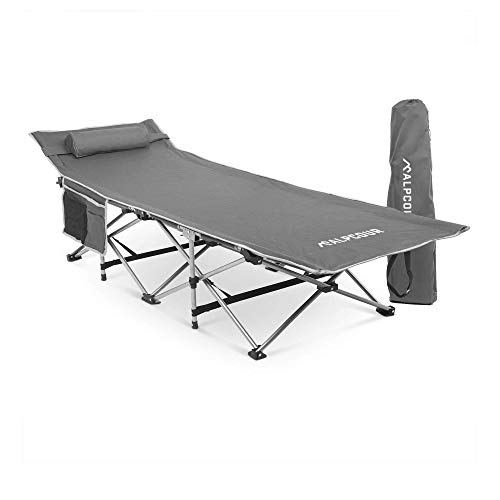
Alpcour Folding Camping Cot
The Alpcour rounds out the list as a balanced all-rounder that does a little of everything well. The frame is sturdy steel rated to 300 pounds, and the deck uses a double-layer Oxford fabric that resists sagging and feels reassuringly thick underfoot. It's about 78 inches long, so taller sleepers get more room than the standard 75-inch cots offer, and it sits at a comfortable height for sitting up and getting out.
Specs
- Sleeping area
- about 78 inches long
- Capacity
- 300 pounds
- Weight
- moderate weight for steel
- Setup
- opens quickly
The deck has a slightly raised headrest area, a small touch that lifts your pillow and makes the cot feel more bed-like without adding bulk. The fabric is tightly stretched and breathable, and the legs splay wide for stability on uneven ground. It comes with a carry bag, so packing it away after a trip is tidy rather than a juggling act. Setup is the fold-out kind with attached legs.
It opens quickly, and the heavier frame locks with a firm push on the final leg. At a moderate weight for steel it's easy enough to carry from car to tent, though like every steel cot here it folds long and belongs in the trunk rather than on your back. It suits campers who want a comfortable, dependable cot at a fair price without chasing any single extreme.
It's not the lightest, the strongest, or the most packable, but it balances comfort, length, and durability nicely. The trade-offs are the usual steel ones: weight, a long folded profile, and the need to dry it before storage. As a do-it-all value cot, it earns its place.
What we like
- Comfortable double-layer Oxford deck
- Longer 78-inch length with raised headrest
- Includes a carry bag
Watch out for
- Heavier steel frame, car camping only
- Folds long, needs trunk space
Army and Military-Style Cots
The army cot is the design most people have in mind: a low steel or aluminum frame, cross legs at each end, and a tough fabric deck stretched tight between two rails. It has stayed in use for decades because there is very little on it that can break. The EARTH Ultimate cot in our list follows that pattern closely, and so do most budget folding cots sold as "military style."
That label describes the shape, not a standard. A true mil-spec cot is built to a government specification, and the surplus ones you find second-hand are often older, heavier and narrower than a modern camp cot. The consumer versions copy the look and usually give you a little more width, but they rarely publish the same load testing.
What you gain is simplicity and a firm, flat deck. What you give up is width and padding: most military-style frames sleep about 75 by 28 inches, which suits back sleepers of average height better than anyone who sprawls. If you want the rugged frame with more room, the TETON Sports Outfitter XXL keeps the same no-fuss idea at 40 inches wide and a 600-pound rating.

What to Look For
Size
Length matters most if you're tall.
A standard cot runs about 75 inches long, which leaves a 6-footer with their heels at the very edge. Look for an 80-inch or 85-inch bed if you're over six feet, and check the listed user height, not just the frame length, since the end bar eats into usable space.
Width is the other half. A 25-inch deck feels like a balance beam when you roll over, while a 32-inch or 40-inch deck lets you sprawl.
Measure your tent floor first so the cot legs don't crowd the walls.
Weight
Be honest about how far you'll carry it.
For car camping, weight barely registers, so a sturdy 20-pound steel cot is fine. If you're hiking in, even a short walk from a remote parking spot, every pound counts.
Aluminum-frame cots can drop to 5 or 7 pounds, which is light enough to strap to a pack. The trade is usually cost and a slightly fiddlier setup.
Decide where you fall before you pay for ultralight materials you may not need.
Ease of Setup
There are two camps here.
Fold-out cots snap open in seconds, like a folding chair, with the legs already attached. Pivot or pole-tension cots are lighter and pack smaller, but you assemble the frame and stretch the fabric over it, which can pinch fingers on the last bar.
If you arrive at camp after dark or set up a lot, lean toward a fold-out. If you want a compact pack and don't mind a couple of minutes of work, the tension style pays you back in size.
Packed Size and Weight Capacity
A cot's folded length decides whether it rides in your trunk or your pack.
Fold-out steel cots collapse flat but stay long, often 36 inches or more. Aluminum tension cots break down to roughly the size of a tent, around 17 to 21 inches, which is the difference between backpackable and not.
Capacity is just as important. Most cots handle 250 to 330 pounds, but heavier campers, or anyone who wants zero flex, should look at the 450-pound and 600-pound heavy-duty frames.
Always leave headroom over your body weight for gear and movement.
Material
The frame is steel or aluminum.
Steel is cheaper and stronger for the price, but heavy and prone to rust if you store it wet. Aluminum is light and rust-resistant, but costs more and can flex under big loads.
The deck fabric is usually 600D polyester or Oxford cloth, sometimes double-layered for extra strength along the rails. Check the feet too.
Wide plastic caps spread the load and protect your tent floor, while bare metal tube ends can punch through a footprint.
Price and Accessories
Cots run from budget to surprisingly steep.
You can find a solid steel fold-out for a modest sum, while ultralight aluminum models and oversized heavy-duty builds cost a good deal more. Spend for the feature you'll actually use.
Side tables and cup holders are genuinely handy for keeping a headlamp and water off the ground. A storage organizer or carry bag adds convenience.
Don't pay for a 600-pound capacity if you're 150 pounds and car camping; put that money toward length and a thicker deck instead.
Choosing a Cot When You Sleep on Your Side
Side sleepers put all their weight on two points, the shoulder and the hip, and a cot deck has very little give to spread it. Width and padding matter more for you than for a back sleeper.
Look for at least 30 inches of deck so your knees and elbows stay on the fabric when you curl up. The ONETIGRIS SUPRATIROS (31.5 inches) and the Coleman ComfortSmart (about 30 inches, with a built-in pad) are the easiest fits here, and the 40-inch TETON Outfitter XXL leaves room to switch sides without waking up at the rail.
Then add cushioning. A 2 to 3 inch foam or self-inflating pad takes the pressure off the hip far better than a thicker sleeping bag. Watch for cross bars, too: some tension cots run a support bar under the deck that you can feel through a thin pad when you lie on your side. If you would rather buy the cot and mattress together, our cot and mattress sets guide covers the widest bundles, and the sleeping pad guide lists pads that fit a standard cot.
What Makes One Cot More Comfortable Than Another
Comfort on a cot comes down to four things, and the frame material is not one of them.
- Deck tension. A drum-tight deck stays flat all night. A loose one sags into a shallow hammock that feels fine for ten minutes and then pulls your back out of line.
- Width. Under 28 inches, your arms hang off the edge. At 30 inches or more you can actually turn over.
- Height. A cot around 17 to 19 inches high is easier to sit on and stand up from than a low backpacking cot, which matters more each year you camp.
- Insulation underneath. Cold air circulates below the deck, so a cot with nothing on it can feel colder than the ground in spring or fall.
You can fix most of a cheap cot's comfort problems in camp. Put a foam pad or a folded blanket on the deck, bring a real pillow instead of a stuff sack of clothes, and level the legs on flat ground so the frame does not twist and creak. If the fabric has stretched, re-seat the end bars or tighten the tension levers before bed rather than after the sag wakes you up.