CampingKnow is reader-supported. When you buy through links on our site, we may earn an affiliate commission at no extra cost to you. Learn more.
You need shade over the camp table, a dry spot to cook near, bug relief after dusk, privacy at a packed campground, or extra room beside a trailer or truck. The average customer rating across the 136 listings screened is 4.4 out of 5. That bar is high. Our picks have to earn their space against gear campers already like.
Most buyers land in one of four camps: a 10x10 pop up canopy for quick shade, a larger open roof for groups, a screened shelter for mosquitoes, or a canopy with sidewalls for wind, rain, and campsite separation. We look for the ones that set up without a fight, stay useful in real weather, and fit the way you actually camp.
Open Canopy, Screen House, or Walls: Which One Do You Need at Camp?
Match the shelter to the campsite problem. An open canopy is the pick when your picnic table bakes at noon or you want cover over the camp kitchen. It gives fast shade, leaves air moving around stoves and coolers, and lets people drift in and out without zippers.
A screen house makes more sense during bug season, especially near water or after sunset. Use it for card games, kid snacks, and evening lounging when mosquitoes would otherwise push everyone into the tent. Bring chairs inside, keep food covered, and zip the door behind you.
Sidewalls solve different problems. Add one or more when you need privacy for changing clothes, a wind break around the table, or a shield from low morning or late day sun. They can make an open canopy feel more like a camp room, but they also cut airflow.
A camp chair with its own canopy is a personal shade fix, not a group shelter. It helps one person read or watch a game in the sun.
CROWN SHADES 10x10 Pop Up Canopy
One-button setup, 100 square feet of shade, UPF 50+ fabric, and a sturdy alloy steel frame make the CROWN SHADES 10x10 the easy overall pick. It sets up fast with 1 or 2 people, has three height settings, vents for wind and rain, and strong owner feedback at 4.6 stars from 11,300 reviews.
Check price on AmazonSide by Side: Which Canopy Solves Your Camp Problem?
| Rank | Product | Best for | Price |
|---|---|---|---|
| #1 | CROWN SHADES 10x10 Pop Up Canopy | Overall | Check price |
| #2 | WEIZE 10x10 Pop Up Canopy | Budget | Check price |
| #3 | Eurmax USA 10x10 Pop Up Canopy | Premium | Check price |
| #4 | EAGLE PEAK 13x13 Pop Up Canopy | Largest | Check price |
| #5 | Alvantor Pop Up Screen House Tent | Bug-free lounge space | Check price |
| #6 | COOS BAY 11x11 Pop Up Gazebo | Screened shelter | Check price |
| #7 | Driftalia 10x10 Pop Up Canopy with Sidewalls | Privacy and wind protection | Check price |
| #8 | Quictent 10x10 Pop Up Canopy | Value | Check price |
Will This Size Fit Your Campsite, Trailer Spot, or Truck Setup?
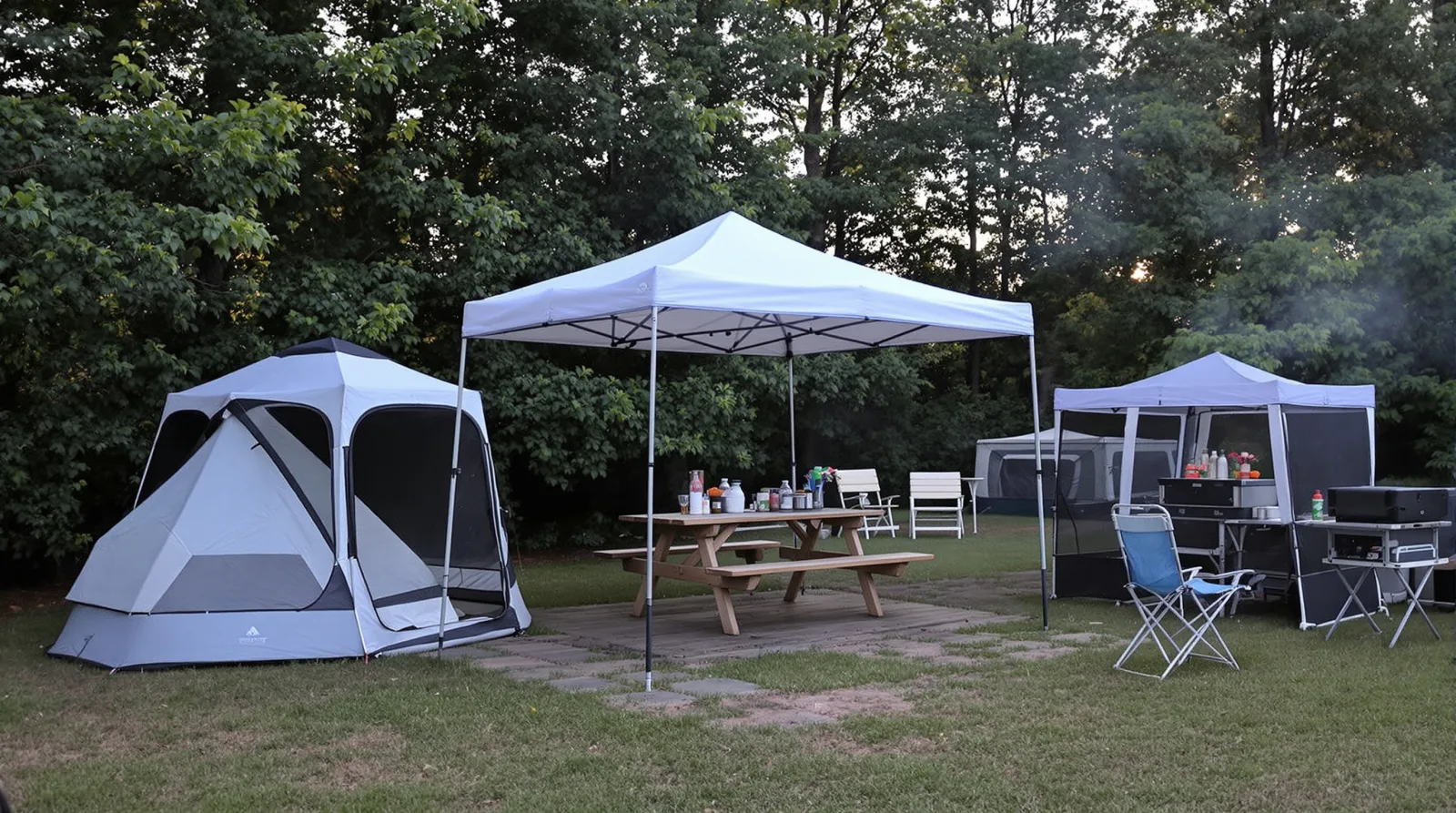
A 10x10 canopy is the safe starting point for most campground pads because it covers a picnic table without taking over the whole gravel or dirt area. A 12x12 or 13x13 gives you more shade, but the legs and guylines may push past the pad edge, so check the site rules before you count on that footprint.
For trailer spots, measure the door swing, step area, and awning side before you set legs. You need space to open the door without rubbing fabric or poles, and you still need guyline room where people walk to the table, water spigot, or hookups.
A 10x20 canopy fits groups, long tables, or a truck bed kitchen, but it needs a long clear run. With a pickup, plan for the tailgate down, bed drawers pulled out, and enough height around racks or raised hatch gear.
Keep any canopy clear of fire rings, grills, camp stoves, and hot exhaust. Cooking heat and sparks damage fabric, so move the shelter instead of cooking under it.
Canopies Worth Packing for Car Camping
100 square feet is the number that decides this buy. That gives you a square work zone for a stove table, coolers, chairs, and the dry bags you keep grabbing during camp chores. The frame uses a one-push center lock, three height settings, and soft buttons, so two people can get shade up fast without tools.
At 36 pounds, it is not the canopy you want to haul far from the car. For drive-up camping, the 150D top, UPF 50+ coating, air vents, four guylines, and 9-foot max height make it easy to live under.
Pros
- One-push center lock is easy with one or two people, according to reviewers
- 100 square feet of covered space for camp kitchen and sitting areas
- UPF 50+ silver-coated top, listed with 95% UV protection
- Air vents and clip-on fabric help reduce wind lift and rain pooling
Cons
- 36-pound weight is manageable, but heavy for long carries
- Open canopy design does not provide bug protection or privacy by itself
Pull into a family campsite, unload the wagon, set two chairs by the cooler, and you still have room to sort bags under this 10x10. Reviewers use it for chairs, a stroller, a blanket, and shade gear without feeling cramped.
The center button locks the frame, and the legs adjust to 8.9, 9.3, or 9.6 feet. Its 150D fabric has a silver-coated UPF 50+ interior, 95% shading efficiency, water resistance, flame retardant treatment, and top vents.
The roller cover helps, but buyers still mention wanting something lighter to move.
Pros
- Budget-friendly role with 100 square feet of shade
- One-button center lock and pinch-free legs simplify setup
- Three listed height settings for camp tables and taller users
- Top vents help air move under the canopy
Cons
- Some buyers want a lighter canopy for transport
- Solo setup may be harder for some users, based on review feedback
You only get two guylines listed with this 10x10, so plan your tie-downs with care at windy campsites. It also uses corner slider buttons rather than a center push hub, which means setup is still simple, but not the same quick-pop feel as some newer frames.
It earns its premium spot with a steel frame, 100 square feet of coverage, PU-coated polyester, seam-sealed stitching, fire retardant certifications, and UV protection rated by the maker at about 99%. Replacement parts stocked in the US help if you keep gear for years.
Pros
- Steel frame and commercial-style build suit frequent camp use
- PU-coated polyester top has seam-sealed stitching for water resistance
- Maker lists CPAI-84, NFPA 701, and ULC S109 fire retardant certifications
- Replacement parts are stocked in the US, according to the manufacturer
Cons
- Only two guylines are listed in the detail table
- Corner-slider setup lacks the center-button hub found on some cheaper models
Compared with the pick ranked above it, the EAGLE PEAK is the size-up move. You give up a smaller camp footprint, and you get 169 square feet of shade from a 13 by 13 straight-leg frame with automatic extended eaves.
For a cooking table, cooler row, and chairs, that extra roof matters. The vented top helps airflow, and the 3-position telescoping steel frame lets you tune height around sun angle and wind.
Setup centers on the Peak Push lock, rated by owners as quick once assembled. Tight sites and solo takedown suit it poorly; reviewers still say two people work best.
Pros
- 169 square feet of shade covers a larger camp work zone.
- Automatic extended eaves add coverage without extra assembly.
- Vented top and 3-position telescoping steel frame help with airflow and height control.
- Peak Push center lock gives you tool-free setup.
Cons
- Reviewers say setup and takedown work best with two people.
- Some owner complaints mention corner fabric poke-throughs and legs that feel light duty.
Owners keep coming back to two points: it pops open fast, and the mosquito screening is the reason they leave it up on decks and patios. One reviewer said only bugs that crawl under the edge got in, and another tied the guylines to deck spindles rather than stakes.
The specs match that lounge-first use: 10 by 10 feet, 84 inches high, six mesh wall panels, 100 square feet of floor area, and 12 guylines. Fiberglass framing keeps the listed weight down to 12 pounds, but the table also says it is not water resistant, so wet cooking stations need a different shelter.
Pros
- Six mesh wall panels give you 360-degree ventilation and bug control.
- Pop-up design needs no assembly.
- 100 square feet fits 4 to 6 adults, based on the listed occupancy.
- SPF 50+ UV protection helps during sunny sitting time.
Cons
- Listed as not water resistant.
- Crawling bugs can get under the bottom edge unless you weight it down.
Picture a buggy lakeside dinner where six people need chairs, a card table, and a place to duck out of sun between stove runs. The COOS BAY makes sense there because it gives you a screened room instead of open shade.
Specs are built for that camp job: an 11 by 11 footprint, 121 square feet of shade, four zippered mesh sidewalls, a vented top, and UPF 50+ fabric rated to block 99% of harmful UV rays. The coating is water resistant for light rain.
Do not plan on leaving it up as a storm shelter or all-season yard roof. Reviews complain about bent supports after a storm, sun-rotted fabric, and gaps in the netting.
Pros
- 121 square feet of shade gives 6 to 8 people room to sit or eat.
- Four zippered mesh sidewalls help with bugs while keeping airflow.
- UPF 50+ fabric is rated to block 99% of harmful UV rays.
- Quick pop-up assembly needs no tools, and a carrying bag is included.
Cons
- Storm and long sun exposure complaints show up in owner reviews.
- Some reviewers report gaps in the mosquito netting.
Campers buying a privacy and wind break often assume four walls turn a pop up into a storm shelter. That is the wrong bet here. Driftalia gives you a 10x10 work zone with removable sidewalls, clear window panels, Velcro tabs, and tie-backs, so you can close the cooking area or roll panels for airflow.
The steel frame has reinforced crossbars, a powder-coated finish, and a listed 120 lb support rating, while the whole kit weighs 30.6 lb. Two-person setup is listed under 5 minutes. Heavy wind and downpour reports are mixed, so campers leaving camp unattended in rough weather should choose a heavier shelter.
Pros
- Four removable sidewalls let you block wind, sun, or views one side at a time
- Clear window panels keep privacy without fully closing off sightlines
- 100 square feet of covered space with a 30.6 lb packed weight
- Reinforced steel frame and powder-coated finish are built for repeated outdoor use
Cons
- Reviewers report poor performance in heavy wind and a downpour even when weighted
- Sidewalls may need to come off in strong wind, which cuts privacy
Alloy steel poles and 210D Oxford fabric with PU coating put this 10x10 Quictent in the value lane. The vented roof and side drainage holes target airflow and runoff over 100 square feet.
Wet weather is the question. Specs list waterproof coverage, but reviews include leaking seams and a collapse during rain. Cold hands get a simpler job with one-person, two-step, tool-free setup.
The carry bag keeps packed storage easy for car camping. Avoid unattended setups, since reviews mention plastic hinges, screws, and a canopy lifted when left unstaked in gusts.
Pros
- Vented roof and drainage holes are useful for airflow and shedding roof water
- One-person, two-step, tool-free setup suits quick shade stops
- Carry bag makes it easier to store in a car, truck, or garage
- Value role with 100 square feet of cover
Cons
- Owner reports include leaking seams and a collapse during rain
- Reviews mention cheap plastic hinges and screws, and one unstaked canopy lifted in gusts
How to Keep a Canopy From Turning Into Campground Litter
Set the canopy like the wind will show up before dinner. Stake every leg or add weights before you sit down, even on a calm afternoon, because gusts arrive fast in open campgrounds and beach lots. If you use sidewalls, face solid panels away from the strongest wind and leave a path for air to spill through when you can.
- Do not leave a roof up overnight when the forecast calls for hard wind, heavy rain, or thunderstorms. Drop it before bed instead of hoping the frame rides it out.
- When you leave camp, lower the canopy or take the fabric off the frame. A quiet site can turn rough while you are at the trailhead.
- Treat screen houses differently than open metal frames. Mesh can shed some wind, but the big roof still needs anchors, and fabric shelters can tear before a steel frame bends.
How to Choose a Shelter That Fits Your Site
Footprint and Usable Shade
A 10x10 canopy fits most picnic tables and small groups, with enough shade for food and chairs when the sun sits high. A 13x13 gives more edge shade as light shifts. Larger shelters such as 10x20 need more campsite room, stronger anchoring, and a vehicle that can swallow the packed frame.
Open Roof, Screen Walls, or Solid Sidewalls
Choose the wall style around bugs and weather. Open roofs give fast shade. Screen houses like Alvantor and COOS BAY help with mosquitoes and flies while air moves through. Solid sidewalls fit Driftalia's role, with privacy and some block from low wind or slanting rain.
Rain Use without Treating It Like a Tent
For rain, read the listing for water shedding, roof tension, and protected seams when those details appear. A tight roof sheds better than a sagging one. Even with rain features, a pop up canopy is a daytime shelter, not a sleeping tent, so pack real tent coverage overnight.
Wind Behavior and Anchoring Plan
Plan for wind before the first stake goes in. Stake every leg when ground allows, use weights on pavement, and lower the roof when weather turns. Never leave the shelter unattended in gusts. Bent legs and torn fabric usually start when a loose canopy starts walking across camp.
Setup Style and Camp Patience
Push center hub designs suit campers who want the roof locked fast without fighting each corner. Standard expanding frames often give more familiar canopy coverage but take more patience. Pop open screen shelters are quick for one person. Solo campers may pick speed over extra shade after a long drive.
Packed Size and Vehicle Fit
Packed size matters once chairs, coolers, bins, and sleeping gear hit the trunk. Check the bag length and weight against your vehicle before buying. A heavier duty frame can feel steady at camp and annoying every time you lift it over a bumper.