CampingKnow is reader-supported. When you buy through links on our site, we may earn an affiliate commission at no extra cost to you. Learn more.
You read a long camping essentials list, close the tab, and still wonder what belongs in the truck first. The average customer rating across the 96 listings screened is 4.1 out of 5. That baseline kept the fluff out.
These 7 picks clear it, and each one has a clear job: sleep, haul, shade, power, or keep gear where you can reach it. Start with an open bed, then add a cap, platform, or awning as your setup changes. Buy the pieces that solve this trip, then build from there.
Do You Need a Topper Before You Start Buying Gear?
You do not need a topper before you start buying truck camping gear, even if you are still comparing used shells, high rise caps, and full camping toppers. Buy the parts that move with the truck setup: rechargeable or 12-volt lights, tie-downs, bins, bed slides or dividers, a portable power station, roof steps or a hitch step, and sleep basics like pads, bags, and camp pillows. Hold off on fitted drawers, platform cuts, side shelves, window fans, curtain kits, and any mattress shaped to the bed until you know bed length, cap height, window placement, and your plan for sitting up inside. Measure twice here.
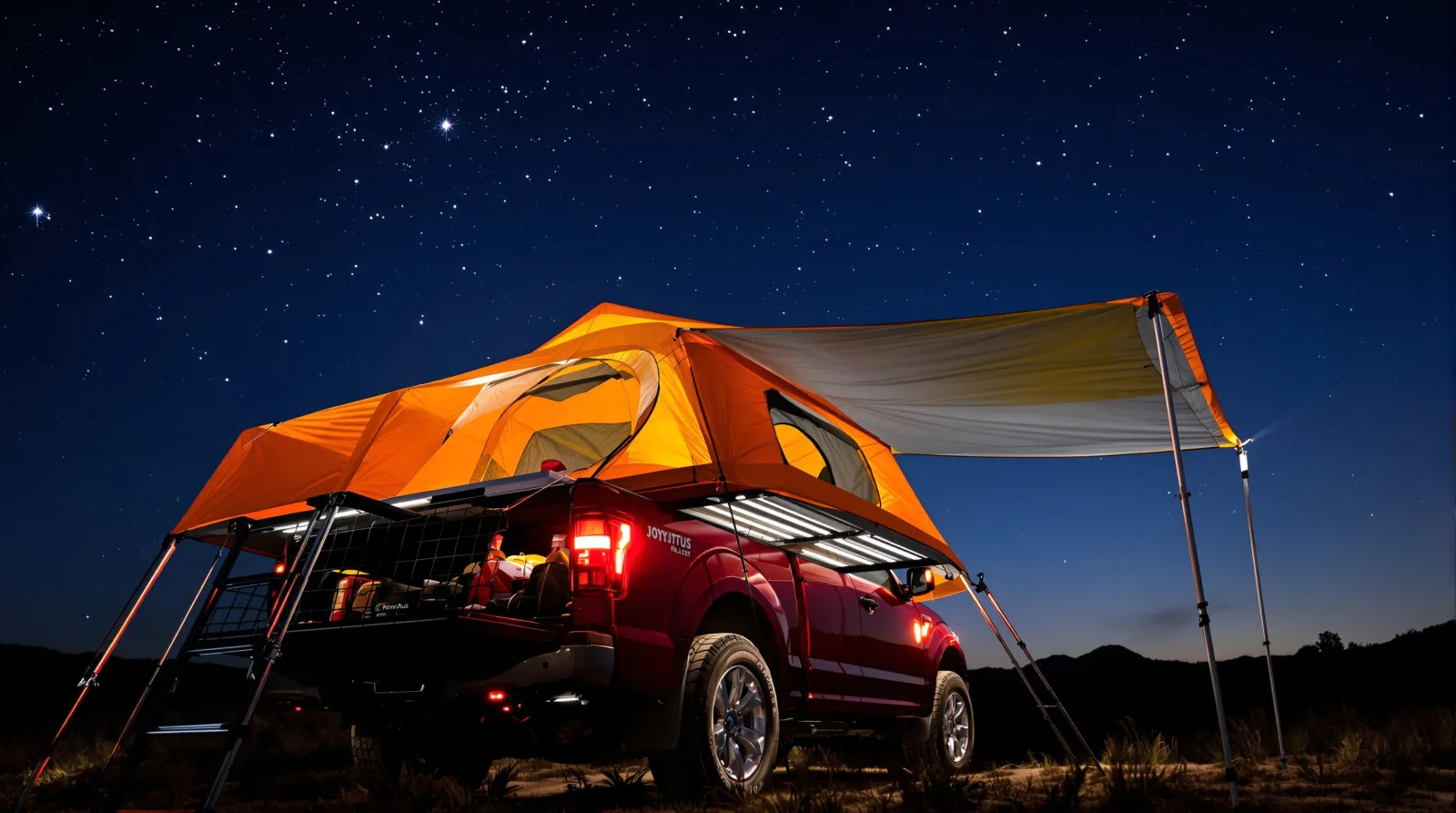
JOYTUTUS Pickup Truck Tent 2.0
210D polyester oxford, PU2000 waterproof coating, a rainfly, and a waterproof bottom give the JOYTUTUS Pickup Truck Tent 2.0 real wet-weather value at $78.99. You get a 2-person truck-bed shelter with 3 windows, 4 pockets, and straightforward setup, backed by a 4.4-star rating from 1,000 reviews.
Check price on AmazonThe Shortlist: Truck Camping Gear by Job
| Rank | Product | Best for | Price |
|---|---|---|---|
| #1 | JOYTUTUS Pickup Truck Tent 2.0 | Overall | Check price |
| #2 | Overland Vehicle Systems Nomadic 270 Awning | Premium | Check price |
| #3 | Nilight TR-05 Bed Strip Lights | Night setup | Check price |
| #4 | Truck Bed Cargo Net 4x6 | Secure hauling | Check price |
| #5 | PiSFAU 200W Power Inverter | Charging devices | Check price |
| #6 | Powerbuilt Tire Step | Roof access | Check price |
| #7 | Umbrauto Truck Bed Air Mattress | Sleep comfort | Check price |
Open Bed, Topper, or Bed Tent: Which Accessories Still Make Sense?
Open Bed, Topper, or Bed Tent: Which Accessories Still Make Sense?
Match the accessory to the bed setup before you buy. A bed tent pays off for open bed campers because it gives you a covered sleep space without adding a permanent shell, while a topper already solves part of that problem. Lights and cargo nets fit almost every truck camp, since you still need to see gear after dark and keep bins from sliding around on washboard roads or quick grocery stops. Simple stuff matters.
An awning makes the most sense if you cook beside the truck, hang out during rain, or need shade at a hot trailhead. A tire step climbs the priority list once roof boxes, racks, kayaks, or a tall topper put gear above shoulder height. This filter keeps you from buying parts built for someone else’s camp layout.
Field Notes on the 7 Accessories
90.5 x 62.9 x 66.9 inches decides whether this fits your truck bed camping plan. Inside, the JOYTUTUS gives two people a raised, enclosed sleep spot with a PU2000 coated 210D oxford shell, rainfly, waterproof floor layer, one door, and 3 windows.
Setup is straightforward, though reviewers mention some pole adjustment, and the brand warns poorly connected poles can break. Shorter campers may want a step stool. Skip this for standing room or topper use.
Pros
- Sized for 2 people in the truck bed
- PU2000 coating, rainfly, and waterproof floor layer help with wet nights
- 3 windows and one zippered door give airflow and access
- Reviewers say one person can set it up with some adjustment
Cons
- Pole connection matters, since improper setup can break poles
- Shorter campers may need a step stool during setup
You roll into a windy lunch stop, want shade over the driver side, and do not want to wrestle a pop-up canopy. The Nomadic 270 swings out to give 129 square feet of coverage from a rack mounted setup.
280G poly-cotton ripstop fabric, heat-sealed seams, reinforced oversized hinges, and heavy-duty rafters handle rain and repeated camp use. Three pivoting aluminum poles adjust with quick locks.
Once mounted, reviewers like the coverage and fast setup. Installation notes are thin, so rack fitment and mounting skill matter.
Pros
- 129 square feet of driver-side coverage
- No poles required for basic deployment, with rafters and oversized hinges supporting the awning
- 280G poly-cotton ripstop fabric uses heat-sealed seams for rain protection
- Reviewers praise the coverage and build quality once installed
Cons
- Installation instructions get repeated complaints from reviewers
- Needs a suitable rack and careful mounting
Wiring comes first: these strips are not a drop-in flashlight, they need a 12-volt hookup, routing, and a switch location you like. Nilight includes a 2-way splitter, inline blade fuses, an on/off switch, and extension cable, so the kit earns a spot in a bed camping setup.
The 2 strips use 180 5050-SMD LEDs with 2400LLM, 6000K white light. IP67 sealed housings suit wet, dirty beds. Under a topper, one overhead strip may be plenty.
Pros
- 180 5050-SMD LEDs across 2 strips light the truck bed clearly
- Includes splitter, blade fuses, switch, and extension cable
- IP67 sealed housing helps protect against rain, dirt, and sand
- Reviewers say the adhesive works well, with mounting hardware included for backup
Cons
- Requires wired 12-volt installation
- Can be brighter than needed inside a camper shell
Compared with the pick above, you give up camp comfort and any shelter help. Cargo control is the whole job here.
TIRETEK gives you a 4 by 6 foot bungee net that stretches to 8 by 12 feet, with tight 4 by 4 inch mesh and 12 metal carabiners.
Use it over coolers, bins, tarps, limb debris, or loose boxes in an open bed. Campers needing weather protection need a cover or topper too.
Pros
- 4 by 6 foot net stretches to 8 by 12 feet
- Tight 4 by 4 inch mesh helps hold small items
- 12 metal carabiners make tie down fast
- Reviewers report strong hold on long highway trips
Cons
- Cargo control only, no rain or dust protection
- Open bed campers still need a tarp, cover, or topper for weather
Reviewers keep calling this little inverter convenient because phones, tablets, and laptops can charge from the cab at the same time. It stores small too.
The specs match that use: 200 watts from a 12 volt vehicle socket, two U.S. AC outlets, four USB ports, 110 volt output, and a modified sine wave. Bring it for device charging and light strings, but use a larger unit for camp appliances or sensitive pure sine wave gear.
Pros
- Two AC outlets and four USB ports
- Compact 2.7 by 1.4 by 5 inch body
- ABS insulated shell with overheating, voltage, overload, and short circuit protections
- Reviewers like charging several road trip devices at once
Cons
- 200 watts limits it to small electronics and similar loads
- Modified sine wave output may not suit sensitive electronics that require pure sine wave power
Picture a camp day with bikes or a cargo box on the roof and a dirty truck parked on uneven gravel. A tire step beats standing on the door sill.
Powerbuilt’s step slips over a tire so you can reach a roof rack, truck box, engine bay, lumber rack, luggage, or bike.
It fits tires with tread cross width of 13 inches or less, adjusts for height, folds for storage, and uses a grated surface with anti-slip tape.
Pros
- Helps reach roof racks, truck boxes, engine bays, and bed cargo
- Universal adjustable design for tires up to 13 inches at the tread
- Grated metal surface and anti-slip tape add grip
- Folds for storage behind a seat or in a truck box
Cons
- Does not fit tires wider than 13 inches at the tread
Full size truck owners buy this to turn a short bed into a real sleep platform, but the common mistake is assuming it fits any pickup. Umbrauto sizes it for 5.5 to 5.8 foot full size beds, with a soft flocked top, PVC body, and thicker 210T grid fabric underneath.
It includes a pump, pillow, nozzle, carry bag, and repair patch. Reviewers say it holds air overnight, though taller campers may run out of length.
Pros
- Fits 5.5 to 5.8 foot full size pickup beds
- Soft flocked top with PVC construction and thicker 210T grid fabric underneath
- Includes pump, pillow, nozzle, carry bag, and repair patch
- Listed 600 lb capacity for 2 to 3 people
Cons
- Not compatible with midsize truck beds
- One 5 foot 9 reviewer said their feet dangled off the end
A Two Person Truck Bed Layout That Does Not Turn Into a Gear Pile
For two people, build the truck bed around the sleep surface before you load anything else. Put the mattress, pad, or cot layout in first, then decide where every bin goes without stealing elbow room. We like gear bins tight to the cab end, or tucked under a platform if the bed height gives you room. Keep headlamps, water, phones, layers, and glasses within reach from both sleeping spots.
- Dirty shoes, wet jackets, recovery gear, and cooking kit stay outside the sleep zone, in a tailgate tote, side box, or lidded bin.
- Mount or hang one light where both people can switch it on without crawling over the other person.
A DIY platform can clean up the whole setup, but plan it around your actual bin height and mattress thickness. Copying a photo can leave you with bins that scrape or a bed that sits too close to the topper roof.
How to Pick Truck Gear That Fits Your Actual Setup
Bed Style and Weather Coverage
Start with bed style: open bed, bed tent, hard shell, or high rise cap. Lights, nets, and tie points fit many setups; a bed tent or mattress needs bed length, wheel well, and tailgate checks.
Sleep Space for One Person or Two
Two people need more than a wider mattress. Check wheel wells, gear bins, platform height, and tailgate access, then confirm the tent or topper leaves sitting room where your heads land.
Setup Time After Dark
Late arrivals punish clutter. Add bed lights, a cargo net that stops bins from sliding, and a step for safer rack or roof box access when your hands are full.
Power Needs without Building a Full Electrical System
A small inverter covers phones, camera batteries, and other low draw devices. It does not replace a house battery, solar plan, or fridge power setup, so size your power around the biggest load.
Load Security on the Road
Highway speed and rough dirt roads move loose totes, recovery gear, and chairs. Use cargo nets, tie points, and straps so the sleep area stays clear when you pull in.
Upgrade Path and Resale Value
Buy around the setup you expect to keep. If a cap or platform may change, choose lights, steps, nets, tie points, and power gear that move to the next truck bed.