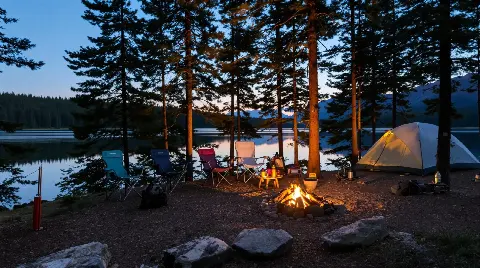
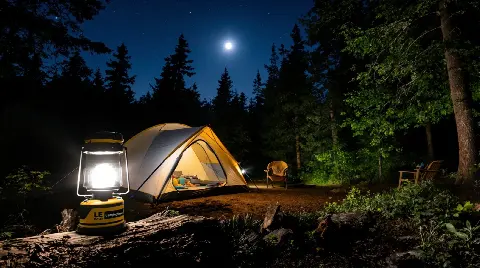
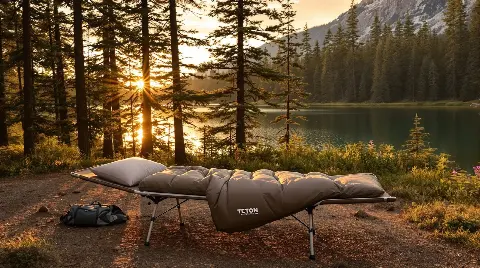
Over 52 million North American households camped in 2025, according to KOA. KOA also counted 87,990,000 US households that identified as campers in 2023. By 2024, KOA put US camping and outdoor hospitality expenditures at $61 billion.
We aggregated data from Kampgrounds of America, U.S. Forest Service, U.S. Census Bureau, and other primary sources.
Starter Gear for Most Campers
If your camping plan starts with the basics most U.S. campers bring, these picks cover shelter, seating, and campsite light.
| Product | Why it fits | Price |
|---|---|---|
 KAZOO Waterproof Family Camping Tent
Fast family shelter Read our review |
Choose this when you want a family tent that pitches in about 30 seconds once you know it and uses ripstop fabric that resists tears and water. | Check price |
 Coleman Camping Quad Chair with 4-Can Cooler
Relaxed seating pick Read our review |
This fits trips where you want a camp chair with a roomy seat, padded armrests, a mesh cup holder, and a built-in cooler for four cans. | Check price |
 LE LED Camping Lantern, 1000 Lumens
Bright campsite lantern Read our review |
Use this when you need a 1000-lumen lantern with four light modes, a metal handle, and a hook for hanging around the site. | Check price |
 LHKNL Rechargeable Headlamp 2-Pack
Two-person light set Read our review |
This works well for couples, kids, or a backup kit when you want two rechargeable headlamps with white and red light and 60-degree tilt. | Check price |
CampingKnow is reader-supported. When you buy through links on our site, we may earn an affiliate commission at no extra cost to you. Learn more.
Key Takeaways
- Over 52 million North American households camped in 2025, exceeding pre-pandemic participation levels. (Kampgrounds of America, 2025)
- 87,990,000 households identified as campers in 2023. (Kampgrounds of America, 2023)
- 53,670,000 households actively took a camping trip in 2023. (Kampgrounds of America, 2023)
- 39% of campers were non-white as of 2024, up from 23% a decade ago. (Kampgrounds of America, 2024)
- 4.4 million new campers entered the market each year on average. (Kampgrounds of America, 2024)
- 31% of all nights camped in 2024 were at private campgrounds and glamping resorts, the highest share recorded. (Kampgrounds of America, 2024)
- 32% of new campers chose cabin or glamping accommodations for their first camping experience. (Kampgrounds of America, 2024)
- $61 billion in total camping and outdoor hospitality expenditures was reached in 2024. (Kampgrounds of America, 2024)
- 158.7 million recreation visits to national forests were estimated in FY2022. (U.S. Forest Service, FY2022)
- 8.1 percent of national forest recreation visits included developed camping, 3.6 percent had it as the primary activity, and participants averaged 43.2 hours doing it as primary activity. (U.S. Forest Service, FY2018-FY2022)
1. How Many Households Camp Now?
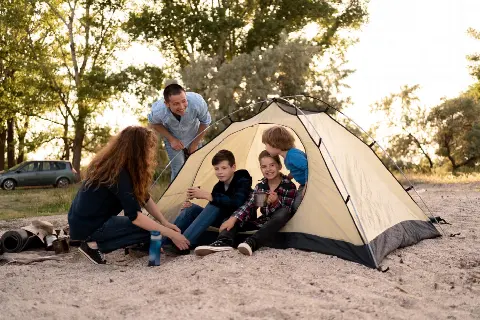
KOA puts the 2025 North American total at over 52 million North American households. That scale puts campground demand in the mainstream, with pressure on popular weekends and family-friendly parks. KOA also reports 71% of campers plan camping trips in 2025, so future intent remains strong. Booking early makes sense for peak dates.
| Metric | Value | Source |
|---|---|---|
| North American households that camped, 2025 | over 52 million North American households | Kampgrounds of America, 2026 Camping & Outdoor Hospitality Report (2025) |
| US households identifying as campers, 2023 | 87,990,000 | Kampgrounds of America, 2024 Camping & Outdoor Hospitality Report Top Level Overview (2023) |
| US active camping households, 2023 | 53,670,000 | Kampgrounds of America, 2024 Camping & Outdoor Hospitality Report Top Level Overview (2023) |
| Additional US camping households, 2024 vs 2019 | 11 million | Kampgrounds of America, 2025 Camping & Outdoor Hospitality Report (2024) |
| US campers planning camping trips, 2025 | 71% | Kampgrounds of America, 2025 Camping & Outdoor Hospitality Report (2025) |
| Active campers leisure trips that are camping trips, 2023 | nearly 60% | Kampgrounds of America, 2023 North American Camping and Outdoor Hospitality Report (2023) |
KOA counts households, not individual people.
2. Who Is Camping in the United States?
The crowd is younger and more diverse, with 39% of campers non-white in 2024. KOA data also puts close to half of campers since 2022 under age 35, which means campgrounds are serving more young adults alongside longtime outdoor households.
Families remain a major part of the mix. In 2022, KOA said 58% of camping households included children, so camping with kids is still a normal part of the market. Campgrounds that offer quiet hours, family bathrooms, and simple activities may fit this audience well.
| Metric | Value | Source |
|---|---|---|
| US non white campers, 2024 | 39% | Kampgrounds of America, 2024 Camping & Outdoor Hospitality Report Top Level Overview (2024) |
| US campers under age 35, since 2022 vs 2014 | close to half (since 2022) vs 30% (2014) | Kampgrounds of America, 2024 Camping & Outdoor Hospitality Report Top Level Overview (2022-2023 vs 2014) |
| People of color camping participation increase, 2014 to 2023 | 54% | Kampgrounds of America, 2024 Camping & Outdoor Hospitality Report Top Level Overview (2014 to 2023) |
| US camper households with children, 2022 | 58% | Kampgrounds of America, 2023 North American Camping and Outdoor Hospitality Report (2022) |
| US new camper households with children, 2022 | 57% | Kampgrounds of America, 2023 North American Camping and Outdoor Hospitality Report (2022) |
3. How Many First Time Campers Are Entering?
KOA still counted 4.4 million new campers a year in 2024.
That means entry did not vanish after the pandemic surge. KOA also reports 41,400,000 first-time camper households from 2014 to 2023, so the longer story is larger than one unusual season.
The 2024 share was 5%, which suggests campgrounds still see beginners in the mix. In 2023, 45% of new campers were from diverse backgrounds, pointing to a broader audience for basic trip planning, gear explanations, and campground etiquette. Anyone new to camping can make the first trip easier by choosing a simple site and confirming rules before arrival.
| Metric | Value | Source |
|---|---|---|
| Average annual new campers, 2024 | 4.4 million | Kampgrounds of America, 2024 Camping & Outdoor Hospitality Report Top Level Overview (2024) |
| US new campers share, 2024 | 5% | Kampgrounds of America, 2025 Camping & Outdoor Hospitality Report (2024) |
| First time camper households, 2014 to 2023 | 41,400,000 | Kampgrounds of America, 2024 Camping & Outdoor Hospitality Report Top Level Overview (2014 to 2023) |
| US new campers from diverse backgrounds, 2023 | 45% | Kampgrounds of America, 2024 Camping & Outdoor Hospitality Report Top Level Overview (2023) |
| New US camping households, 2022 | 6,432,000 | Kampgrounds of America, 2023 North American Camping and Outdoor Hospitality Report (2022) |
| New US camping households, 2021 | 9,115,000 | Kampgrounds of America, 2023 North American Camping and Outdoor Hospitality Report (2021) |
| New US camping households, 2020 | 10,130,000 | Kampgrounds of America, 2023 North American Camping and Outdoor Hospitality Report (2020) |
KOA reports household counts for these entries, so they should not be read as individual people.
4. What Types of Camping Are Growing?
KOA says private campgrounds and glamping resorts accounted for 31% of all nights camped in 2024.
The shift is less about tents fading and more about choice becoming normal. A trip may mean a standard site, a furnished tent, a cabin, or an RV pad with services nearby. KOA says nearly 10 million households camped in an RV in 2024, which keeps towables and motorhomes in the core mix.
Cabins and glamping also meet people at the first step, since 32% of new campers chose those accommodations for their first experience. KOA reports 56% of new campers prefer locations offering a full range of amenities. That makes glamping vs camping a real planning choice, especially for groups with different comfort levels.
5. How Much Money Does Camping Generate?
Camping is a $66 billion North American economic footprint, according to KOA.
That money does not stay at the campsite. It moves through grocery stores, gas stations, outfitters, restaurants, laundromats, repair shops, and guide services. A campground reservation can be the first purchase in a longer local trip.
KOA also put US camping and outdoor hospitality expenditures at $61 billion in 2024, with camper daily spending at $200 per day. Those figures help explain why small towns near forests, lakes, and trail systems often treat outdoor travel as part of their business base.
Public lands add another channel. The U.S. Forest Service said recreation visitors spent about $11 billion in areas near national forests and grasslands in FY2021. RV parks and campgrounds also form a private business layer, while many public agencies operate sites outside Census Bureau RV park counts.
Trip planning can spread money locally by buying supplies near the destination and using nearby services when available.
The Census Bureau RV park count excludes parks run by the National Park Service, state and local governments, and camping sites operated by the Bureau of Land Management, the U.S. Forest Service, and the U.S. Army Corps of Engineers.
6. How Much Camping Happens on Public Land?
A huge amount of outdoor use runs through national forests: 158.7 million visits in FY2022.
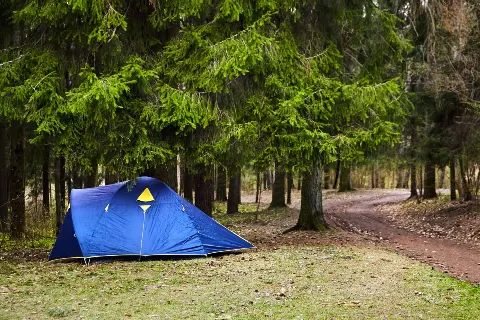
U.S. Forest Service data is useful because it describes trips, activities, time, and travel distance. It counts visits, so a person who returns often can appear more than once.
The camping figures point to longer stays. Developed camping participants average 43.2 hours when it is their primary activity, and primitive camping participants average 35.5 hours.
Travel distance adds planning context. Nearly half of national forest visits came from people living within 50 miles of the forest visited, while over one-fifth traveled more than 200 miles. Near-city sites may feel different from remote sites.
Survey respondents could select multiple activities, so participation shares should be read as overlapping activities.
Most recent available data: U.S. Forest Service, 2022.
Camping by the Numbers
Methodology and Sources
KOA counts households, Outdoor Foundation counts people, and NPS counts visits, so the article cannot merge those measures. The public data reviewed here do not name a state with the most camping or a best camping state.
Watch the next KOA Camping and Outdoor Hospitality Report, Outdoor Foundation participation releases, BEA outdoor recreation updates, and U.S. Forest Service visitor monitoring summary.
Figures are reported as each source published them. Surveys with different methods are shown separately and were not combined.
- Kampgrounds of America, 2025 Camping & Outdoor Hospitality Report (2025)
- Kampgrounds of America, 2024 Camping & Outdoor Hospitality Report Top Level Overview (2024)
- Kampgrounds of America, 2023 North American Camping and Outdoor Hospitality Report (2023)
- U.S. Forest Service, National Visitor Use Monitoring Survey Results National Summary Report (FY2022)
- U.S. Census Bureau, RVs: A Way to See America From the Safety of Your Own “Home” (2020)
- Kampgrounds of America, 2026 Camping & Outdoor Hospitality Report (2025)
Last updated: November 2026
We update this page annually.