CampingKnow is reader-supported. When you buy through links on our site, we may earn an affiliate commission at no extra cost to you. Learn more.
A cooler has one job, and you find out fast whether it can do it. By the second afternoon of a hot weekend, you either have cold drinks and firm food or you have a swamp of warm water and floating lunch meat. The gap between those two outcomes is mostly the cooler, and the price tag does not always tell you which one you bought.
We loaded six of them with the same ratio of ice to gear, left them in the same patch of sun, and opened each one the same number of times a day to see how long the ice actually held. We also dragged the wheeled models across gravel, packed a soft one into a full trunk, and tried lifting the big family boxes when they were full, which is where a lot of coolers lose you. The results sorted themselves into clear roles rather than a single winner. What follows is one pick for each kind of camper: the person who wants ice to survive a long weekend, the family feeding six people, the buyer who refuses to overspend, and the day-tripper who just needs cold cans on a short walk. Match the cooler to the trip you actually take, and you stop fighting warm water for good.
YETI Tundra 45 Hard Cooler
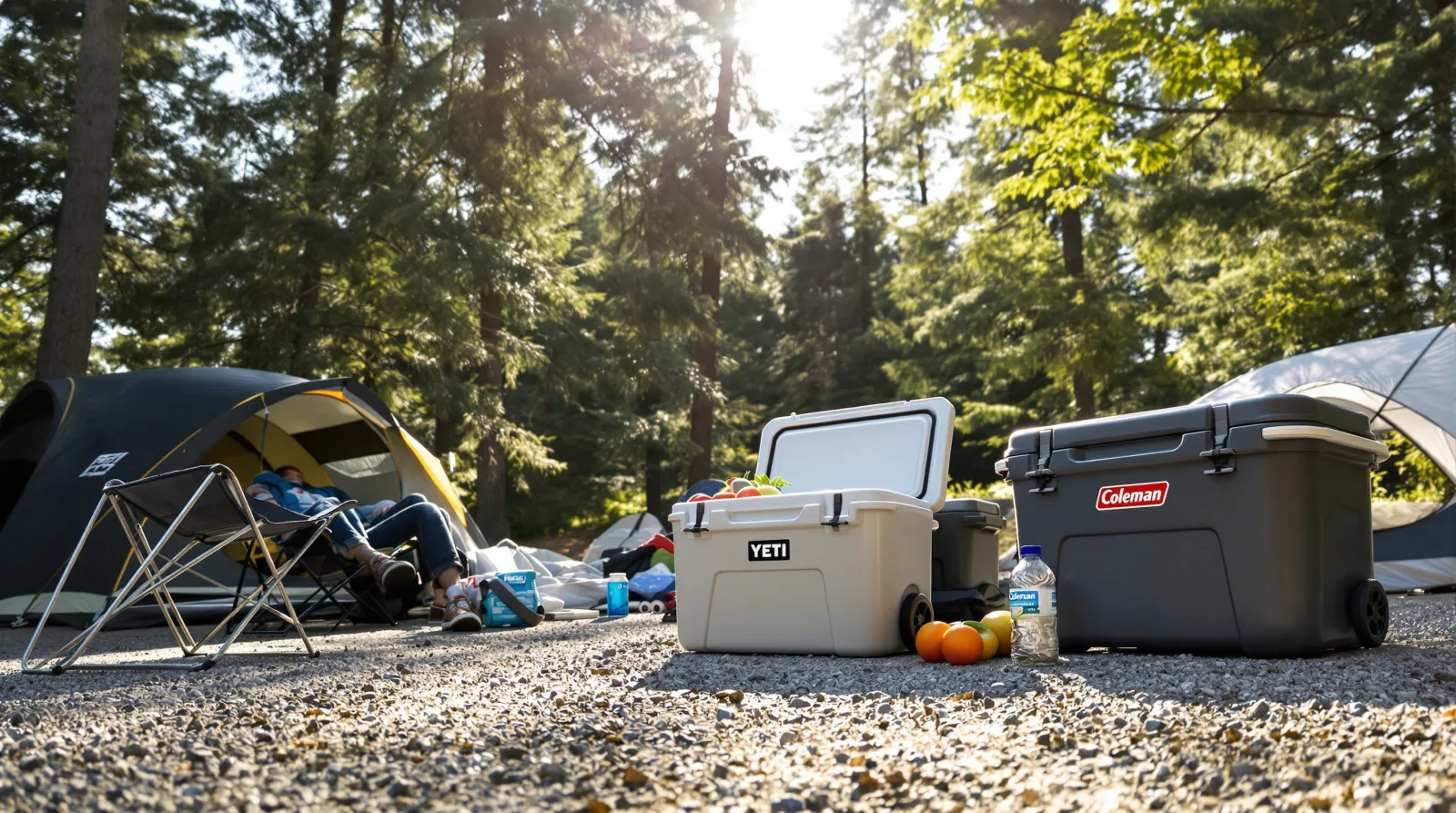
Rotomolded walls with thick insulation and a freezer-grade gasket held ice the longest in our test, stretching past five days in real summer heat and closer to a week when we pre-chilled it. It is heavy and there are no wheels, but for raw ice retention and a build that survives years of abuse, nothing else here matched it.
Check price on AmazonQuick Comparison
| Rank | Product | Best for | Price |
|---|---|---|---|
| #1 | YETI Tundra 45 Hard Cooler | Ice retention | Check price |
| #2 | RTIC 52 QT Ultra-Light Hard Cooler | Value | Check price |
| #3 | Igloo BMX 52 Quart Cooler | Budget hard cooler | Check price |
| #4 | Coleman 70 Quart Xtreme Cooler | Large groups | Check price |
| #5 | Coleman Xtreme 50 Quart Wheeled Cooler | Wheeled cooler | Check price |
| #6 | RTIC Soft Pack 20 Soft Cooler | Soft cooler | Check price |
The Reviews
This is the cooler that decides the argument about whether rotomolded boxes are worth it. The Tundra 45 is molded in one piece with no seams to leak heat, packed with thick pressure-injected insulation, and sealed by a freezer-quality gasket that runs the whole lid. In our sun test it held usable ice past five full days, and when we chilled it overnight and started with block ice, it pushed close to seven.
Nothing else in the group came near that number. The 45 size swallows enough food and ice for a couple or a small family over a long weekend, holding roughly twenty-six pounds of ice or a couple of days of group meals. The rubber T-shaped latches stay shut, the rope handles are comfortable even loaded, and the whole thing is certified bear-resistant when you padlock it, which matters in a lot of backcountry sites. The trade-offs are real: it is heavy empty and a two-person carry full, and there are no wheels. If holding ice is the thing you care about most, you live with that.
Pros
- Longest ice retention in our test, five days and up
- One-piece rotomolded build with no weak seams
- Certified bear-resistant when padlocked
- Freezer-grade gasket and latches that actually seal
Cons
- Heavy empty, a two-person lift when full
- No wheels, so you carry every trip
RTIC built its name on giving you most of a premium cooler for a lot less, and this is the model that proves the point. It uses up to three inches of closed-cell foam in the walls and a freezer-style gasket, and it held ice for the better part of a week in our test, landing within a day of the YETI rather than the day or two you might expect from the gap in price. The catch is in the name: it is roughly thirty percent lighter than a traditional rotomolded cooler, so loading and carrying it is far less of a chore.
At 52 quarts it holds around seventy-six cans, which is a genuine family size for a weekend. The latches are simpler than the YETI's and the lid is not certified bear-resistant, so this is one for established campgrounds rather than remote backcountry. For the camper who wants long ice life and a big box without the rotomolded premium or the rotomolded weight, this is the easy value pick.
Pros
- Holds ice nearly as long as coolers that cost far more
- About 30 percent lighter than rotomolded boxes its size
- 52 quarts fits a family weekend, around 76 cans
- Freezer-style gasket and thick closed-cell foam
Cons
- Not certified bear-resistant
- Latches feel less heavy-duty than the premium brands
The BMX is the cooler for people who want a tough box that holds ice for a few days without paying rotomolded money. It is blow-molded rather than rotomolded, so it is lighter and cheaper, but Igloo reinforced the base and corners and added what it calls Cool Riser feet that lift the body off hot ground, which slows the heat creeping in from below. In our test it gave us a solid three to four days of ice, which covers most weekend camping trips comfortably.
Useful touches add up here. There are rubberized T-grip latches that snap down hard, stainless hardware that will not rust, tie-down points for a truck bed or boat, and a fish ruler molded into the lid that pays for itself the first time someone disputes a catch. At 52 quarts it holds about eighty-three cans. It will not match a sealed rotomolded cooler over a five-day stretch, but for the money it is hard to argue with, and it shrugs off the kind of knocks a cheap cooler would crack under.
Pros
- Three to four days of ice at a budget price
- Cool Riser feet keep the base off hot ground
- Reinforced corners and rust-proof stainless hardware
- Tie-down points and a molded fish ruler
Cons
- Shorter ice life than rotomolded coolers
- Lid seal is good, not freezer-grade
When you are feeding a big group, capacity beats every other number, and this 70-quart Coleman gives you a lot of it for very little money. It swallows around a hundred cans, enough to keep a family of six in drinks and food across a weekend without a second cooler. Coleman builds extra insulation into the lid and walls and rates it to hold ice up to five days at ninety degrees.
In our shadier real-world packing it held usable ice for three to four days, which is plenty for most campsites. It is light for its size because it is foam-injected plastic rather than a rotomolded tank, so one person can carry it when it is not fully loaded. The lid has molded cup holders, the latch keeps the seal tight, and there are channels that let you leave the drain plug cracked to dump melt without tipping the whole thing. It is not the cooler for a week-long ice marathon, but for big batch cooking and large groups on a budget, the sheer volume is the selling point.
Pros
- Huge 70-quart capacity, around 100 cans
- Light enough for one person to carry unloaded
- Rated to hold ice up to five days at 90 degrees
- Inexpensive for the size, with a leak-resistant drain
Cons
- Thinner insulation than rotomolded coolers
- Big footprint takes real trunk space
If the walk from the car to the site is long, or the parking lot to the beach is all sand, wheels change the whole experience. This 50-quart Coleman rolls on tough plastic wheels and pulls behind you on a telescoping handle, so a full cooler that would normally need two people becomes a one-handed drag. We pulled it across gravel and grass without trouble, and the handle tucks down flat for storage in the trunk.
It holds about eighty-four cans and carries the same Coleman insulation that earns the five-day ice rating, so you are not trading cooling for convenience the way some wheeled coolers make you. In our test it held ice for three to four days, in line with the non-wheeled Coleman. The wheels do add bulk and a little weight, and loose sand will still make you work, but for anyone who has hauled a heavy cooler by the side handles and regretted it, this is the obvious fix.
Pros
- Wheels and a tow handle turn a two-person carry into one
- Around 84-can capacity in a manageable 50 quarts
- Same five-day ice rating as the non-wheeled Coleman
- Handle collapses flat for storage
Cons
- Wheels add bulk and weight
- Loose sand still makes it a workout
Not every outing needs a hard cooler the size of a footlocker. For a day hike, a paddle, a picnic, or the overflow of cold drinks next to the big box, a soft cooler is easier to carry and far easier to stash. This RTIC holds twenty cans plus ice and uses up to an inch and a half of closed-cell foam, so it punches above the usual soft-cooler weight class.
We got close to two days of cold out of it when we pre-chilled and packed it tight, which is strong for a bag. The waterproof zipper is the standout. It genuinely seals, so you can lay the bag on its side in a pack without a puddle, and the whole thing floats if it goes overboard. The exterior is a tough coated fabric that wipes clean and resists punctures from gear shifting around it. It will never compete with a rotomolded cooler on ice life, and twenty cans fills up fast, but as the grab-and-go cooler that lives in the car or rides on your back, it earns its place.
Pros
- Holds cold close to two days, strong for a soft bag
- Leakproof zipper means you can lay it flat
- Tough coated fabric wipes clean and resists punctures
- Light, packable, and floats if it ends up in the water
Cons
- Shorter ice life than any hard cooler here
- Twenty-can capacity fills up quickly
What to Look For
How Many Days of Ice Do You Actually Need?
This is the number that should drive your whole decision, and it is the one most buyers guess at.
A single overnight or a day at the lake asks very little, and almost anything here will keep food cold that long. A two or three day weekend is the sweet spot most campers live in, and a good blow-molded cooler like the Igloo BMX or a Coleman covers it without strain.
Only when you are out for four, five, or more days, or camping in serious heat with no shade, do you genuinely need a rotomolded box like the YETI or the thick-walled RTIC that can hold ice past five days.
Buying a week-long cooler for overnight trips means paying for and lugging insulation you never use.
Rotomolded, Blow-Molded, or Soft
These three build types explain almost every gap in price and performance. Rotomolded coolers, like the YETI Tundra, are molded in one seamless piece with thick walls and a tight gasket.
They hold ice the longest and take years of abuse, but they cost the most and weigh a lot empty. Blow-molded coolers, like the Coleman and Igloo models, have thinner foam-injected walls.
They are far lighter and cheaper and hold ice for a few days, which is all most weekends require. Soft coolers like the RTIC Soft Pack trade ice life for portability, carrying a day or so of cold in a bag you can sling over a shoulder.
Pick the build that matches your trip length, not the one with the best marketing.
Sizing by Quarts and Your Group
Cooler size is measured in quarts, and a rough rule keeps you out of trouble: plan on about a quart per person per day, then add room for ice, since ice should fill close to half the box for good cooling.
A solo overnighter is fine in a 20-quart soft cooler. A couple for a weekend wants something in the 35 to 45 range.
A family of four to six for two or three days is comfortable at 50 to 70 quarts, which is why the RTIC 52 and the 70-quart Coleman land where they do. Two smaller coolers often beat one giant one, because you can open the drinks cooler constantly and leave the food cooler sealed, which keeps that ice working longer.
How to Pack a Cooler So the Ice Lasts
The same cooler can give you two days or four depending on how you load it, so this is worth getting right.
Chill the cooler the night before with a sacrificial bag of ice, then dump it and pack with cold food and drinks, never warm. Use block ice or frozen water jugs for the base since they melt far slower than cubes, and fill cubes around them to reach into the gaps.
A full cooler holds cold better than a half-empty one, so top dead space with extra ice rather than air. Keep it in the shade, throw a blanket or towel over the lid in direct sun, and open it as little as you can.
A separate small cooler for the drinks you grab all day saves the main one from constant warm-air dumps.
Bear-Resistant Certification and Security
If you camp where black bears roam, an ordinary cooler is an invitation, and many parks and forests require certified storage.
Look for coolers tested and listed as bear-resistant by the Interagency Grizzly Bear Committee, which the YETI Tundra earns once you run padlocks through its lid holes.
The certification means a bear cannot pry or chew its way in within a set time, which protects your food and, more importantly, keeps bears from learning to associate campsites with meals.
A blow-molded cooler offers none of this, so in bear country it belongs locked in a vehicle or a provided steel locker, not left at the site overnight.
Wheels, Handles, and Getting It There
A cooler you cannot move comfortably is a cooler you start to resent.
Full rotomolded boxes get genuinely heavy, so think honestly about the distance from your car to your spot. If it is a long walk, a steep path, or loose sand, a wheeled model like the Coleman Xtreme earns its keep by letting one person tow what would otherwise take two to carry.
For shorter hauls, check that the handles are comfortable: molded side grips dig into your hands when loaded, while rope or padded swing handles spread the weight.
And remember that wheels and handles add bulk in the trunk, so measure your cargo space before you commit to the biggest box on the shelf.