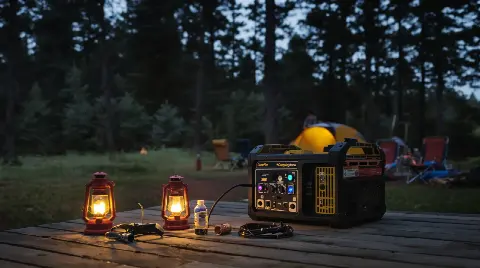
Jackery Explorer 1000 v2 Portable Power Station
Its 1,024Wh LFP battery, 1,500-watt output, and 10ms UPS mode make it the most capable all-rounder for campers who want serious, uninterrupted backup power.
Check price on AmazonThe Short List
Stores 1,024Wh and puts out 1,500 watts for base camp backup.

Includes two AC outlets, four USB-A ports, USB-C, and DC output.

LiFePO4 battery is rated for more than 4,000 charge cycles.

At 2.3 pounds, it offers eight outputs for small devices.
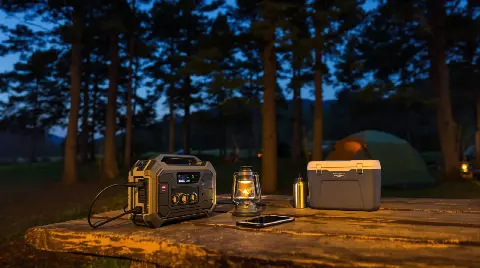
Electricity is the one thing most campers forget to plan for until their phone dies halfway up the trail. Real-time maps, headlamps, a small cooler, a CPAP machine: all of it runs on power you do not have once you leave the grid. A portable power supply solves that problem in a single box you can throw in the trunk.
Think of it as a very large power bank with extra storage and a few tricks a normal battery pack cannot match, such as AC wall outlets, 12V car ports, and solar charging. It stores a bank of watt-hours after charging and then hands that energy back to whatever you plug in, anywhere you happen to be. Below are eight portable power stations worth a look, covering everything from ultra-light weekend units to full home-backup generators. Each write-up lists what it does well, where it falls short, and who it suits, followed by a buying guide and FAQ to help you match a unit to the way you camp.
Quick Comparison
| Rank | Product | Best for | Price |
|---|---|---|---|
| #1 | MARBERO M82 Portable Power Station (237Wh) | Campers who want one box with every output type | Check price |
| #2 | Jackery Portable Power Station Explorer 240 | Road-trip and car campers charging phones and laptops | Check price |
| #3 | Jackery Explorer 300 Portable Power Station | Campers who want light, long-lived power | Check price |
| #4 | ALLWEI 300W Portable Power Station (256Wh) | Light loads and emergency backup at home or camp | Check price |
| #5 | X-Doria Raptic Titan Portable Power Station | Rugged use where durability and looks both matter | Check price |
| #6 | Anker 521 Portable Power Station (256Wh) | Phones and laptops on a long weekend | Check price |
| #7 | HOWEASY 88Wh Portable Power Station | Backpackers and minimalists who count every ounce | Check price |
| #8 | Jackery Explorer 1000 v2 Portable Power Station | Campers who want home-grade backup power off-grid | Check price |
The Reviews
MARBERO M82 Portable Power Station (237Wh)
The MARBERO covers nearly every plug you'd bring to camp: two AC outlets, four USB-A ports, a USB-C port, and DC output. It delivers 300 watts (375 peak) from a 237Wh battery, enough for phones, lights, and small appliances.
Specs
- Capacity
- 237Wh
- Output
- 300 watts, 375-watt peak
- Weight
- Not listed
- Battery type
- Not listed
It recharges from a wall in about six hours, from a car in about eight, or from a compatible solar panel. Two built-in LED lights double as a camp lantern.
What we like
- Two AC outlets, four USB-A ports, USB-C, and DC
- 300 watts with 375-watt peak
- Two built-in LED lights
- Charges from wall, car, or solar
Watch out for
- 237Wh will not run big appliances
- Six-hour wall recharge is slow
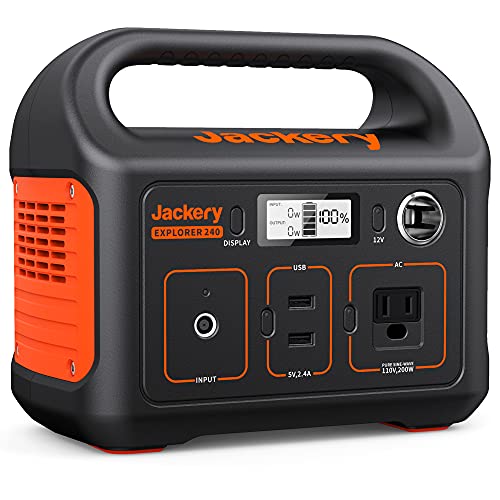
Jackery Portable Power Station Explorer 240
The Jackery Explorer 240 is a favorite for outdoor, travel, hunting, and emergency use. With a 240Wh backup lithium battery and a 110V/200W pure sine wave AC outlet, it can charge an iPhone about 24 times, an iPad Air around 7.5 times, and a MacBook Pro 13 twice. The 240 watt-hour (16.8Ah, 14.4V) lithium-ion pack needs no gasoline and makes no clanging, so you can pack light for your next camp trip.
Specs
- Capacity
- 240Wh
- Output
- 110V/200W pure sine wave AC
- Weight
- Not listed
- Battery type
- lithium-ion
The pure sine wave AC socket lets you power several sensitive devices without damage, including phones, notebooks, and string lights, which makes it ideal for car camping and road trips. It is primarily intended for charging laptops, mini-coolers, drones, and other outdoor electronics. Protection covers over-temperature, short circuit, over-discharge, overpower, overcharge, and voltage, so you can plug in with confidence. It is solar ready as well, which means you can pair it with a compatible panel and stay topped up on longer trips without ever touching a wall outlet.
What we like
- Quiet and eco-friendly
- Solar ready generator
- Pure sine wave outlet is safer than a car inverter
- Comprehensive built-in protection
Watch out for
- Solar panel must be purchased separately
- Can heat up in use
- Running many ports at once can stress the unit
Jackery Explorer 300 Portable Power Station
At 7.5 pounds and 292Wh, the Explorer 300 is easy to carry to camp and strong enough for laptops, drones, and cameras. Its two AC outlets, 100W USB-C port, two USB-A ports, and car port handle six devices at once.
Specs
- Capacity
- 292Wh
- Output
- 300-watt limit
- Weight
- 7.5 pounds
- Battery type
- LiFePO4
The LiFePO4 battery is rated for more than 4,000 charge cycles, which is a long service life for a unit this size. With a 100W panel, sold separately, Jackery says it reaches 80 percent in about 2.8 hours.
What we like
- 292Wh at only 7.5 pounds
- 100W USB-C port and two AC outlets
- LiFePO4 battery rated past 4,000 cycles
- Reaches 80 percent in about 2.8 hours on a 100W panel
Watch out for
- Solar panel sold separately
- 300-watt limit rules out heaters and cookers
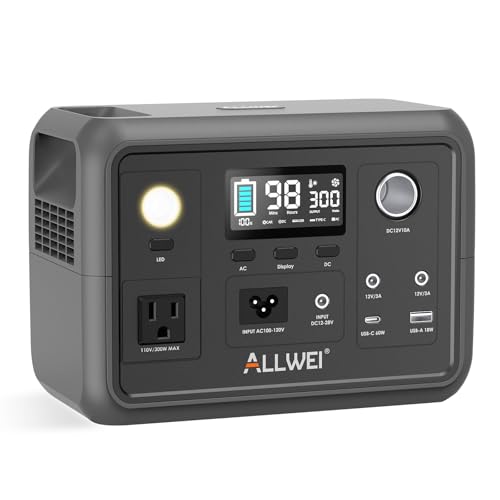
ALLWEI 300W Portable Power Station (256Wh)
ALLWEI pairs a 256Wh LiFePO4 battery with 300 watts of pure sine wave output (600 peak), a useful match for light loads and short outages. The 60W USB-C port is fast enough for most laptops.
Specs
- Capacity
- 256Wh
- Output
- 300 watts, 600 peak
- Weight
- 6.4 pounds
- Battery type
- LiFePO4
At 6.4 pounds it's easy to throw in a trunk. It recharges from the wall or car in about four hours, from a 100W panel in four to five, and in two or so using wall and solar together. A three-level LED light with SOS mode helps in a blackout.
What we like
- 256Wh LiFePO4 battery
- Pure sine wave output with 600-watt peak
- 60W USB-C port
- Combined wall and solar charging in about two hours
Watch out for
- Only one AC outlet
- 300 watts will not run larger appliances
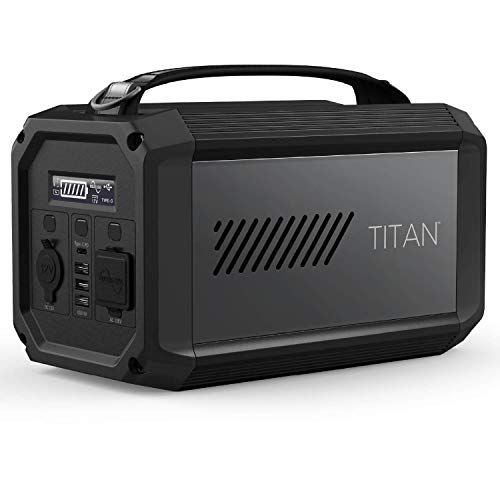
X-Doria Raptic Titan Portable Power Station
The X-Doria Raptic Titan is the beast of this group, with looks and build that grab attention. Its 225Wh backup lithium battery can run a lantern for 30-plus hours, charge a smartphone 20-plus times, a tablet 6-plus times, a camera around 35 times, and a laptop about five times, so you are unlikely to run dry. The transformer-style design only adds to the appeal, and it handles outdoor adventures, power-outage backup, and even a CPAP machine.
Specs
- Capacity
- 225Wh
- Output
- Not for devices over 200W
- Weight
- Not listed
- Battery type
- lithium
The best part is that it fully recharges from a simple 100W solar panel in just 4 to 5 hours. It stays compact, portable, and powerful, with rubberized protection on all four corners, an active cooling system, and an extruded aluminum body designed for security and comfort. Take it on the trail to run exterior lights and capture your adventures with up to 35 charges on tap.
What we like
- Aluminum frame design looks and feels rugged
- High 225Wh lithium battery backup
- Fully charges from a 100W solar panel in 4 to 5 hours
- Corner protection and active cooling for tough conditions
Watch out for
- Not for devices over 200W
- Solar panel is not included
- Not waterproof and can short out from liquid

Anker 521 Portable Power Station (256Wh)
Anker's 521 is a sensible step up from a big power bank: 256Wh in a LiFePO4 battery, six ports (two AC, two USB-A, USB-C, and a car outlet), and 300 watts of output with a 600-watt surge.
Specs
- Capacity
- 256Wh
- Output
- 300 watts, 600-watt surge
- Weight
- Not listed
- Battery type
- LiFePO4
The battery chemistry is the real selling point. Anker rates it for up to 10 years, so this is a unit you can keep in the camp box for a long time. The USB-C port handles fast laptop charging, which covers most of what a weekend asks for.
What we like
- LiFePO4 battery rated for up to 10 years
- Six ports including two AC and USB-C
- 300 watts with 600-watt surge
- USB-C handles fast laptop charging
Watch out for
- 256Wh is modest for multi-day fridge use
- 300 watts will not run larger appliances
HOWEASY 88Wh Portable Power Station
At 2.3 pounds and roughly 6.6 by 4 by 3 inches, the HOWEASY is the one to take if weight matters more than capacity. You still get eight outputs, including two AC sockets rated at 120 watts.
Specs
- Capacity
- 88Wh
- Output
- 120 watts
- Weight
- 2.3 pounds
- Battery type
- Not listed
Keep expectations in line with its 88Wh battery. It will top up phones, run a small light, or charge a camera, but it isn't built for anything power-hungry. Recharging works from the included AC adapter or car charger, or from a solar panel you buy separately.
What we like
- Only 2.3 pounds
- Eight outputs including two AC sockets
- Built-in light with SOS mode
- Charges from wall, car, or solar
Watch out for
- 88Wh is for small devices only
- 120-watt AC limit
Jackery Explorer 1000 v2 Portable Power Station
This is the heavyweight of the list. The Explorer 1000 v2 stores 1,024Wh and puts out 1,500 watts (3,000 surge), enough to run a fridge or electric pot at a base camp or through a power cut, and it's light for its class at 23.3 pounds.
Specs
- Capacity
- 1,024Wh
- Output
- 1,500 watts, 3,000 surge
- Weight
- 23.3 pounds
- Battery type
- LFP
The 10ms UPS mode keeps connected gear running if shore power drops, and the app-controlled 50-minute emergency charge helps when you're short on time. Jackery rates the LFP battery for over 4,000 cycles to 70 percent capacity.
What we like
- 1,024Wh with 1,500 watts of output
- 10ms UPS mode
- 50-minute emergency charge through the app
- LFP battery rated past 4,000 cycles
Watch out for
- 23.3 pounds is heavy to carry far
- Far more than a weekend of phone charging needs
What to Look For
Type of Product
First decide which sort of device you want.
Do you prefer a generator, a solar panel, or a power bank? If you need to charge laptops, appliances, and other gear, get a portable generator.
If you only need to keep a phone charged or run emergency lighting, a power bank or solar charger is enough.
Also think through a few details before you buy.
What are the voltage requirements of the devices you plan to charge? Are they USB-compatible?
Do you need a BMS to protect them? And if you want AC output, choose a unit with a proper mobile AC power source for camping.
Power Output
How much electricity do you actually need?
Most makers quote capacity in mAh (milliamp hours), where roughly 10,000 mAh equals about 3 full smartphone charges. Portable power units also vary in their output sockets, so work out the energy demands of your gadgets and pick a power source that comfortably covers them.
Form of Camping
Are you backpacking, car camping, or boondocking?
Backpacking demands a small, lightweight unit, while boondocking gives you a little more room for size and weight. Pick a light power source if you are carrying it on your back.
If you have an RV, go for a compatible battery built for camping.
Frequency of Camping
How often do you camp?
If you head out regularly, it is worth investing in a powerful device even though it costs more upfront. Most units lose some capacity if left unused for many months, so if you are a frequent camper or plan to use it often, buy a genuinely good one.
Camping Location
Solar power for camping is popular right now, but it is not ideal for every location.
In some areas you are better off relying on battery power. If you are a backpacker, choose a lightweight source, and if you have an RV, pick a compatible battery for camping.