CampingKnow is reader-supported. When you buy through links on our site, we may earn an affiliate commission at no extra cost to you. Learn more.
Bad water can end a trip faster than a sprained ankle. You won't feel it at the stream, yet two days later giardia or a stomach bug will have you crawling back to the car. A good filter takes that worry off the table for a few extra ounces in your pack, and once you trust it, every creek, lake, and spring becomes a refill station.
The catch is that no single filter fits every trip. A solo hiker scooping clear mountain streams needs something tiny and fast. A family at a lakeside site wants a system that fills bottles for six without anyone working a pump. A traveler facing questionable tap water needs a purifier that stops viruses, which most backcountry filters do not touch. We sorted the six picks below by who they actually suit, from squeeze filters and a straw to a gravity system, a press-style bottle, and a pump purifier for the worst water you'll ever scoop.
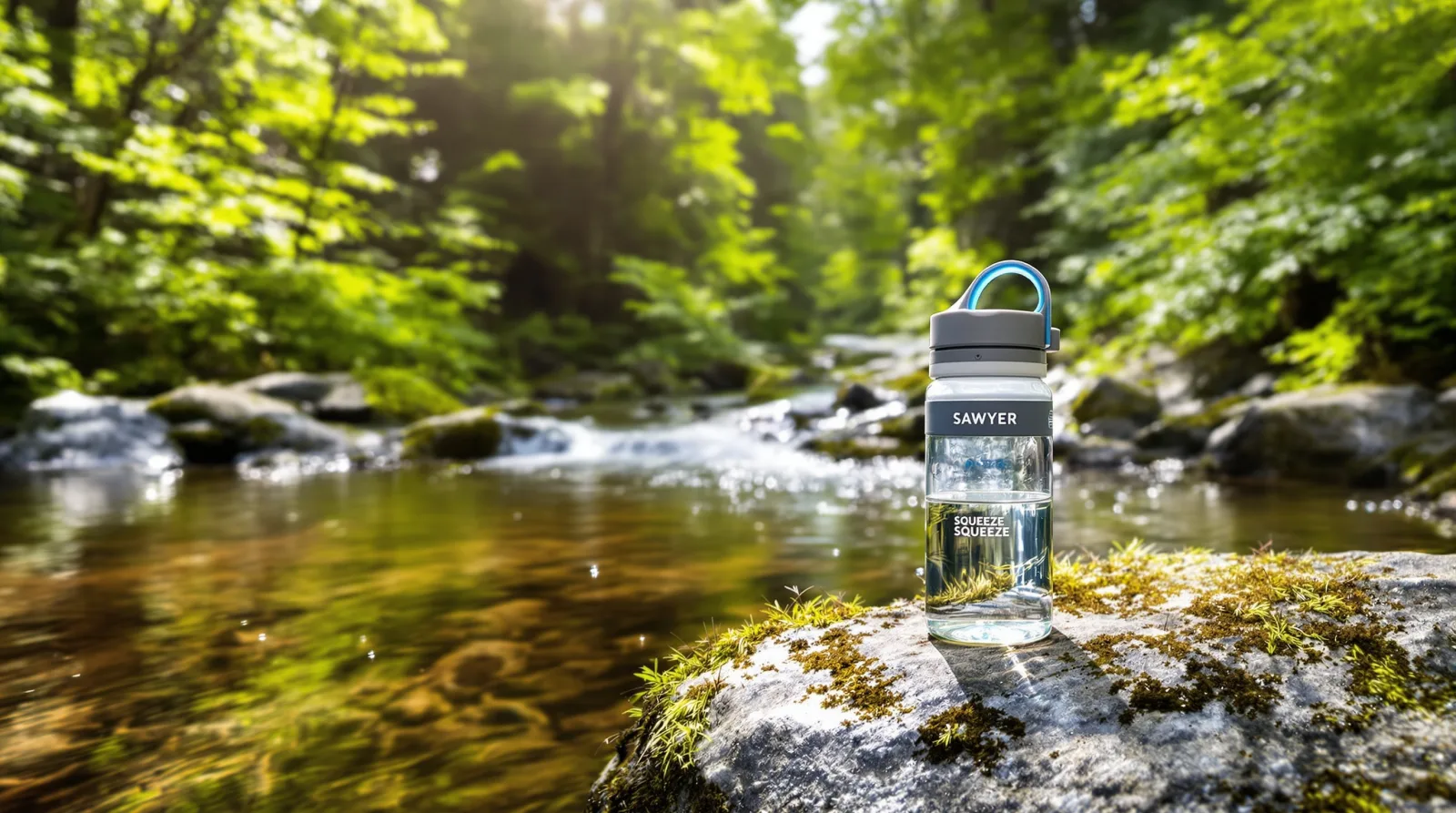
Sawyer Squeeze Water Filtration System
A 3 oz hollow-fiber filter that screws onto its own pouches or a standard bottle, filters to 0.1 micron, and keeps going for years if you backflush it. It strips out bacteria and protozoa, weighs almost nothing, and costs less than most rivals, which is why it ends up in so many packs.
Check price on AmazonQuick Comparison
| Rank | Product | Best for | Price |
|---|---|---|---|
| #1 | Sawyer Squeeze Water Filtration System | Overall | Check price |
| #2 | Katadyn BeFree 1.0L Collapsible Water Filter | Ultralight squeeze | Check price |
| #3 | LifeStraw Personal Water Filter | Budget straw | Check price |
| #4 | Platypus GravityWorks 4-Liter Filter System | Groups | Check price |
| #5 | GRAYL GeoPress Water Purifier Bottle | Bottle-style purifier | Check price |
| #6 | MSR Guardian Water Purifier Pump | The worst water | Check price |
The Reviews
This is the filter we hand to anyone asking where to start. The Squeeze uses a hollow-fiber membrane rated to 0.1 micron, removing 99.9999% of bacteria and 99.9% of protozoa like giardia and cryptosporidium. You fill the pouch, screw the filter on, and squeeze clean water into your mouth or a bottle.
It also threads onto most disposable bottles. At 3 ounces it disappears in a pack, and when flow slows you backflush it with the included syringe back to nearly full speed. It will not stop viruses, so it is a backcountry filter for clean streams rather than a travel purifier, but for most camping and hiking it is all you need.
Pros
- 0.1 micron hollow fiber removes bacteria and protozoa
- Only 3 oz and packs to nothing
- Threads onto standard bottles, not only its pouches
- Backflushes clean instead of needing new cartridges
Cons
- Does not remove viruses
- Included pouches wear out faster than the filter
The BeFree pairs a soft 1-liter flask with a 0.1 micron hollow-fiber filter in the cap, and it flows faster than almost anything its size. You scoop, screw the cap on, and drink straight through it or squeeze into a bottle at up to 2 liters per minute when fresh. The flask crushes flat when empty.
The standout feature is cleaning. No syringe, no backflushing: you unscrew the filter, swish it in water, and the EZ-Clean membrane sheds the gunk, the easiest filter here to keep running. The soft flask is less rugged than a hard bottle and the threads are proprietary, but for fast-and-light hiking it is hard to beat.
Pros
- Very fast flow up to 2 liters per minute when new
- Swish-to-clean membrane, no syringe needed
- Flask collapses flat and weighs little
- Removes bacteria and protozoa to 0.1 micron
Cons
- Does not remove viruses
- Soft flask and proprietary thread limit bottle swaps
The original LifeStraw is the cheapest way to make stream water safe, and it could not be simpler. Nothing to assemble, no batteries, no pouch. You lie at the water or dip a cup and drink straight through it.
The hollow-fiber membrane filters to 0.2 micron and removes 99.999999% of bacteria and 99.999% of protozoa plus microplastics, and one straw treats up to 4,000 liters with care. The trade-off is that a straw only works while you drink at the source; you cannot easily fill a bottle for the trail or cook with it. For a day hike, a car emergency kit, or a backup in a pack, it is cheap insurance that weighs 2 ounces.
Pros
- Lowest price on this list
- Nothing to set up, just drink through it
- Filters bacteria, protozoa, and microplastics
- Weighs about 2 oz, ideal as a backup
Cons
- Hard to fill a bottle or cook with
- Does not remove viruses or chemicals
Filtering for a tent full of people one squeezed liter at a time gets old fast. The GravityWorks lets gravity do the work. You fill the 4-liter dirty reservoir, hang it from a branch, and the hollow-fiber filter feeds a clean 4-liter bag below at about 1.75 liters a minute, no pumping.
You fill everyone's bottles and the cook pot while you set up camp. It meets EPA and NSF guidelines for removing bacteria and protozoa, and a four-second backflush is built in: lift the clean bag above the dirty one and let water run backward. At around 11.5 ounces it is heavier than a solo squeeze, but split across a group it is the most efficient way to stay hydrated.
Pros
- Gravity-fed, no pumping or squeezing
- Fills bottles for a whole group quickly
- Built-in four-second backflush to restore flow
- Separate clean and dirty bags keep things sorted
Cons
- Heavier and bulkier than a solo filter
- Does not remove viruses
The GeoPress works like a French press for water. You scoop dirty water into the outer cup, push the inner cup down through it, and in about eight seconds you have 24 ounces of purified water in the same bottle. No sucking, no squeezing, no waiting for gravity.
Unlike the hollow-fiber filters above, the GeoPress is a true purifier. It removes viruses along with bacteria and protozoa, and its activated carbon also cuts chemicals, heavy metals, and bad tastes, the pick for international travel. The cartridge lasts about 250 liters and the press takes a firm push, but for grab-and-go clean water it is the most convenient option here.
Pros
- Removes viruses, bacteria, and protozoa
- Press-and-drink, clean water in about 8 seconds
- Carbon layer cuts chemicals and improves taste
- All-in-one bottle, nothing extra to carry
Cons
- Cartridge lasts only about 250 liters
- Heavier than a squeeze filter and holds just 24 oz
This is the filter you carry when the water is genuinely bad. The Guardian is a military-grade pump that removes viruses, bacteria, protozoa, and sediment, pushing 2.5 liters a minute through a hollow-fiber core. The clever part is that it self-cleans on every stroke, diverting some water to flush the membrane, so you never backflush.
It handles silty water that would clog a lighter filter in minutes. All that costs weight and money. At well over a pound and several times the price of a squeeze filter, it is overkill for clean streams. But for global travel, disaster prep, or expeditions where the only water is muddy and might carry viruses, nothing here matches it. It treats up to 10,000 liters, a buy-once tool for drinking anywhere.
Pros
- Removes viruses on top of bacteria and protozoa
- Self-cleaning pump, no backflushing ever
- Handles silty, cloudy water without clogging
- Fast 2.5 liters per minute and rated to 10,000 liters
Cons
- Heavy and expensive next to a squeeze filter
- More pump than a clean-stream trip needs
What to Look For
Filter or Purifier? Know What Stops Viruses
Settle this first, because it decides which picks apply to you.
A filter uses a physical membrane to strain out bacteria and protozoa like giardia and cryptosporidium, the threats in most clean wilderness water.
The Sawyer, Katadyn, LifeStraw, and Platypus picks are all filters. A purifier goes further and stops viruses too, which matters where human waste contaminates the water, as in much of the developing world.
The Grayl GeoPress and MSR Guardian are purifiers.
Viruses are far smaller than a typical filter pore, so a hollow-fiber filter cannot catch them. Hiking clean backcountry, a filter is plenty; traveling internationally or near towns and livestock, you want a purifier.
Micron Rating and What the Pore Size Means
The micron number is the size of the gaps in the membrane, and smaller is more protective.
Most quality hollow-fiber filters sit at 0.1 micron, like the Sawyer Squeeze and Katadyn BeFree, while the LifeStraw filters to 0.2 micron. Both are fine, since bacteria run roughly 0.2 to 5 microns and protozoan cysts are larger still, so anything at 0.2 micron or below catches them.
Viruses can be as small as 0.02 micron, which is why no filter rated in tenths of a micron stops them and you need a purifier. Once you are at 0.1 or 0.2 micron the bacteria and protozoa are covered; the rest is flow and weight.
How You Draw Water: Squeeze, Gravity, Pump, Press, or Straw
The method shapes the whole experience.
A squeeze filter like the Sawyer or BeFree is light and quick for one or two people, but your hands do the work. A gravity system like the GravityWorks hangs from a branch and fills bags hands-free, ideal for groups but bulkier.
A pump like the Guardian moves water fast from shallow sources, at the cost of weight. A press bottle like the GeoPress turns one bottle into a one-step purifier, great for travel.
A straw like the LifeStraw is simplest and cheapest, but only works while your face is at the water. Match the method to your group size.
Flow Rate and Maintenance over a Long Trip
A filter that crawls is a filter you stop using.
Flow looks great out of the box and drops as silt clogs the membrane, so the real question is how easily you bring it back. The Katadyn BeFree just needs a swish in clean water.
The Sawyer Squeeze and Platypus use a quick backflush, Sawyer with a syringe and Platypus by reversing the bags for four seconds. The MSR Guardian self-cleans on every pump stroke.
On dirty sources let sediment settle or pour through a bandana first.
Keep up with the cleaning and a good filter lasts for years.
Freezing Kills Filters, So Plan for Cold Nights
This trap ruins more filters than anything else.
Hollow-fiber membranes are full of tiny tubes, and if the water inside freezes it expands and cracks the fibers, opening gaps too small to see but large enough to let bacteria through.
Once a used filter has frozen you cannot trust it again, and there is no way to test it in the field. If you camp where nights drop below freezing, sleep with the filter in your bag or a jacket pocket so your body heat protects it.
A brand-new dry filter is safe to freeze, but once it has touched water, cold becomes the enemy.