CampingKnow is reader-supported. When you buy through links on our site, we may earn an affiliate commission at no extra cost to you. Learn more.
You are usually choosing between two camp cooking habits: charcoal flavor with simple parts, or propane speed with cleaner packing. The products compared here carry 51,012 customer reviews between them.
That owner base matters, but the right grill still depends on where you cook. A campground picnic table, an RV storage bay, a tailgate, and a car camping bin all ask for different fuel, grate space, setup time, and cleanup. This guide sorts eight grills by those jobs, so you can match the grill to the trip instead of forcing one cooker to do everything.
Can You Use Charcoal Where You Camp?
Can You Use Charcoal Where You Camp?
Charcoal is the question many buyers ask after they pull into the campground. Check the current fire rules before you pack briquettes, because dry summer bans can include charcoal grills even when propane stoves are still allowed. Some campgrounds limit charcoal to designated fire rings or grill boxes, and many require you to dump cold ash in marked ash cans instead of trash bins or the woods. Propane is often the safer pick for dry trips and RV parks because you can shut it off fast and leave no coals behind. Charcoal still earns a spot when the campground allows it and you want that slower, hotter cook at camp.
Weber Jumbo Joe 18-Inch Charcoal Grill
240 square inches of grate space, an 18 pound body, rust-resistant aluminum dampers, and a compact 19.75 by 20.5 by 19.75 inch size make the Weber Jumbo Joe easy to pack without feeling tiny at camp. At $89.99 with a 4.8 rating from 5,600 reviews, it hits the best balance of capacity, portability, and trust.
Check price on AmazonCamp Grill Lineup at a Glance
| Rank | Product | Best for | Price |
|---|---|---|---|
| #1 | Weber Jumbo Joe 18-Inch Charcoal Grill | Overall | Check price |
| #2 | Coleman RoadTrip 285 Propane Grill | Largest | Check price |
| #3 | Gas One 14-Inch Charcoal Grill | Budget | Check price |
| #4 | Weber Smokey Joe 14-Inch Charcoal Grill | Lightest | Check price |
| #5 | Cuisinart 14-Inch Tabletop Charcoal Grill | Two people | Check price |
| #6 | Char-Broil Grill2Go X200 Portable Gas Grill | Premium gas | Check price |
| #7 | Oklahoma Joe’s Rambler Charcoal Grill | Charcoal searing | Check price |
| #8 | Char-Broil Portable 1-Burner Gas Grill | Ultra-budget gas | Check price |
Grill, Griddle, or Stove: Which One Belongs in the Car?
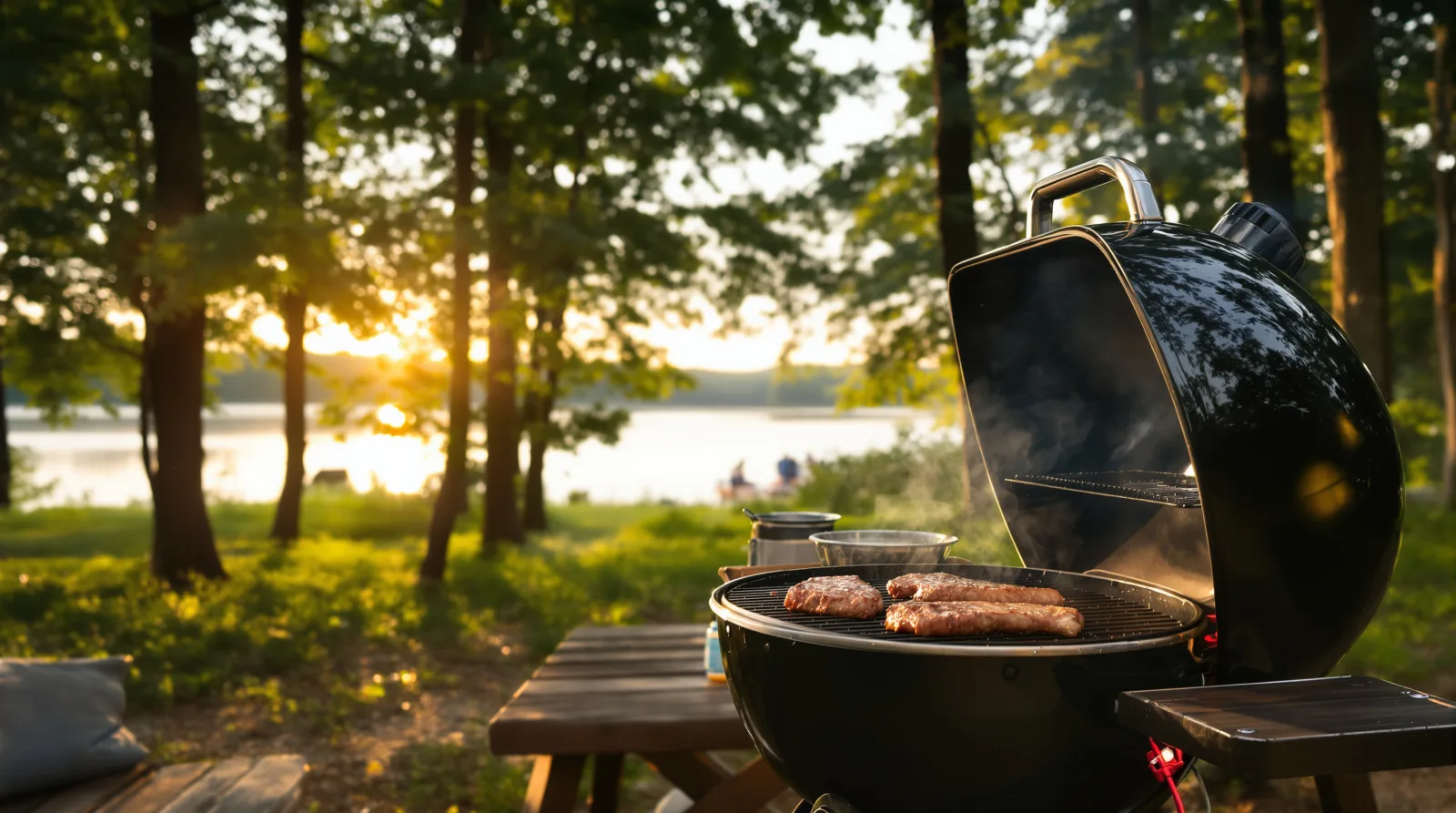
If dinner means burgers, fish fillets, vegetables, and foil packets, pack a classic grill. You get grate marks, some drip space, and enough open heat for foods that like direct flame or a little char.
Choose a flat top when breakfast drives the menu: pancakes, eggs, bacon, grilled cheese, and chopped vegetables all stay put on a smooth surface. It also handles fish without sticking pieces falling through the grate, which matters when you only brought one trout.
Pick a burner and grill setup if coffee, boiling water, or a pot of beans has to happen beside the main meal. That combo saves space when your camp box needs one cooker for coffee at sunrise and burgers or foil packets at night.
Field Notes on Each Grill
240 square inches is the number that decides this buy. You get real charcoal cooking space in a kettle that still weighs 18 pounds, with a 19.75 by 20.5 inch footprint that fits a truck bed or beach run.
Porcelain enameled bowl and lid, aluminum dampers, and an ash catcher keep camp cooking familiar. Big families may want more grate and a gas option where charcoal is restricted.
Pros
- 240 square inch cooking area in a compact charcoal kettle
- 18 pound weight is easy to load for tailgates and beach days
- Porcelain enameled bowl and lid with rust resistant aluminum dampers
- Ash catcher helps with camp cleanup
Cons
- Uses charcoal, so ash and coal packing are part of the plan
- Single grate gives you less cooking flexibility than a multi burner gas grill
Rolling into a group picnic with burgers, corn, and a small table is where this cart grill fits. Quick fold legs and wheels save you from hunting for a flat rock or packing a separate stand.
Three adjustable burners give up to 20,000 BTUs across 285 square inches, with push button ignition and an integrated thermometer. It runs on a 16.4 ounce propane cylinder.
Apartment balconies and car camping suit it. Backpacking does not.
Pros
- 285 square inches and three adjustable burners work for group meals
- Up to 20,000 BTUs with push button ignition
- Quick fold legs and wheels reduce table space needs
- Integrated thermometer helps you watch cooking temperature
Cons
- Runs on a 16.4 ounce propane cylinder sold separately
- Too much grill for carry in campsites
A 14 inch charcoal grate means you cook tight, and larger meals can turn into batches. For cheap camp burgers, vegetables, or a small backyard burn, the 150 square inch surface and 4 pound body are easy to carry and store.
The 3 point locking lid helps during transport and traps heat, while dual vents feed the coals. Assembly takes some patience around the legs. Large groups should bring more grill.
Pros
- 150 square inch surface in a 4 pound body
- 3 point locking lid helps carry the grill and trap heat
- Dual ventilation system feeds airflow to the coals
- Small footprint stores easily between trips
Cons
- 14 inch grate can force batch cooking for bigger meals
- Leg assembly can take patience
Compared with the pick above it, the Smokey Joe asks you to cook smaller and stay with charcoal. Its grate fits 6 Weber-press burgers.
You get an 8.4-pound grill with a Tuck-N-Carry lid lock, ash catcher, and porcelain-enamel finish.
We like it for two people, tailgates, and campsites where coal cleanup is allowed. Gas-only sites should pass.
Pros
- Lightest pick here at 8.4 pounds
- Tuck-N-Carry lid lock doubles as a lid holder
- Ash catcher helps protect tables and cleanup
- Porcelain-enamel finish resists scratches and rust
Cons
- Charcoal fuel needs allowed ash disposal
- Small grill suits two people better than a group
Reviewers keep calling this grill small, light, and easy to carry to a campsite. They also report enough room for 4 medium burgers or 10 hot dogs, with top and bottom grates that help control heat.
The spec sheet backs that up: 196 square inches, dual vents, three lid locks, and a 14 by 14 by 15 inch body. Big group cooks should bring more grill.
Pros
- 196 square inches of cooking surface
- Dual vents help manage charcoal heat
- Three lid locks secure the lid in transport
- Reviewers say assembly and campsite carry are easy
Cons
- Small size is limiting for group meals
Charcoal rules, ash cans, and slow lighting get old on a car-camp weekend or tailgate. Gas and push-button ignition answer that.
At 24 pounds, it belongs near the vehicle, not deep in a hike. Side handles and stainless steel latches help the move.
Its 200-square-inch grate cooks up to 8 burgers, and the cast-aluminum firebox gives it a tougher feel. Tight tabletops may fit a smaller charcoal grill.
Pros
- Gas fuel and push-button ignition keep startup simple
- 200 square inches cooks up to 8 burgers
- Cast-aluminum firebox and lid with high-impact frame
- Stainless steel latches and side handles help transport
Cons
- 24-pound weight is better for car camping than hike-in sites
- Some reviewers mention overpowering heat, so lower-heat foods may take practice
Camp cooks who want charcoal sear at a table buy the Rambler for flavor, but they may be wrong to think it packs light. At 48.5 pounds, it rides better in a camper or truck than in your hands.
The 218 square inch surface fits 6 burgers, 6 steaks, or 12 bratwursts, with cast iron grates and a height adjustable charcoal tray for heat control. Campgrounds with charcoal bans make it the wrong pick.
Pros
- 218 square inches fits up to 6 burgers, 6 steaks, or 12 bratwursts
- Height adjustable charcoal tray and adjustable air vent help you manage heat
- Cast iron grates and heavy duty steel construction suit charcoal searing
- Removable ash pan cuts down the cleanup mess
Cons
- 48.5 pounds is heavy for hand carry
- Charcoal fuel can be ruled out by some campground fire rules
Steel construction, a high temperature finish, and porcelain coated grates keep this small camping gas grill simple to wipe down. The grate coating helps with rust resistance after wet picnic tables.
In cold weather, the single propane burner gives you 11000 BTU without charcoal ash. Packed in a small RV, the 11 pound body saves space.
Heavy pans should stay home. Reviewers call the metal light gauge.
Pros
- 11 pound body and compact size fit small RVs, beach trips, and basic camp boxes
- Liquid propane cooking avoids charcoal ash and starter mess
- 190 square inches gives you enough grate space for simple camp meals
- Porcelain coated grates are made for rust resistance and easier cleaning
Cons
- Reviewers report lighter gauge metal than older versions
- 90 day warranty on burner, grate, lid, and other parts is short
Packing the Grill Without Smoking Up Your Trunk
Packing the Grill Without Smoking Up Your Trunk
Before you buy a camping grill, picture the ride home. Let charcoal, pellets, or burned wood cool fully before you touch the firebox, and shut propane off at the tank. Empty ash only in a campground ash can or another approved spot. No exceptions.
Brush the grate, then bag dirty grates or greasy tools if the sink is miles away. Lock or wrap drip trays so they do not dump fat in your cargo area. Keep charcoal bags and propane cylinders away from food bins, especially coolers with loose ice or produce.
How to Pick a Grill That Fits Your Trip
Fuel Rules at Your Campsite
Check campground rules before you pick flavor. Burn bans, RV park balcony limits, and ash disposal can rule out charcoal. Coals fit sites that allow them and give you a safe dump spot; propane is simpler where coals cause trouble.
Packed Size and Grease Control
Measure the grill against your trunk or bin, then check lid latches, drip trays, loose ash paths, and whether it must ride upright. Small tabletop gas grills and compact charcoal kettles store cleaner than larger rolling models.
Cooking Surface for Your Group
Match grate size to meals you actually cook. Burgers for a family need more surface than steaks for two; breakfast often needs a griddle, and side dishes can crowd a grill fast.
Heat Style: Searing, Slow Cooking, or Quick Weeknight Food
Charcoal gives strong searing heat, propane gives easier control, and a lid helps covered cooking. A thick steak, foil packet, hot dog lunch, and cast iron breakfast all ask for different heat behavior.
Setup Height and Table Safety
Know where the grill will sit. Tabletop models need a stable, heat safe surface; folding legs and rolling stands solve that at bulkier packed sizes. Some campsites need a grill table or picnic table plan before you buy.
Cleanup Before the Drive Home
Sunday packups punish messy grills. Check ash cooling time, grease cups, grate access, and whether you have water nearby. Loose ash and old grease smell up a car fast, especially when the grill tips in transit.