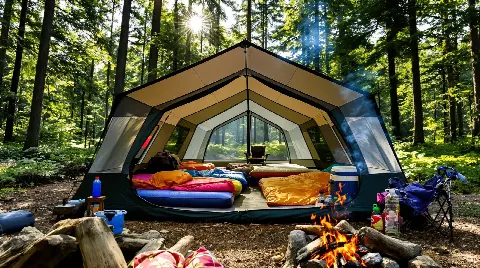
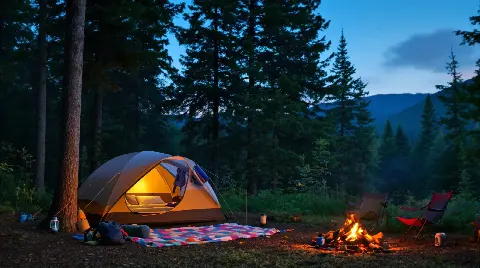
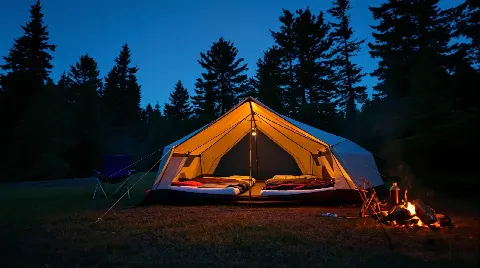
You come back to camp with soaked boots, a damp jacket, and a pack you do not want pressed against your sleeping bag. A tent vestibule is the covered space outside the inner sleeping area, usually formed by the rainfly.
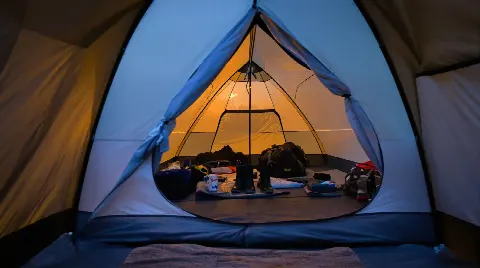
Think of the vestibule as a small porch for gear that can live outside the mesh body but still stay under cover. Boots, packs, camp sandals, wet jackets, and a dog towel all have a place to sit without crowding your pad. Mud stays outside. You also get a buffer at the door, so rain has a harder time blowing straight into the sleeping area while you unzip, crouch, and climb in.
A vestibule can also help with entryway airflow, especially on rainy nights when you want the fly on but still need some venting near the door. You do not need one for every trip, since fair weather car camping with a roomy tent gives you more storage options. For backpacking, shoulder season camping, or small tents shared by two people, that covered entry space can make camp feel cleaner and easier to manage.
Why the Word Vestibule Shows Up in Buildings and Anatomy Too
If “vestibule” sends you from tent pages to architecture or anatomy pages, you are seeing the same root word used in different places. A vestibule means an entry space, small chamber, or area that sits before a larger space. In camping, that usually means the covered space outside the tent’s sleeping area, under the rainfly. Same word, different room.
In a building, a vestibule is the small area between outside and inside, like the space just inside a front door before you reach the lobby, hallway, or main room. It can slow wind, rain, cold air, and foot traffic before they reach the interior. That building meaning lines up pretty closely with the tent meaning, since both describe a transition space at the entrance.
Anatomy uses the word too, but those results point somewhere else. The ear vestibule is part of the inner ear, and the vulvar vestibule is a named body space. Those definitions have no camping connection, so if you are trying to learn what a vestibule does on a tent, you are in the right place.
Tents with Vestibule Space
If you want covered storage and easier entry, these two-door tents with vestibules match the setup discussed in this guide.
| Product | Why it fits | Price |
|---|---|---|
 MSR Hubba Hubba NX 2-Person Lightweight Backpacking Tent
Lightweight couple pick Read our review |
Choose this when you want a light backpacking tent with two vestibules for shared gear storage and two doors for easier access. | Check price |
 Marmot Crane Creek 2P
Roomy entry option Read our review |
This suits trips where you want two large doors and dual vestibules, plus enough interior space for two people and their packs. | Check price |
 Naturehike Mongar 2P
Shared-use shelter Read our review |
Pick this for two-person camping when you want two doors, two windows, and a roomy layout that supports shared gear use. | Check price |
 ALPS Mountaineering Lynx 2-Person Tent
Durable vestibule tent Read our review |
This fits campers who want a full coverage rainfly, two vestibules, and a tougher floor for trips where weather protection matters. | Check price |
How Big Should Tent Vestibule Space Be for Your Gear?
The vestibule on a tent should match the gear you actually keep out of the sleeping area. A small vestibule can handle muddy boots, a wet rain jacket, and maybe a compact pack if you stack things carefully. It works as a drip zone. You still bring bulky items inside or accept some shuffling every time you get in and out.
A roomier vestibule changes camp life because your pack can stay covered without pressing against the tent body or blocking the door. You can set boots where they drain, keep a stove bag or water bottle handy, and unzip the inner door without pulling wet gear onto your quilt. In steady rain, that extra covered space also gives you a place to pause before you crawl into the dry side.
For a 2 person tent, picture two packs, two pairs of boots, and one camper needing to pee at night. With one front vestibule, all that gear often sits in the same path, so the outside sleeper climbs over boots or asks the inside sleeper to move. Two doors with two smaller vestibules can work better than one bigger front porch because each person gets a side: one pack, one pair of boots, one exit. Simple works.
Size also depends on how you pack. A frameless pack or soft duffel tucks into odd corners better than a tall internal frame pack, and big winter boots eat space fast. If you camp with a dog, camera gear, or wet layers, you will use every bit of covered space you have.
For two campers, separate access often feels bigger than a single shared storage bay because nobody has to crawl through the other person’s mess at midnight.
How to Judge a Tent Vestibule Before You Buy
Covered storage area
A vestibule is the covered space outside the tent body but under the rainfly. Check the listed vestibule area in square feet, then picture what must leave the sleeping floor: boots, one pack, and a wet rain shell. A small camp chair only belongs there if the vestibule is clearly large enough and does not block the door.
Entry style
Front entry doors put the vestibule at the head or foot of the tent, so you crawl past stored gear to get in. On smaller backpacking tents, that can feel tight fast. Side entry doors usually work better on a 2 person tent because each sleeper can reach a door and gear without climbing over the other person.
Rain and wind coverage
Do not judge a vestibule by listed area alone. Look at how far the fly reaches past the door and how the zipper opens in rain. Some doors shed water away from the opening, while others drip straight onto the threshold or inner door. That gets old quickly when boots and a sleeping bag sit nearby.
Floorless space and mats
Most tent vestibules have no sewn in floor, so expect dirt, splash, and runoff. Tent vestibule mats, inside outside mats, and trimmed foam pieces can give boots and packs a cleaner landing spot. Pick a floor mat that drains or dries fast. A plastic sheet that traps water against the tent fabric can leave you with a puddle at the door.
Ventilation and condensation
Closing the vestibule cuts wind at the doorway, but it can also trap moisture from breath, wet gear, and damp ground. Check for roof or fly vents, and use partial door openings when weather allows. Keep wet shells and packs from pressing against the inner tent wall. Contact points are where damp fabric usually shows up first.
Pitch complexity and campsite footprint
Bigger vestibules often need extra stake points and more guyline space, so the tent footprint grows beyond the sleeping floor dimensions. Check the pitch diagram before you book or choose a site. Rocky tent pads, narrow forest sites, and crowded campgrounds can make a large vestibule hard to stake cleanly, even when the tent body fits.
Can You Add a Vestibule to a Tent You Already Own?
You can add covered entry space to many tents, but you usually cannot turn a plain tent into the exact version that came with a built in vestibule. A built in vestibule is part of the tent design: the rainfly extends past the door, the poles hold the shape, and the stake points pull the fabric at the right angle. That setup gives you a clean overlap at the door and a tight pitch in bad weather. It fits because the tent was cut for it.
Some brands sell tent specific vestibule add-ons, and those are the closest thing to a true upgrade. For one to work, your tent needs the right pole layout, matching clips or sleeves, stake geometry that lines up with the floor and fly, and enough fly overlap so rain does not run into the door. A vestibule made for a different tent can look close online and still fail once you try to tension it. Check the exact tent model and year before you buy.
The tarp does not become part of the tent body, so it will not seal like a factory vestibule. Still, it can give you the covered entry space you want, and you can adjust the height and angle to match the weather.
DIY setups land in the same camp as tarps. You can use a lightweight tarp, extra cord, trekking poles, nearby trees, or spare tent poles to build a small awning over the entrance. Keep fabric off the tent fly when you can, leave airflow around the door, and stake the shelter so runoff moves away from the floor. Simple works.