CampingKnow is reader-supported. When you buy through links on our site, we may earn an affiliate commission at no extra cost to you. Learn more.
You order the plush mattress, clear the cargo floor, and find the edge jammed against the wheel wells or sagging into the back seat gap. Now your hips slide downhill, the hatch will not close cleanly, and the pump cord reaches only if you park just right. The average customer rating across the 101 listings screened is 4.3 out of 5.
A 4.3 average tells you most of these mattresses feel decent once they are inflated, but the winner comes down to smaller fit details. You want the right shape for an SUV cargo area, enough support across folded seats, a pump setup that matches your power source, and firmness you can adjust after the first hour. Fit beats hype here. In this guide, we focus on mattresses that make sense for SUVs, back seats, and couples who need room to sleep without wrestling the gear all night.
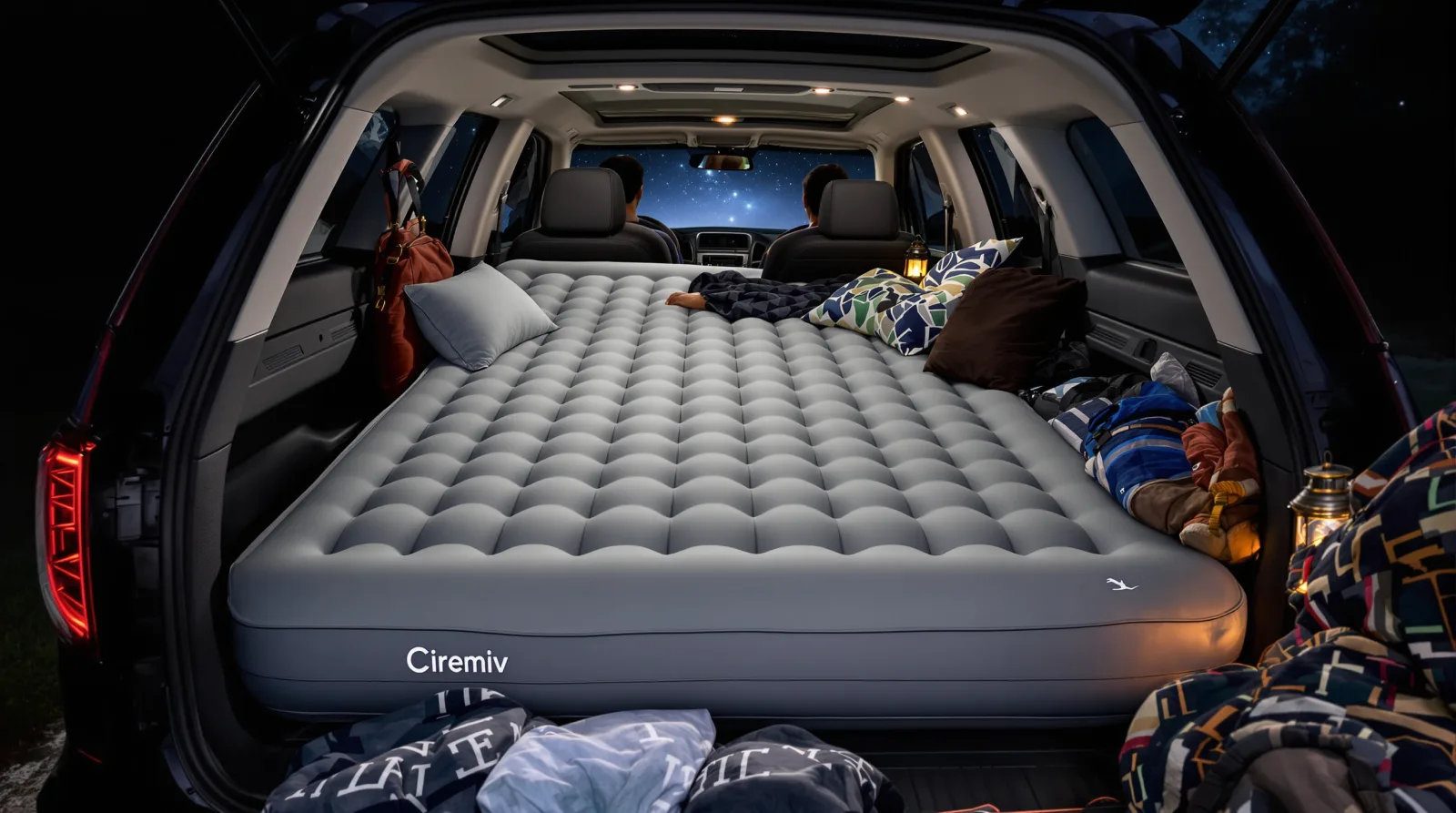
Ciremiv SUV Air Mattress with Pump
Thick flocking covers the top, bottom and sides, and the kit includes a pump, pillow, carry bag, repair patch, eye mask and ear plugs. Owners report easy setup, quick deflation and good fit in SUVs like a Lexus RX350, 4Runner and Honda. At $65.99 with a 4.5-star rating, it’s the practical overall pick.
Check price on AmazonAt a Glance: Which Mattress Fits Your Setup
| Rank | Product | Best for | Price |
|---|---|---|---|
| #1 | Ciremiv SUV Air Mattress with Pump | Overall | Check price |
| #2 | D-Hive SUV Air Mattress | Premium | Check price |
| #3 | Umbrauto SUV Air Mattress | Trunk camping | Check price |
| #4 | Generic Car Air Mattress with Pump | Budget | Check price |
| #5 | KMZ SUV Air Mattress | Value with pillows | Check price |
| #6 | Double Camping Sleeping Pad with Pillow | Two people | Check price |
| #7 | OGERY Self-Inflating Sleeping Pad | Self-inflating comfort | Check price |
| #8 | Memory Foam Camping Mattress Pad | Foam comfort | Check price |
Will It Fit a Subaru, RAV4, Tesla, or Pickup Back Seat?
No single car camping mattress fits every Subaru Outback, Forester, Crosstrek, Toyota RAV4, Tesla hatch area, or pickup back seat. Bring a tape. Measure the narrowest width between wheel wells or door panels, the usable length from the hatch or seatback to the front seats, and the height you have before your head hits glass, trim, or a folded seat edge. Then compare those numbers to the mattress size after it is inflated, since soft sides can still rub on plastic panels.
- Subaru Outback, Forester, and Crosstrek: fold the rear seats, then check both cargo length and the step or slope where the seatbacks meet the cargo floor.
- Toyota RAV4: measure with the front seats set where you actually drive, since pushed back seats can shorten the sleep space fast.
- Tesla hatch areas: check the hatch opening, the floor length, and the glass angle near your feet or head before you count on a full rectangle.
- Pickup back seats: measure across the rear bench area, then check the center hump and footwells before choosing an SUV cargo mattress.
A folded rear seat that slopes toward the hatch can make a flat mattress feel like a slide. A center hump can lift the middle of the pad, and open rear footwells leave unsupported corners unless you use a filler platform, storage bins, or a mattress designed with drop sections. Test with cardboard or a camp pad before the trip if the floor looks uneven.
A dedicated back seat air bed makes more sense when you sleep across the second row, carry gear in the cargo area, or use a truck cab instead of a truck bed. Those beds usually rely on footwell fillers and a bench shape, while an SUV cargo mattress works best on a folded, measured, supported load floor.
Mattress Notes From the Tailgate
Two adults is the number that decides this one. Reviewers used the Ciremiv in a 2013 Lexus RX350, an 18-foot 4Runner, and a Honda, with one saying it slept two adults and another using it for two nights with a child.
Living with it sounds simple: plug in the included pump, inflate, sleep, then roll it back into the carry bag. One reviewer said inflation took about 2 minutes. The flocked material covers the top, bottom, and sides, and the kit includes a pillow, repair patch, eye mask, ear plugs, and small storage bag. You should pass if you need published dimensions before buying, since the listing leans on SUV fit examples rather than a clear size table.
Pros
- Fits several real SUVs in reviewer reports, including RX350, 4Runner, and Honda models
- Included pump, carry bag, pillow, repair patch, eye mask, and ear plugs
- Flocked surface covers the top, bottom, and sides
- Reviewers say it inflates, deflates, and stores easily
Cons
- No clear mattress dimensions listed in the provided specs
- Vehicle fit still depends on your cargo area shape
Road trips where you inflate at night and pack up in the morning are where the D-Hive makes sense. One reviewer used it on trips to the Grand Canyon and Yosemite, slept on it overnight, then deflated it each morning without noticing air leaks.
The build is heavier than many SUV air beds, with 300-denier Oxford fabric and a 3-layer one-way inflation valve. D-Hive says that valve leaks 30% less air than traditional air mattresses. The included electric pump fills it in about 2 minutes, and quick deflation helps when you need to clear the cargo area.
Two joined air chambers give you a solo setup or a full-width bed. That helps if one person wants space and gear on the other side. You still have to tune the firmness like any air mattress, and one reviewer called that out directly.
Pros
- 300-denier Oxford fabric targets puncture resistance from thorns, claws, and sharp objects
- Two joined air chambers let you inflate one side or both
- Included electric pump inflates it in about 2 minutes
- Reviewers report good air retention on repeated trips
Cons
- You need to adjust air pressure to find the right firmness
- Higher cost than the other SUV air beds in this set
The measurement check comes first: Umbrauto lists 6.07 ft when fully flat, or 5.4 ft with the head support raised. It is meant for compact to full-size SUVs with 5.4 to 6.07 ft from the back of the front seats to the trunk door, so a short cargo area can end the conversation fast.
For trunk camping, it earns its spot because the fit guidance is specific and the setup matches quick overnight stops. Reviewers used it in a 2015 Honda Pilot SE and a 2015 Ford Explorer, with one calling it good for one person on fast camping and bike trips. The flocked top feels soft, the PVC body adds support, and the 210T grid fabric bottom targets punctures and leaks. The kit includes a pump, pillows, nozzle, repair patch, and carry bag, but outside the car you need the right power access for the pump.
Pros
- Clear fit range helps you measure before buying
- Works well for trunk camping in reviewer vehicles like a 2015 Honda Pilot SE and 2015 Ford Explorer
- Includes pump, pillows, nozzle, repair patch, and carry bag
- Flocked top, PVC body, and 210T grid fabric bottom
Cons
- Pump use away from the vehicle can be difficult without the right car power adapter
- Best reviewer use case is one person, not a roomy two-person setup
Compared with the KMZ SUV Air Mattress, this budget bed gives up four separate air chambers, a repair patch, and the two-pillow setup. You get a simpler back-seat mattress with a car-powered pump, carry bag, one pillow, and a child anti-drop section meant to block the front-row gap for kids or pets.
The listed build is thick flocking over PVC with waterproof, easy-clean claims and a stated 600-pound capacity. Reviewers who used it in a Jeep Compass and across a back seat say it set up easily, fit tightly, inflated fast, and held air overnight.
Fit still comes first. A rectangular back-seat air bed does not give you the same cargo-area tuning as a chambered SUV mattress, so measure your seat width, door opening, and footwell gap before you count on it for two adults.
Pros
- Includes a car-powered pump, carry bag, and pillow.
- Listed 600-pound capacity suits shared back-seat use.
- Child anti-drop design helps cover the front-row gap.
- Reviewers mention fast inflation and overnight air hold.
Cons
- No listed separate air chambers for partial inflation.
- Rectangular back-seat fit can miss SUV cargo contours.
Reviewers keep coming back to fit and inflation control. One used it in a Nissan Pathfinder, another got it into a Nissan Xterra, and an Ascent owner slept on it for about two weeks total over the summer. They call out the ability to inflate one side or both sides, and the car lighter pump gets mentioned as easy to use.
The specs back up that feedback: four separate air chambers let you fill the whole mat or part of it for solo use, and the attached pillow area inflates separately according to a reviewer. KMZ includes an electric pump, two inflatable pillows, a carry bag, and a repair patch, with double-sided flocking and PVC listed as more than 50 percent thicker than traditional mattresses. Measure your cargo area, since the listing here gives no length and width.
Pros
- Four separate air chambers allow full or partial inflation.
- Includes two inflatable pillows, pump, carry bag, and repair patch.
- Double-sided flocked surface feels softer than bare PVC.
- Reviewer fit notes include Pathfinder, Xterra, and Ascent use.
Cons
- The provided listing does not give length and width.
- One reviewer noticed it needed attention when temperatures dipped.
Picture a shared tent floor at a drive-in campsite, a beach night, or a flat platform where two people want one pad instead of two skinny singles. This Pretyw pad is the obvious grab there because it carries small, uses its own foot pump, and does not need the car outlet that SUV air beds use.
You get a 78 by 54 inch sleeping surface and 4 inches of inflated support, with a built-in pillow along the head end. Reviewers describe it as spacious for two, quick to pump by foot, and comfortable on hard or uneven ground.
The listing says the foot pump fills it in 1 to 3 minutes, and the deflation valves dump air in 1 second. Its 40D nylon and multi-layer TPU build suit tent floors better than back-seat gaps or cargo wells, so car sleepers with uneven vehicle interiors need a shaped mattress instead.
Pros
- 78 by 54 inch size gives two people one shared pad.
- 4 inches of inflated support helps on hard ground.
- Built-in foot pump means no separate pump or mouth inflation.
- Packs with its storage bag for tent, beach, or car trips.
Cons
- A 54 inch shared width can feel close for two sleepers.
- Rectangular shape is not built for back-seat gaps or cargo wells.
You buy the OGERY because you want real mattress feel without filling the cargo area with a tall air bed. You may be wrong if you think self-inflating means no work at all, since the valve lets the foam expand, then the built-in foot pump lets you firm it up. The 77 x 27 x 3 inch size fits best on a flat platform, cot, or tent floor where a single sleeper needs shoulder and hip support.
Its hybrid foam-and-air build cuts the bounce that makes basic air pads feel twitchy. Reviewers call out quick inflation, easy firmness changes, and comfort over multi-night use, including one larger camper at 6 feet 1 inch and 275 pounds. Skip it for two people or a shaped SUV cargo bed, because this is a straight single pad, not a vehicle-fitted mattress.
Pros
- 3 inch hybrid foam and air support feels steadier than a basic air pad
- Built-in foot pump lets you adjust firmness without mouth inflation or a separate pump
- 77 x 27 inch footprint works well on flat platforms, cots, and tent floors
- Reviewers report easy roll-up and compact storage in the included tote
Cons
- Single-width shape does not cover a shared cargo area
- Self-inflation still needs foot-pump adjustment for final firmness
The HOMBYS pad uses 1 inch of high-density memory foam over 2 inches of soft support foam, with a velvet cover over a waterproof TPU-coated layer. That gives you a medium-firm pad with no valve, pump, or air bounce.
On wet ground, dew-covered floors, or inside a damp SUV, the removable cover protects the foam and can be washed. In cold weather, you still have 3 inches of foam between you and the floor, though no R-value is listed.
Packed size is the catch. Reviewers like it on a cot, couch, car bed, or guest floor, but they also say it is bulky and takes up storage space. It suits car camping better than any trip where you carry gear far from the parking spot.
Pros
- 2-layer foam build gives you 3 inches of support without air setup
- Waterproof TPU-coated removable cover helps with rain, dew, and wet floors
- Works in a car, on a cot, on a couch, or as a guest floor mattress
- Washable cover helps after camp use
Cons
- Bulky to store, according to multiple reviewers
- At 4.29 kg, it is aimed at car camping rather than carry-in trips
One Big Bed or Two Pads for Couples?
For couples, one big mattress feels closest to home, but it only works if you both like the same bed feel. A double camping pad gives shared shoulder room and no center gap, so cuddly sleepers usually prefer it over two singles. Start with sleep style. If one of you tosses around or climbs out early, the whole pad can bounce, and lighter sleepers may roll toward the heavier person on softer models.
SUV air mattresses are best for couples sleeping inside the vehicle, especially in wagons and crossovers where wheel wells and seat backs shape the space. They can turn the cargo area into one flat bed, but many feel closer to an airbed than a camp pad, so firmness changes a lot with air pressure and temperature. If one partner wants a firm surface and the other wants a softer one, that single chamber can start a small camp argument before the lantern is off.
Two separate pads suit couples who care more about sleep quality than one-piece comfort. Each person gets their own firmness, height, and fabric feel, which helps if one of you sleeps on a plush self-inflating pad while the other likes a firmer foam or air pad from the lineup. The gap is the catch: straps, fitted sheets, or a wide two-person bag can tame it, but narrow pads still separate as you shift. For restless sleepers, that small crack often matters less than having independent support.
How to Choose a Bed for Your Vehicle
Cargo Floor Shape and Wheel Wells
SUV mattresses with side wings fill the spaces beside the folded seats, so they can fit crossovers that waste room with wheel-well cutouts. Rectangular foam pads only fit the narrowest rectangle.
Measure the narrowest point between wheel wells, the usable length with seats folded, and any height drop behind the front seats. Miss one number and the bed can buckle, hang over a gap, or block the hatch.
Air, Self Inflating, or Foam
Air mattresses pack smaller and let you change firmness with a few breaths or pump bursts. Foam feels steadier under hips and elbows, and it has no leak risk in the middle of the night.
Self inflating pads split the gap for campers who want cushion without blowing up a full car bed. Check packed size and thickness, since comfort claims do not fix a pad that bottoms out on seat hinges.
Sleeping Alone, as a Couple, or with a Dog
A double pad sounds right for two people, but car cargo areas rarely match a bedroom queen shape. Wheel wells, seat backs, and trim panels steal width exactly where shoulders or a dog want space.
One shared air chamber can bounce when your partner rolls over. In some vehicles, two separate pads sleep better because each person controls firmness, and a dog can land on one side without rocking the whole bed.
Pump Power and Campsite Setup
Included pumps save time, but check the power source before you count on them. A car outlet pump works well near the tailgate, while a battery pump or manual top off helps when the vehicle is parked away from the tent pad.
Inflate the mattress at home before the trip and time how the valves behave. Pickup today or a nearby-store buy still needs a fit check in your actual cargo area.
Packed Size and Where It Rides During the Day
Think about where the mattress rides after breakfast, not only where it sleeps at night. A foam or tri fold pad can eat cargo space during a trailhead drive or grocery run.
Inflatable sets often pack into a bag that may slide under a seat or behind a cooler. If the packed bed has no daytime home, you end up unloading gear every time someone needs the back row or hatch.
Cold Weather and Ground Contact
A vehicle floor still gets cold, especially where metal, glass, and open air sit below the cargo area. Air mattresses can feel chilly because your body warms the air pocket slowly.
Use a blanket, closed cell pad, or warmer sleep system under you when nights drop. Skip that layer and a thick air bed can still pull heat away from your hips and shoulders.
Leaks, Soft Spots, and First Night Checks
Most air mattress gripes start with the same bad scene: you roll into camp late, blow up the bed, and wake up on the floor. Do the boring check at home, where light, water, and patience are easier to find. Ten quiet minutes in the garage can save a cold night beside the car.
- Inflate it before the trip. Fill the mattress at home and listen near the seams, valve, and sleeping surface.
- Put weight on it. Leave a couple of full duffels, storage bins, or your own body weight on the mattress for a while, then check for soft spots.
- Learn the valve. Open, close, and deflate it once before camp. Some valves need a firm push or a cap seated squarely.
- Pack the patch kit. If the mattress comes with one, keep it with the pump or camp repair bag, not loose in a kitchen tote.
- Bring backup comfort on longer trips. A foam topper or thick blanket gives you a usable sleep surface if air loss shows up far from home.