CampingKnow is reader-supported. When you buy through links on our site, we may earn an affiliate commission at no extra cost to you. Learn more.
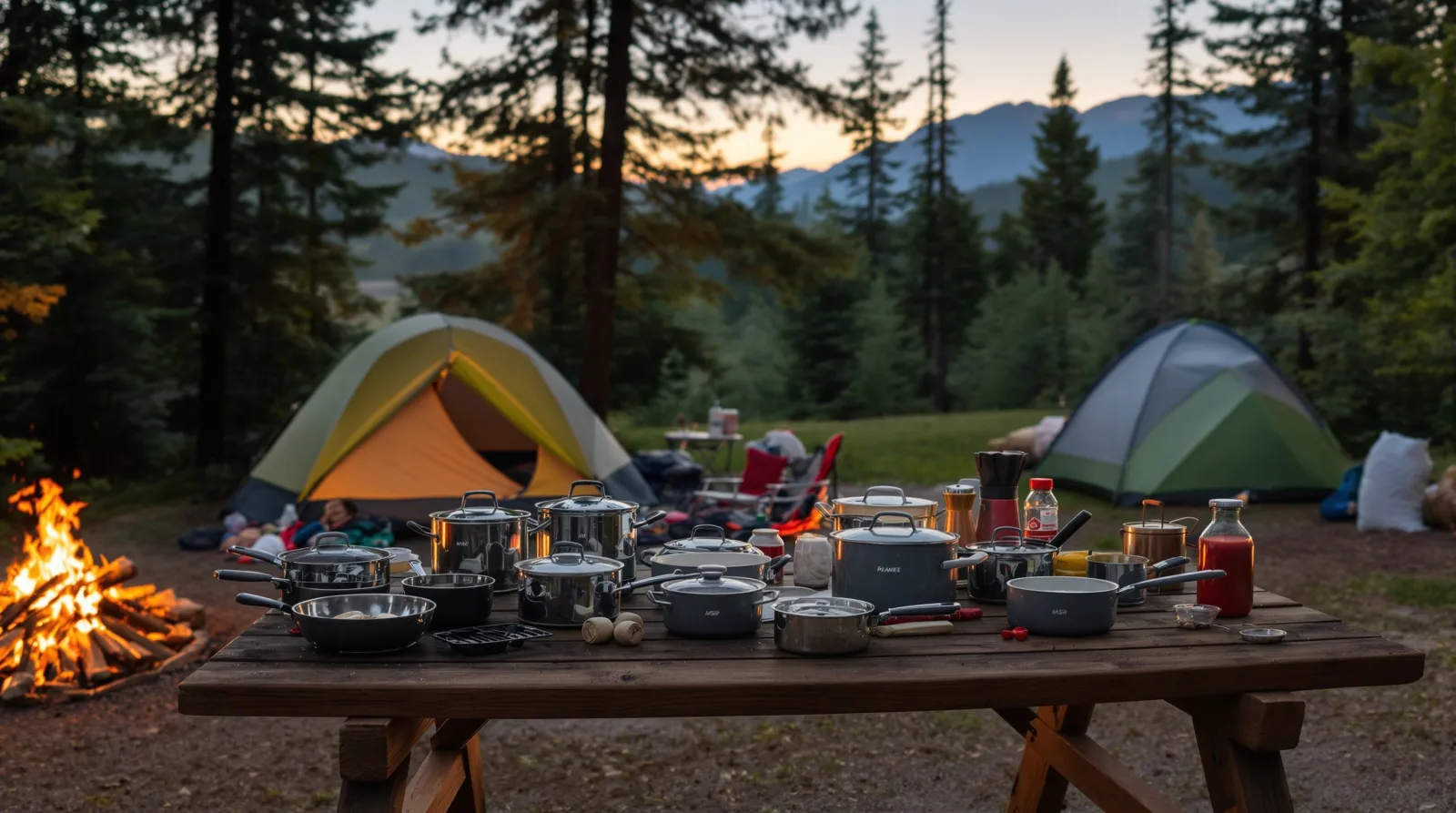
Camp food tastes better than it has any right to, right up until you try to cook it in a warped pan with a handle that folds at the wrong moment. The cookware is the part of the kitchen people skimp on, and it's the part you notice every single meal. A set that nests cleanly, heats evenly, and survives a few knocks turns dinner from a chore into the best part of the evening.
There is no one set that fits every trip, though. A family parked next to the car can carry a heavy stainless kitchen and never feel it. A pair counting grams on a long hike needs something that packs to nothing and boils water fast. We cooked real meals on each of the sets below, from morning eggs to one-pot pasta, and sorted them by who they actually suit.
Brands like GSI, Stanley, MSR, and Sea to Summit show up more than once because they have earned it. Below you'll find a complete car-camping kitchen, a backpacking duo set, a collapsible kit that flattens into a pack, and a solo pot light enough to forget. Pick by your group size and how you travel, and the rest of the choice gets easy.
GSI Outdoors Pinnacle Camper
A complete two to four person kitchen in one nesting bundle: two pots, a real frypan, plates, bowls, and insulated mugs that all pack inside the stuff sack, which doubles as a wash basin. It covers nearly every camp meal without overloading the trunk.
Check price on AmazonQuick Comparison
| Rank | Product | Best for | Price |
|---|---|---|---|
| #1 | GSI Outdoors Pinnacle Camper | Overall | Check price |
| #2 | Stanley Adventure Base Camp Cook Set | Car-camping families | Check price |
| #3 | GSI Outdoors Pinnacle Dualist | Backpacking pairs | Check price |
| #4 | Sea to Summit X-Pot 5-Piece Set | Collapsible set | Check price |
| #5 | MSR Ceramic Solo Pot | Ultralight solo | Check price |
| #6 | Stanley Adventure 11-Piece Cook Set | Budget for small groups | Check price |
The Reviews
This is the set we reach for when we want one box to handle a whole camp. It packs a 2-liter and a 3-liter pot, a proper non-stick frypan, four plates, four bowls, and four insulated mugs, and the whole lot nests into a stuff sack that becomes a wash basin at cleanup. The folding handle locks onto any piece, so you are never juggling a hot pot with a bandana.
The non-stick coating means eggs slide off instead of welding themselves on, which matters more at a campsite than it does at home. It is built for two to four people, so a solo hiker will find it overkill, but for a couple or a small family it covers nearly every meal you'd want to cook outdoors.
Pros
- Complete kitchen for 2 to 4 in one nesting bundle
- Non-stick pots and pan clean up fast
- Stuff sack doubles as a wash basin
- Folding handle works on every pot and pan
Cons
- Too much kit for a solo trip
- Non-stick needs a soft sponge, not steel wool
When weight is off the table, stainless steel is hard to beat, and this set leans into that. It is a full camp kitchen for four: a large pot, a vented lid, a cutting board, a spatula and serving spoon, a dish rack, plates, bowls, and sporks, all nesting into one stack. Stainless shrugs off scorching, scrubbing, and the back of a packed trunk in a way no coated pot will.
It is genuinely heavy, so leave it home for any trip you carry on your back. For car camping, van life, and base-camp weekends, the durability and the sheer completeness make it a buy-once set that outlasts most tents.
Pros
- Tough stainless steel survives real abuse
- Feeds four with utensils and a cutting board included
- Nests into one compact stack
- No coating to scratch or wear out
Cons
- Heavy, strictly a car-camping set
- Stainless heats less evenly than anodized aluminum
The Dualist is built around the trail math of two people who want a hot meal without hauling a kitchen. A 1.8-liter non-stick pot does the cooking, and tucked inside are two insulated mugs, two bowls, and two folding sporks, with a stuff sack and a pot gripper to finish it. Everything collapses into the pot, and a fuel canister fits inside too.
At well under a pound for the whole kit, it earns its place in a shared pack. The pot is sized for boiling and simple one-pot meals rather than searing, so if you dream of camp omelets every morning, look at a dedicated frypan set instead.
Pros
- Full two-person kit under a pound
- Everything nests into the pot, fuel included
- Insulated mugs hold heat on cold mornings
- Pot gripper keeps hands clear of the flame
Cons
- Better for boiling than frying
- Plastic mugs and bowls feel basic
The clever trick here is silicone. The 2.8-liter pot has a hard-anodized aluminum base for fast, even heat, but its walls collapse flat, and the two bowls and two mugs in the set fold down the same way. The whole kit drops to the height of a thick book, which frees up pack or bin space that a rigid set would steal.
It is the answer for anyone short on storage, whether that is a small car, a kayak, or a tightly packed bag. The folding walls are tougher than they look, though you do treat the silicone with a little more care than bare metal, and a translucent strainer lid rounds it out for pasta nights.
Pros
- Collapses to a fraction of its height
- Anodized base heats fast and evenly
- Includes nesting bowls and mugs that fold too
- Strainer lid for draining
Cons
- Silicone needs gentler handling than metal
- Pricey for the number of pieces
For one person who mostly boils water and cooks the occasional simple meal, this is all the kitchen you need. It is a single 1.3-liter ceramic-coated pot with a strainer lid and a folding handle, packing to under seven inches and around 7.5 oz. The ceramic surface is non-stick without the worry, since it is free of PTFE and PFOA. A canister stove and a small fuel can tuck inside, so your whole cook system becomes one tidy package. It will not feed a group and it is not made for elaborate cooking, but for solo backpacking and fast-and-light trips it is hard to carry less while still eating well.
Pros
- About 7.5 oz, packs tiny
- Ceramic non-stick is PTFE and PFOA free
- Stove and fuel nest inside the pot
- Strainer lid saves carrying a second tool
Cons
- Solo only, no second piece
- Ceramic coating wants gentle utensils
If you want a real set for four without a premium price, this Stanley kit covers the basics and skips the extras. A 2.6-quart stainless pot anchors it, with bowls, sporks, and serving utensils that all nest inside, plus room for a small fuel canister in the stack. Stainless keeps it tough, so it handles a camp stove or a grate over coals without complaint.
You give up the frypan and the plates you'd get in pricier kits, and the finish is plain rather than polished. For a first family set or a spare to keep in the camping bin, it does the job for years and asks very little in return.
Pros
- Inexpensive stainless set for four
- Nests compactly with room for fuel
- Tough enough for stove or coals
- Dishwasher safe at home
Cons
- No frypan or plates included
- Plain finish and basic sporks

What to Look For
Start with Your Group Size and How You Travel
Everything else follows from this.
A solo hiker wants a single pot like the MSR that boils water and disappears in a pack. A backpacking pair is served by a compact two-person kit such as the GSI Dualist.
A family at a drive-up site can carry a full stainless kitchen like the Stanley Base Camp and never feel the weight. Buying a heavy four-person set for a thru-hike, or a tiny solo pot for a family of five, is the most common and most frustrating mistake.
Decide the number of mouths and the mode of travel first, then shop.
Material: Anodized Aluminum, Stainless Steel, or Titanium
Each metal trades the same three things differently. Hard-anodized aluminum heats fast and evenly and stays light, which is why most cook sets use it, though the non-stick finish needs a soft sponge. Stainless steel is the toughest and cheapest, shrugs off scorching and scrubbing, and is the natural choice for car camping where weight does not matter, but it heats less evenly and runs heavier. Titanium is the lightest and nearly indestructible, the darling of ultralight hikers, but it costs the most and creates hot spots that can scorch food. Match the metal to the trip rather than chasing the priciest option.
Will You Cook over a Fire or a Stove?
This decides how much abuse your pots take.
A canister or liquid-fuel stove gives clean, controlled heat, and any set here handles it happily. Cooking over an open fire is a different game: soot blackens everything, flames lick up the sides, and coated pots can take a beating.
If you plan to cook over flames often, lean toward bare stainless steel that you can scrub hard and not fret over, and accept that the outside will never look new again. Save the non-stick sets for stove cooking.
Nesting and Packed Size
A good set disappears into itself.
Look for pots, bowls, mugs, and a pan that all stack into the largest pot, ideally with space left for a fuel canister, so the kitchen becomes one tidy package instead of a rattling pile.
Collapsible kits like the Sea to Summit X-Pot take this furthest, flattening to the height of a book, which is a real gift in a small car or a packed kayak.
Packed size often matters more than the raw weight number, since a bulky set steals room you'd rather give to food and layers.
What's Actually in the Box
Read the piece list before you buy, because sets vary wildly.
Some are a single pot, others a full kitchen with plates, insulated mugs, a cutting board, and utensils. More pieces mean more to clean and carry, so be honest about what you'll use.
A couple who eats simple one-pot meals does not need four plates and a serving spoon, while a family that cooks proper dinners will be glad of the frypan and the extra bowls.
Buy the set that matches how you actually eat, not the one with the biggest number on the label.