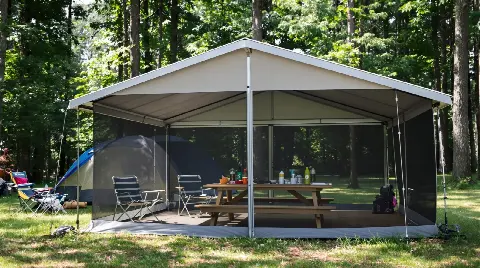
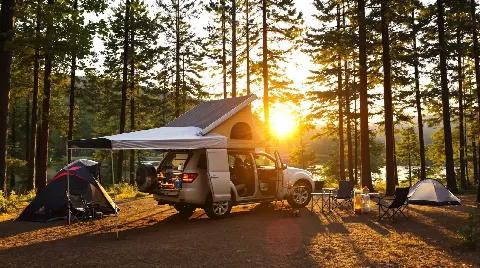
HEIMPLANET Original 3-Season 4-Person Tent
It nails the air tent promise. One valve inflates the whole frame in seconds, the geodesic shape shrugs off serious wind, and the ripstop build handles all three shoulder seasons. If you want a tent that pitches fast and still feels solid when the weather turns, this is the one.
Check price on AmazonThe Short List

Pitches in about 8 minutes with a double-action pump.
Inflatable tents used to get a side eye. People worried they would pop, sag, or fail in the first storm. That reputation is out of date.
Modern air beam tents swap rigid poles for sealed air tubes, and the good ones hold their shape through wind and rain just fine. You pull the tent out of the bag, hook up a pump, and watch it stand itself up. No threading poles through sleeves in the dark. The trade is simple.
You carry a pump, and a quality air tent costs more than a basic pole tent of the same size. In return you get a pitch that takes minutes instead of a sweaty half hour, and a structure with no poles to snap or lose. For families and weekend campers, that swap is usually worth it.
We pulled together ten inflatable tents worth a look, from clear stargazing domes to bombproof geodesic shelters built for real weather. Some sleep one. Some sleep five. Here is how they stack up, what each one does well, and where each one falls short.
Quick Comparison
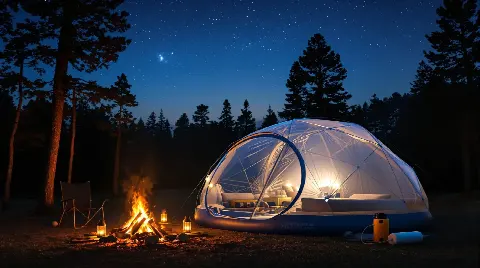
The Reviews
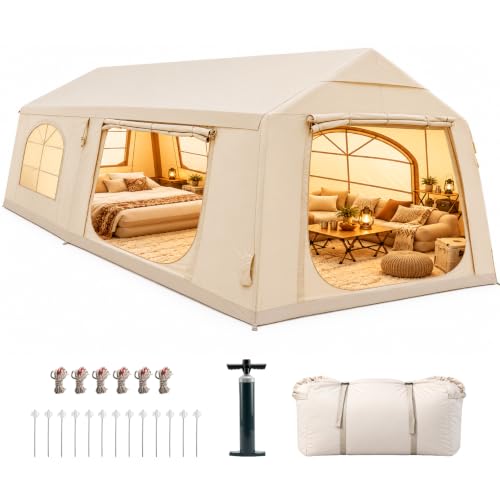
Inflatable Hot Tent with Skylight
This inflatable tent is the closest fit for a backyard glamping slot because it pairs an air-beam setup with a skylight and a large two-room layout. The listing gives it an 18.37 ft by 9.84 ft footprint and a 6.9 ft center height, so adults get space to stand and move without bending.
Specs
- Capacity
- 8-10 person
- Pitch info
- Inflates in 5 minutes
- Weight
- Not listed
- Material
- Oxford fabric
Setup is designed to be simple, with no poles needed and a high-efficiency air pump included. The Oxford fabric is listed with PU3000mm waterproofing and UPF50+ protection, which helps cover changing weather and sun exposure during daytime use.
The stove jack adds cold-weather flexibility, while dual doors and four large mesh windows support airflow. It is not a fully clear dome like the discontinued pick, but the skylight keeps the stargazing angle that made that slot useful.
What we like
- Skylight for night-sky views
- Large 8-10 person layout
- Inflates in 5 minutes
- Stove jack included
Watch out for
- Large footprint needs room
- Not a clear bubble design
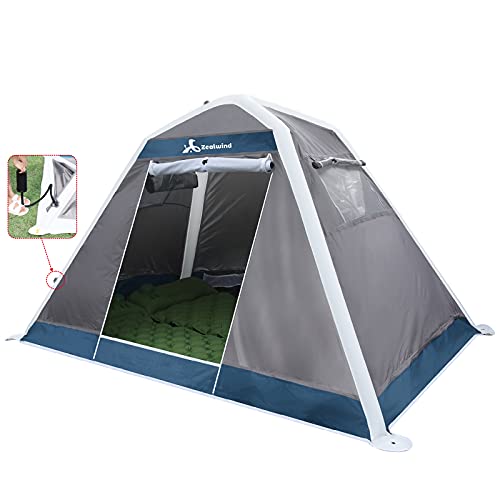
Zealwind 2 Person Waterproof Inflatable Camping Tent
The Zealwind is the first true air beam tent on the list, with inflatable tubes forming the outer frame instead of poles. The whole thing weighs about 5 pounds, so it stuffs into the included carry backpack and travels easily. Each layer is built from B4 mesh and waterproof polyester, which keeps the weight down while still shedding light rain.
Specs
- Capacity
- two adults
- Pitch info
- single valve
- Weight
- about 5 pounds
- Material
- B4 mesh and waterproof polyester
Pitching is the selling point. You feed air through a single valve with the pump, the beams firm up in seconds, and a single clip locks the chambers so the shape holds. Packing down is the reverse. Open the valve, let the air out, roll it up, and drop it in the bag.
One person can do the whole job without breaking a sweat or reading a manual twice. Inside there is room for two adults and up to three kids at a squeeze, which is generous for the footprint. Double-layer mesh on the door, windows, and roof keeps air moving and bugs out, a real plus on warm nights when condensation and mosquitoes are the usual complaints.
For a small family doing fair-weather weekends, that ventilation matters more than people expect. The honest catch is durability. The materials are light, which is great for carrying but means the tent is not built to take abuse. Rough handling, sharp ground, or a real storm will test it. Treat it gently, use a footprint under the floor, and it is a fine warm-weather family tent for the money.
What we like
- Very light at around 5 pounds
- Packs down into a carry backpack
- Double-layer mesh gives lots of ventilation and bug protection
- Quick single-valve pitch and pack
Watch out for
- Lightweight build is not very damage resistant
- Best kept to mild weather, not storms

Tangkula Inflatable Camping Tent for Family
The Tangkula keeps things simple. There is a single air pipe doing the structural work, and a hand pump gets it standing in a few minutes. Because there are no poles to assemble, it is a sensible pick for backpacking trips and longer expeditions where you don't want to fuss with a pitch at the end of a long day on your feet.
Specs
- Capacity
- couple or family of three
- Pitch info
- a few minutes
- Weight
- around 11 pounds
- Material
- 190T polyester
Construction is sturdier than the weight suggests. The shell is 190T polyester with a PU coating for waterproofing, the inflatable pipe is TPU, and the interior uses a B3 fine gauze for bug protection. Tangkula rates it for four-season use, and the windproof, waterproof coating backs that up for most conditions short of a full winter storm. Layout is the surprise here.
For a tent this size you get two rooms plus a vestibule, so a couple or a family of three can split sleeping space from gear storage. The whole package weighs around 11 pounds and comes with a carry bag, which is reasonable for a multi-room air tent you can still strap to a pack. The main gripe is the pump.
It is manual, not automatic, so inflating the beam takes a bit of arm work before the tent is up. That is a minor trade for the price and the room you get. If you want a do-it-all small family tent that still suits a backpacking style, it is a solid choice.
What we like
- Two rooms plus a vestibule for the size
- Rated for four-season use
- PU-coated 190T polyester with a TPU beam
- Up in a few minutes with the hand pump
Watch out for
- Manual pump takes real effort
- Heavier than ultralight solo options
Vango Odyssey Inflatable Family Tunnel Tent
Vango more or less wrote the book on family air tents, and the Odyssey shows why. It uses the brand's AirBeam system with a double-action pump, so the tunnel shape goes from bag to standing in about 8 minutes. The beams stay reliably upright once inflated, and the pump moves air on both the push and the pull stroke to speed things along.
Specs
- Capacity
- Not listed
- Pitch info
- about 8 minutes
- Weight
- bulky and heavy
- Material
- Protex 70 denier
Weather protection is where this tent earns its keep. The flysheet is Protex 70 denier and fire-retardant, with a 4000mm hydrostatic head and fully taped seams. Vango's patented TBS II tension band system braces the structure from inside, so it stays planted in gusty conditions that would have a cheaper tent flexing. The dark fabric inside also cuts morning light, so you can actually sleep past dawn.
There is a pre-attached sun canopy over the entrance that gives you a shaded porch to sit under, plus a full mesh inner door and an over-side canopy door for airflow. A PE groundsheet covers the floor. It is a proper family base camp, the sort of tent you set up on Friday and live in all weekend without thinking about it again.
The one weak spot is heavy, sustained rain. It handles showers and wind well, but in a long downpour you will want to watch the canopy area and the seams. For typical mixed-weather camping with kids, though, it is hard to fault and easy to recommend.
What we like
- 8-minute AirBeam pitch with a double-action pump
- TBS II tension bands keep it stable in wind
- Pre-attached sun canopy gives a shaded porch
- Dark sleeping fabric blocks early light
Watch out for
- Not ideal for prolonged heavy rain
- Bulky and heavy to store

HEIMPLANET Original Fistral Tent
This is the first HEIMPLANET on the list, and the brand's whole approach is different. You connect the inner and outer airframe once, and from then on it is a roll-out, pump-up, peg-down tent every single time. A single valve fills all the chambers, and to break camp you just release the air and roll it back into the bag.
Specs
- Capacity
- two-person
- Pitch info
- single valve
- Weight
- light enough to carry
- Material
- Not listed
The signature is the geodesic frame. Instead of a simple tunnel or dome, the air struts form a triangulated shell that spreads the load and stands up to high wind speeds. It is the same design language HEIMPLANET uses across the range, and it is genuinely stable in a blow. Double-layer air struts add redundancy, and a groundsheet is available for floor protection underneath.
The Fistral is the compact two-person option, light enough to carry and quick to pitch, which makes it a tidy couples tent for bikepacking, festivals, or weekend trips. Wind and water resistance are both strong for the size, and the one-pump setup means you are not wrestling poles after a long day on the trail. The honest limit is headroom.
The dome shape that makes it so stable also keeps the ceiling low, so two adults will be sitting up carefully rather than standing. If you value a bombproof shell and a fast pitch over interior volume, the Fistral delivers. If you want to stand up and change, look at a tunnel design instead.
What we like
- Stable geodesic frame for high wind
- One-valve inflation across all chambers
- Light and packable for couples
- Strong wind and water resistance
Watch out for
- Low dome headroom
- Premium price for two-person size
HUKOER Luxurious Outdoor Single Tunnel Inflatable Tent
The HUKOER is another clear bubble built for the backyard rather than the backcountry. It is a geodesic dome with a tunnel entrance, wrapped in transparent PVC tarpaulin so you can lie inside and watch the sky or the surroundings without unzipping a thing. It is more of an experience than a campsite tent.
Specs
- Capacity
- family or small group
- Pitch info
- blower
- Weight
- Not listed
- Material
- transparent PVC tarpaulin
Like other bubble tents, it runs on a blower, and this one doubles as an air filter, so the air inside stays fresh while the dome stays pressurized. That makes it a comfortable spot for a family afternoon, a kids' play space, or an evening under the stars with the lights turned low and a heater nearby. Inside there is plenty of room for a family or a small group of friends to spread out, and the tunnel entry keeps drafts down while giving the setup a proper room feel. It is the kind of tent you stake in the garden and leave up for a long weekend rather than packing away each morning.
The catch is the same as every clear dome. The PVC shell is not made for hiking or rough use, and it needs the blower running to hold its shape. Treat it as a fixed-site novelty and it is great fun. Try to backpack with it and you will be disappointed before you reach the trailhead.
What we like
- Fully transparent dome for big views
- Roomy enough for family or a small group
- Blower includes air filtration
- Tunnel entrance cuts drafts
Watch out for
- Fragile PVC is not for hiking
- Needs constant blower power to stay up
HEIMPLANET Original 3-Season 4-Person Tent
This is the HEIMPLANET that does everything the brand promises at family size. You connect the airframe once to give the inner and outer tent their structure, then every trip after is roll out, pump up, peg down. The multiple air chambers all link to a single valve, so the whole frame inflates in seconds.
Specs
- Capacity
- Four people
- Pitch info
- inflates in seconds
- Weight
- Not listed
- Material
- ripstop nylon
It might be the fastest-pitching tent on this entire list. The build is made for weather. A geodesic frame paired with ripstop nylon gives it serious wind resistance, tested to handle gusts up to around 110 mph. HEIMPLANET groundsheets add floor protection, and the three-season rating means it is happy from spring through autumn, including the cold, wet, blustery shoulder weeks when lesser tents start to struggle.
There are no fiberglass poles and no guy lines to trip over, which is the whole point. You are not threading anything or staking out a web of lines in the wind. One pump, a few pegs, and you are done.
For a group that values a fast, low-stress pitch after a long drive or a hard hike, that convenience is real and you feel it every night. The trade is space. Four people and their gear will fill it, and it is snug for a full family with kids and a dog. It is also a premium-priced tent. But for durability, stability, and speed combined, it is the most complete air tent here, which is why it is our top pick.
What we like
- Inflates in seconds through one valve
- Tested to roughly 110 mph wind
- Ripstop nylon with a HEIMPLANET groundsheet
- No poles or guy lines to manage
Watch out for
- Tight for a full family plus gear
- Premium price
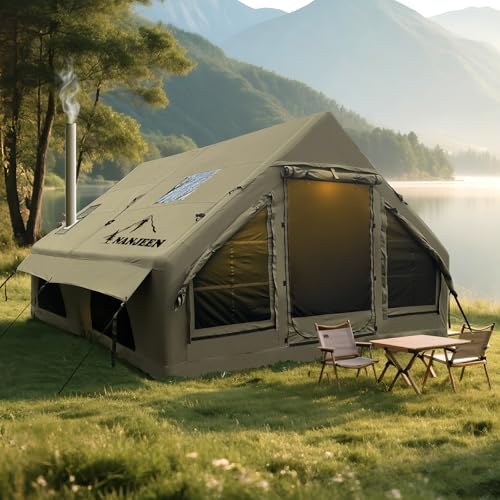
NANJEEN Large Luxury Inflatable Tent
The NANJEEN Large Luxury Inflatable Camping Tent is the best fit here because its listing focuses on wind and rain resistance, waterproof tech cotton, reinforced seams, and heavy-duty construction. It is also listed as all-season ready, which makes it a strong replacement for a weather-focused inflatable tent slot.
Specs
- Capacity
- 2 to 10 people
- Pitch info
- 8 minutes
- Weight
- 35kg
- Material
- waterproof tech cotton
The 12㎡ interior is made for 2 to 10 people, so it suits buyers who want a large shelter rather than a compact air tent. Setup is listed at 8 minutes with the included hand pump, with no poles or tools required. Dual doors and mosquito-proof mesh windows add airflow and entry options.
The main tradeoff is weight. At 35kg, this tent is built with heavy materials, but it will not be easy to carry far from a vehicle. Its large interior also means buyers need enough campsite space to pitch it comfortably.
What we like
- Wind and rain resistant build
- Waterproof tech cotton fabric
- 8-minute setup with hand pump
- Dual doors and mesh windows
Watch out for
- Heavy at 35kg
- Large footprint needs space

SereneLife Inflatable Tent
The SereneLife is the oddball of the group, and that is a compliment. It combines an inflatable air mattress and a tent into one piece. A sturdy coil beam runs through the spine of the mattress to hold its shape, and the tent canopy is built right over the top, so your bed and your shelter inflate together in one go.
Specs
- Capacity
- one person
- Pitch info
- about 3 minutes
- Weight
- light enough to carry
- Material
- PVC and polyester
It is made from heavy-duty PVC and polyester, which gives it real stability and lets the mattress support up to 450 pounds. The canopy is windproof and waterproof, so a passing shower or a gusty night will not wreck your sleep. SereneLife designed it for both indoor and outdoor use, which makes it handy for guest beds, festival camping, or a quick night under the stars. Setup is fast.
A manual hand pump inflates the whole thing in about 3 minutes, and it is light enough to carry without thinking about it. The package includes a travel bag and self-adhesive repair patches, so a small puncture is not the end of the trip, just a five-minute fix before you turn in. The obvious limit is capacity.
It sleeps exactly one person, so it is no good for couples or families. But as a one-and-done solo sleep system, it solves the eternal problem of a cold, deflating pad under a separate tent. For solo trips, car camping naps, or spare-bed duty at home, it is clever and genuinely useful.
What we like
- Bed and tent in one inflate
- Supports up to 450 pounds
- Up in about 3 minutes with a hand pump
- Comes with a travel bag and repair patches
Watch out for
- Sleeps only one person
- PVC build is heavy per person

HEIMPLANET Original Cave 2-3 Person Inflatable Tent
The Cave rounds out the list and brings the HEIMPLANET formula to a smaller, slightly more affordable footprint. Like its siblings, you assemble the airframe once, then it is connect, roll open, pump, and go from there. The one-pump system inflates every chamber together, and one open valve deflates the whole thing in moments when you are ready to pack.
Specs
- Capacity
- two comfortably
- Pitch info
- one-pump system
- Weight
- Not listed
- Material
- Not listed
The shape is the standout. A star-shaped roof and symmetrical slopes shed rain and brace against wind better than a plain dome, which is exactly what you want when the weather turns on you. Double-layer air struts add backup, and a 5000mm water column rating means it keeps you dry through serious rain, a clear step up from many tents on this list. Inside, the Cave fits two comfortably or three at a push, making it a good couples or small-group tent for backpacking and weekend trips.
Removable groundsheets give you flexible floor protection, and the multi-chamber safety system means a single damaged strut will not collapse the tent around you. The trade, as with the Fistral, is interior space. It is cozy rather than roomy, and three adults will feel the squeeze.
It is also still a premium tent, just less than the four-person model. For two people who want HEIMPLANET's durability and weather protection without the bigger price, the Cave is the sweet spot.
What we like
- 5000mm water column for heavy rain
- One-pump inflate and instant deflate
- Star-shaped roof sheds wind and rain
- Removable groundsheets for flexible protection
Watch out for
- Snug for three adults
- Premium pricing

What to Look For
Stability and Wind Resistance
Stability is the first thing to check, because it is what separates a tent that rides out a storm from one that folds at 2 a.m. With air tents, stability comes from the beam design and the pressure inside.
Geodesic frames like HEIMPLANET's triangulate the load and handle the highest wind speeds, while single-tunnel designs are simpler but flex more in a crosswind.
Whatever shape you choose, peg it out properly and check the seams and valves before you buy. Outdoor tents need to hold their form through wind, rain, and uneven ground, so don't trade durability for a lower sticker price.
Size and Storage
Two sizes matter with an inflatable tent: how much room it gives you pitched, and how big it is packed.
Sleeping capacity is usually generous, but remember that a large air tent catches wind like a sail, so it can lift and move if you don't peg and pack it down properly.
The packed size is the part people forget. Big family air tents roll into heavy, bulky bundles that eat trunk space and need a dry place to live at home.
Measure your boot and your closet before you commit, not after the tent shows up.
Layout and Rooms
Think about how you will actually live inside.
Cabin-style and larger tunnel tents often come with room dividers, and if you are shopping at the big end, look for multiple chambers or separate rooms.
A two-room layout lets you split sleeping from gear, or keep kids and pets in their own space, which makes a long weekend far more pleasant. Some models add child-friendly touches and a vestibule for muddy boots.
A smart layout turns a tent from a place you sleep into a place you can comfortably hang out when the weather keeps you in.
Materials and Waterproofing
Most tents use polyester or a polyester blend, but the grade matters a lot.
Standard waterproof polyester is fine for fair weather and keeps the cost down. Poly-cotton, a blend of cotton and polyester, breathes better and resists condensation, which is why higher-end tents lean on it.
For the air beams themselves, look for TPU, which holds pressure reliably over time. Check the waterproof rating too.
A 3000mm hydrostatic head handles showers, while 5000mm shrugs off heavy rain.
Higher numbers and fully taped seams are worth paying for if you camp in wet country.
Ventilation, Windows and Doors
Without airflow, a tent gets stuffy and damp fast, and you wake up to condensation dripping off the ceiling.
Windows and vents fix that, and the best ones have mesh layers so you can open up for a breeze without inviting bugs in. Doors do double duty as your main vent, so larger tents with two or three doors breathe better and are easier to climb in and out of.
Look for sturdy, snag-free zippers and a zip-close mesh inner door. Good ventilation is the difference between a comfortable night and a clammy one.
Extras Worth Having
The small stuff adds up.
Interior lantern hooks let you hang a light or dry gear off the floor. Mesh storage pockets keep phones, headlamps, and glasses off the ground and easy to find in the dark.
A pre-attached sun canopy or porch gives you a shaded, dry spot to sit out a shower or cook a meal. Snow flaps, removable groundsheets, and repair patches all earn their place when conditions turn.
None of these make or break a tent on their own, but together they separate a thoughtful design from a basic one.