CampingKnow is reader-supported. When you buy through links on our site, we may earn an affiliate commission at no extra cost to you. Learn more.
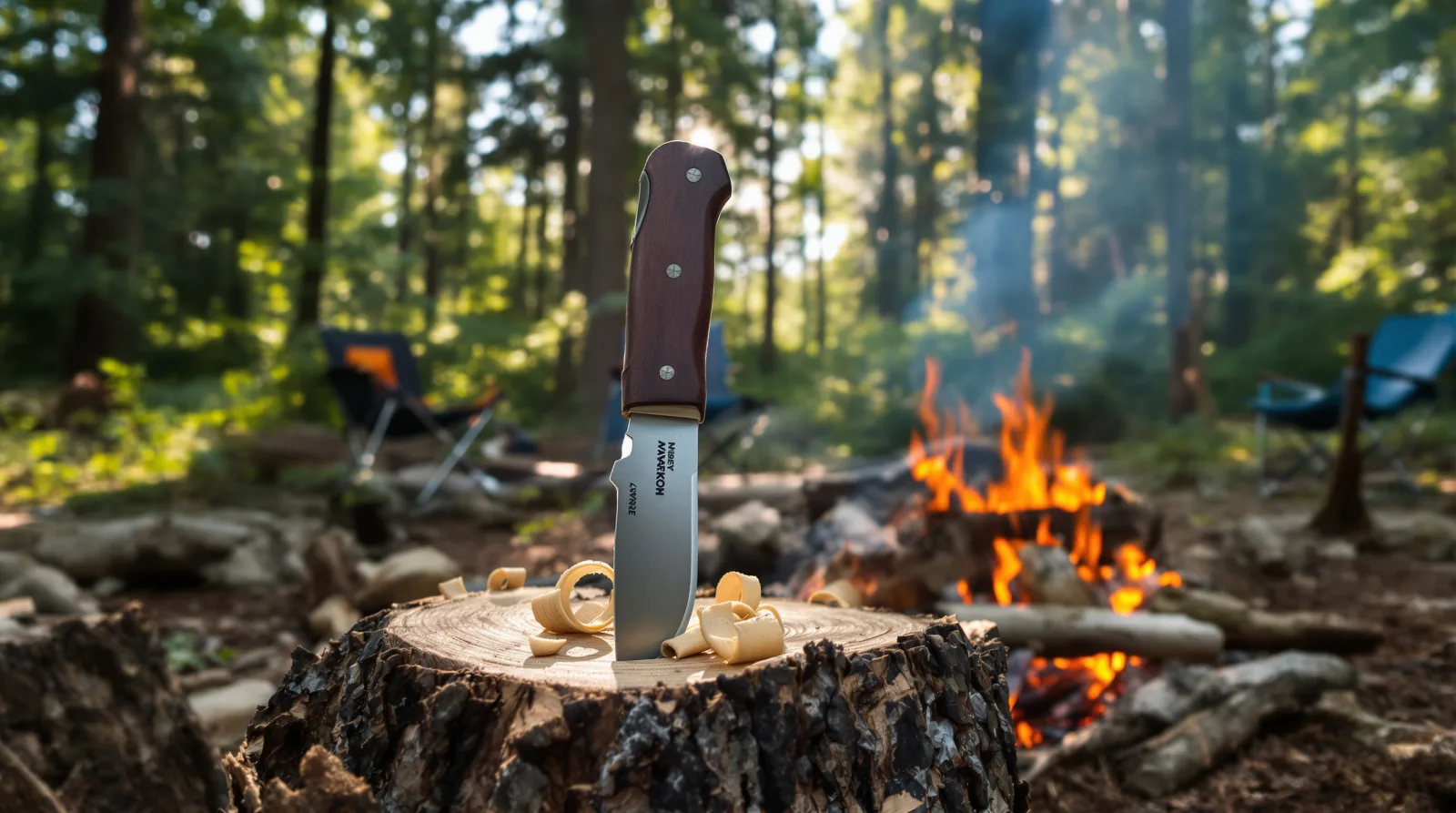
A camp knife earns its keep on the small jobs nobody photographs. Splitting a wrist-thick log down to dry kindling, shaving a curl of fatwood into a fire, popping the lid on a stubborn can, trimming a tent guy line that frayed. None of that is dramatic, and all of it falls apart fast with the wrong blade.
A flimsy knife flexes when you lean on it, loses its edge after one batch of kindling, and rattles loose in a cheap sheath until you stop trusting it. The right one just works. We tested these six fixed blades the way a camper actually uses them, not the way a marketing video does. That meant batoning through dry and green wood, carving feather sticks down to paper curls, striking a ferro rod off the spine, and prepping a few campfire dinners.
We checked how each held an edge, how the handle felt after twenty minutes of work, and whether the sheath kept the blade locked and quiet on the belt. One thing up front: a survival knife for camping is a wood and food tool, a fire helper, a problem-solver around the site. We rate these as bushcraft and outdoor gear, full stop. Below you will find a pick for almost every camper, from a twelve-dollar workhorse to a USA-made survival blade that will outlast the person who buys it.
Morakniv Garberg
A full-tang Scandi-ground knife that answers the long-standing knock against Mora, the partial tang. The Garberg takes hard batoning and prying in stride, carves feather sticks like a dedicated bushcraft tool, and costs a fraction of the boutique full-tang knives it competes with. For most campers it does everything they need and nothing they do not.
Check price on AmazonQuick Comparison
| Rank | Product | Best for | Price |
|---|---|---|---|
| #1 | Morakniv Garberg (Carbon Steel) | Overall | Check price |
| #2 | Morakniv Companion Heavy Duty (Carbon Steel) | Budget | Check price |
| #3 | Ka-Bar Becker BK2 Campanion | Batoning and heavy use | Check price |
| #4 | Condor Tool & Knife Bushlore | Bushcraft and carving | Check price |
| #5 | ESEE-6P | Full-tang survival knife | Check price |
| #6 | Gerber StrongArm (Plain Edge) | Low-maintenance everyday camp knife | Check price |
The Reviews
Mora built its name on light, sharp, cheap knives, and the one fair complaint was the partial tang. The Garberg fixes that. It is a true full-tang blade, a solid bar of carbon steel running from tip to butt, so you can baton it through a log or pry a stuck stake without that nagging worry about the handle parting from the blade.
At 4.3 inches with a 3.2mm spine and a Scandi grind, it sits in the sweet spot for camp work: long enough to split firewood, short enough to carve with control. The carbon steel version takes a wickedly fine edge and is easy to bring back on a stone in the field, though you have to keep it dry and lightly oiled or it will patina and eventually spot. The square spine throws a heavy shower of sparks off a ferro rod, exactly what you want for fire prep. It is not the prettiest knife here and the sheath is plain, but as a do-everything camp blade at this price, nothing else lands as cleanly.
Pros
- True full tang handles batoning and prying
- Scandi grind carves and feather-sticks beautifully
- Sharp 90-degree spine throws ferro-rod sparks
- Costs a fraction of boutique full-tang knives
Cons
- Carbon steel needs drying and oiling to fight rust
- Plain looks and a basic sheath
If you want one knife that punches absurdly above its price, this is it. The Heavy Duty Companion takes the classic Mora and thickens the blade to 3.2mm of high-carbon steel with a slightly blunter 27-degree edge angle, which trades a hair of slicing keenness for an edge that shrugs off harder use. The high-friction rubber handle stays grippy with wet or cold hands, and the whole thing weighs almost nothing on the belt.
The catch is the tang. This is a partial, or stick, tang, so it is not built for aggressive batoning through knotty rounds the way the Garberg is. Treat it as a carving, food, and fire knife rather than a splitting maul and it will serve you for years. As a first camp knife, a pack backup, or a loaner for kids learning to whittle, the value is hard to argue with.
Pros
- Costs about as much as a fast-food lunch
- Thick carbon blade holds a working edge well
- Grippy handle stays secure when wet
- Light enough to forget you packed it
Cons
- Partial tang, not made for heavy batoning
- Carbon steel will patina without care
The BK2 is a tank. It runs a 5.25-inch blade of 1095 Cro-Van steel that is a chunky 0.25 inches thick at the spine, and it weighs a full pound, so it splits wood and chops through bone or tough roots with an authority the lighter knives here cannot match. When you want to baton a fat round into kindling without babying anything, this is the blade you reach for.
The drop-point shape and full, thick tang take everything you can throw at them. That heft cuts both ways. The thick saber grind is not the finest carver, so feather sticks take more effort than they do with a Scandi blade, and a pound on the belt is something you feel on a long hike. As a rugged camp and survival tool that you genuinely cannot break under normal use, the BK2 has earned its cult following.
Pros
- Quarter-inch 1095 spine splits wood with ease
- Full thick tang takes hard batoning and chopping
- Tough drop point handles prying and digging
- Backed by Ka-Bar's well-known warranty
Cons
- A full pound, heavy for backpacking
- Thick grind carves less cleanly than a Scandi
For the camper who loves the quiet craft side of the outdoors, carving spoons, building a try-stick, processing tinder, the Bushlore is a joy. It pairs a 4.3-inch blade of 1075 high-carbon steel with a flat Scandi grind that bites into wood and peels long, clean curls with almost no effort. The walnut handle is shaped to fill the palm and warms up in the hand the longer you work, which matters on a cold morning by the fire.
It ships with a genuinely nice hand-stitched leather sheath, a rarity at this price, that holds the knife snug with a satisfying snap. Out of the box the edge is good but not perfect, and most owners strop it to a true razor in a few minutes. The 1075 steel is on the softer side, which makes field sharpening dead easy but means you touch it up a bit more often. For dedicated woodwork at camp, it is one of the best values going.
Pros
- Scandi grind peels feather sticks effortlessly
- Comfortable walnut handle for long carving sessions
- High-quality leather sheath included
- Soft 1075 steel sharpens in the field fast
Cons
- Softer steel needs touch-ups more often
- Edge usually wants a strop out of the box
ESEE-6P
When you want a knife you can stake your weekend on, the ESEE-6 is the answer a lot of serious outdoor people land on. It is a full-tang slab of 1095 carbon steel with a 6.5-inch flat-ground blade, made in the USA, and backed by a no-questions warranty that genuinely replaces the knife no matter how it broke. The longer blade gives you reach for batoning bigger wood and clearing brush, while the powder coat fights rust and the canvas Micarta handles lock into a wet palm.
This is the most knife on the list for true backcountry use, where a failure stops being an inconvenience and becomes a problem. The trade is size and weight: at 6.5 inches it is more blade than a casual car camper needs, and it carries heavier than the Moras. If your idea of camping leans toward remote, self-reliant trips where the knife is core survival gear, the ESEE-6 is built for exactly that.
Pros
- Bombproof full-tang 1095 made in the USA
- Long blade has reach for big wood and brush
- No-questions warranty replaces a broken knife
- Grippy Micarta handles and a solid molded sheath
Cons
- Long and heavy for casual car camping
- Carbon steel needs care to keep rust off
Not everyone wants to dry and oil a blade after every trip. The StrongArm is the grab-and-go answer: a full-tang knife with a 4.8-inch blade of 420HC stainless steel, made in the USA, that resists rust well enough to toss in a damp pack and forget. The rubberized diamond-texture grip is one of the most secure handles here, holding fast with muddy or gloved hands, and a striking pommel at the butt lets you tap stakes or break glass in a pinch.
Stainless 420HC will not hold an edge quite as long as the carbon steels above, and it is not as effortless to bring back to hair-popping sharp, but it gets sharp enough for camp duty and asks almost nothing in upkeep. The modular sheath is a standout, swapping between a MOLLE-and-drop-leg setup and a snap-on belt carry, both of which lock the knife in tight. For a low-fuss camp and outdoor knife that handles batoning, food prep, and general chores without drama, it is a smart pick.
Pros
- Stainless 420HC shrugs off moisture and neglect
- Excellent rubberized grip in wet or gloved hands
- Striking pommel for stakes or emergencies
- Versatile modular sheath, MOLLE or belt carry
Cons
- Stainless holds an edge less long than 1095
- Plastic sheath is loud if not snugged down

What to Look For
Full Tang Versus Partial Tang
This is the first thing to settle, because it decides what the knife can survive.
A full tang means the blade steel continues as one unbroken piece all the way through the handle, so when you baton through a log, pry a rock, or lean your weight on the spine, the force runs through solid metal with nothing to come apart.
A partial or stick tang, like the standard Moras use, runs a narrower spike of steel into the handle, which keeps the knife light and is fine for carving and food prep but is not built for hard splitting.
If you plan to baton wood often, buy full tang and never think about it again.
Otherwise a quality partial tang like the Companion will save you weight and money.
Blade Steel: Carbon Versus Stainless
Steel is the longest-running argument in knives, and the honest answer is that it comes down to a trade between edge care and rust care. High-carbon steels like 1095, 1075, and Mora's carbon take a screaming edge, hold it well, and sharpen easily on a simple stone in the field, which is why bushcrafters love them.
The price is that they rust if you leave them wet, so you wipe them dry and give them a thin film of oil. Stainless steels like 420HC and Sandvik 12C27 resist corrosion far better, so you can be lazier with upkeep, but they generally do not hold an edge quite as long and can fight you a little more on the stone.
Premium stainless like S30V or MagnaCut narrows that gap and costs more. For most campers, carbon if you do not mind a thirty-second wipe-down, stainless if you want to toss the knife in a pack and forget it.
Why Fixed Beats Folding for Survival
A folding knife is a fine pocket companion, but it is the wrong tool for the hard end of camp work, and the reason is mechanical.
A folder has a hinge and a lock, two things that can wear, gum up with grit, or fail under the sideways and prying loads a knife sees when you baton or dig.
A fixed blade has none of that. It is one solid piece of steel, far stronger and far easier to clean after gutting a fish or cutting sappy wood, with nothing to fiddle open with cold or wet hands.
For a knife you are counting on when help is hours away, simplicity is the feature.
Blade Length and Thickness
Bigger is not better here, it is just different.
A blade in the 4 to 5 inch range, like the Garberg or the Bushlore, is the camp sweet spot: long enough to baton most firewood and process game, short enough to carve with real control and pack without fuss.
A longer 6-inch-plus blade like the ESEE-6 buys you reach for bigger wood and brush clearing at the cost of fine-carving control and weight.
Spine thickness matters too.
A thick 0.25-inch spine like the BK2's is a splitting champion yet a clumsy carver, while a thinner 3mm stock slices and feather-sticks far more cleanly.
Match the blade to the work you do most, not the biggest knife in the case.
Grind, and What It Does for Carving and Fire Prep
The grind is the shape of the bevel, and it quietly decides how the knife behaves.
A Scandi grind, found on the Garberg and Bushlore, has a single flat bevel that rides on the wood and peels long clean curls, which makes it the darling of bushcrafters who carve and make feather sticks.
It is also dead simple to sharpen, since you just lay the bevel flat on the stone. A flat or saber grind, like the ESEE and BK2, is more of an all-rounder, a bit less surgical in wood but tougher and better at general slicing.
One detail worth checking on any camp knife is the spine: a crisp 90-degree edge on the back lets you scrape a ferro rod for a heavy spark and shave fatwood for tinder, while a rounded spine robs you of both.
Sheath Quality and Carry
A great knife with a bad sheath is a knife you stop carrying.
The sheath has to hold the blade with positive retention, meaning it stays put when you flip it upside down and shake it, and it should let you draw and return the knife one-handed without a fight. Molded polymer and Kydex sheaths, like the ESEE's and Gerber's, lock in with a snap and shed water, and the better ones offer belt, MOLLE, or drop-leg options. Leather, like the Bushlore's, looks and feels classic and runs quiet, though it needs to dry out fully so it does not trap moisture against a carbon blade.
Whatever the material, check that it carries the way you camp, on a belt, lashed to a pack, or clipped to a vest, and that it does not rattle. A loose blade in a loose sheath is how good knives get lost on the trail.